Energy

Renewable energy brings hope to Nepal’s earthquake devastated villages

After devastating earthquakes in 2015, clean cookstoves, rainwater harvesting and drip irrigation is making life easier for villagers in Nepal's rural districts
<p>Rupa Tamang cooks food on her improved cookstove. [Image: Nabin Baral]</p>

Rupa Tamang cooks food on her improved cookstove. [Image: Nabin Baral]

Devastated by the earthquake in 2015, Sikhreghyangh village in Nepal’s central Kavre district is slowly regaining shape.

The village still looks like a battleground; piles of mud and stones from collapsed buildings bring back memories of the brutality of the earthquake that killed more than 9,000 people. While a few families are busy building new houses, many are waiting for the government’s support. Dominated by the Tamang, an indigenous group of Nepal, the village has not received much attention from the government, even though it is less than 50 kilometres from the capital, Kathmandu.

Despite the troubles, Rupa Tamang has made every effort to make her family’s life easier. On the left of the entrance to her small hut, a wooden tripod holds a bamboo dustbin off the ground to collect plastic. The 500-litre water tank collects rainwater from a six-metre long pipe tied to the roof.

“We use this water for irrigation and other household purposes. In winter, the tank is used to store water brought from a source few kilometres away,” says Rupa. “In the rainy season, rainwater fills the tank.”

[vimeo 235480478 w=640 h=360]

Sikhreghyangh is one of three villages planned as an eco-development village, supported by several NGOs, such as the Centre for Renewable Technology Nepal (CRT-N). “We don’t give much financial support but provide them with technical support to use any technology, and provide seed money to buy those facilities,” said Subas Lamichhane, a field coordinator at CRT-N. “The rest is done by the communities themselves.”

Rupa has also installed a solar panel to power light bulbs, and uses an improved cook stove which emits negligible smoke and has helped her cook food more easily. “After the earthquake, life became hell, but we are returning to normalcy and these small technologies have brought in rays of hope,” she says. “I spend less time collecting firewood as the new improved cookstove consumes less firewood. It saves time which I can spend with my three-year-old son.” 

Using a single improved cook stove can reduce 60-90% of indoor air pollution and  2.5 tonnes of greenhouse gases by per stove per year, according to Nepal’s Alternative Energy Promotion Centre.

“These kind of small interventions help communities ease their lives. Indirectly, this also helps mitigate global problems like climate change,” says Lamichhane, who coordinates local activities in the district under CRT-N. “We don’t talk much about climate change at a grassroots level, but we help them understand the benefits of such green technologies.”
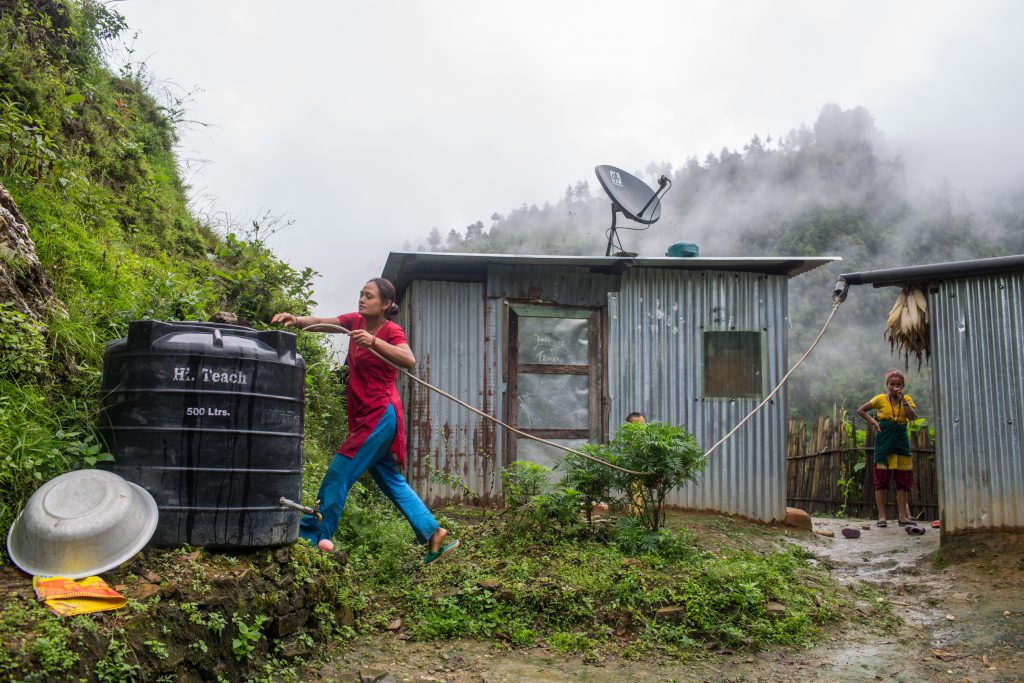
Rupa Tamang harvests rainwater from the roof of her makeshift house after the 2015 earthquake. [image by: Nabin Baral]
In the foothills either side of the village, people are busy extracting stones. This range of the Mahabharat mountains – also known as the lesser Himalayas – boasts hard rocks which are highly demanded in the cities. Many of the local people work as labourers in the nearby stone extraction sites.

Preeti Man Tamang, 50, has limited land and had no idea about greenhouses which, with a small investment of just Rs 2,000 (USD 20), could eventually bring him more money.

“[The CRT-N] gave me plastic to build this greenhouse and taught me ways to construct it. I did everything by myself and you can see all the tomatoes around me now,” says Preeti.  “I want to do more but I don’t have enough land.”
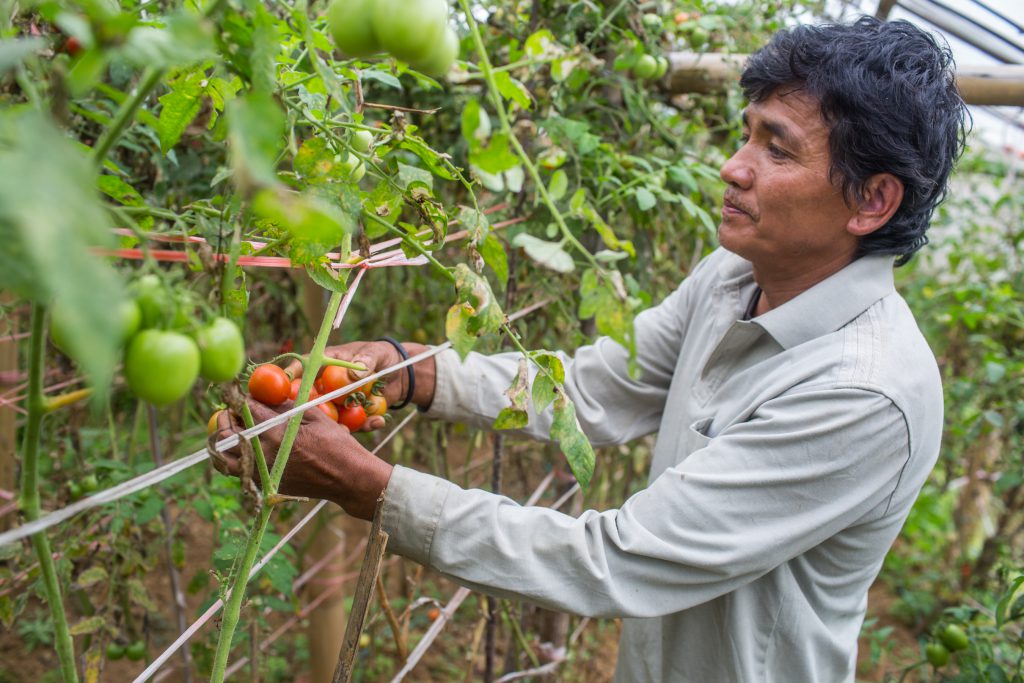
Preeti Man Tamang inspects tomatoes in his greenhouse. He uses drip irrigation to water his vegetables efficiently. [image by: Nabin Baral]
Patali Tamang, 67, smiles from the window of his newly-built house. It’s one of a few houses that have been built so far, out of around 40 in the village. Next door, her neighbour Bir Bahadur Tamang is busy caring for the vegetables in the backyard of his house. This year, the production of tomatoes drastically reduced. “I try to apply as little pesticides as possible. We would like to be an organic village but controlling pests was very hard this year,” says Bir. “It’s the major challenge.


Cookies Settings

Dialogue Earth uses cookies to provide you with the best user experience possible. Cookie information is stored in your browser. It allows us to recognise you when you return to Dialogue Earth and helps us to understand which sections of the website you find useful.

Required Cookies

Required Cookies should be enabled at all times so that we can save your preferences for cookie settings.

Dialogue Earth - Dialogue Earth is an independent organisation dedicated to promoting a common understanding of the world's urgent environmental challenges. Read our privacy policy.

Cloudflare - Cloudflare is a service used for the purposes of increasing the security and performance of web sites and services. Read Cloudflare's privacy policy and terms of service.

Functional Cookies

Dialogue Earth uses several functional cookies to collect anonymous information such as the number of site visitors and the most popular pages. Keeping these cookies enabled helps us to improve our website.

Google Analytics - The Google Analytics cookies are used to gather anonymous information about how you use our websites. We use this information to improve our sites and report on the reach of our content. Read Google's privacy policy and terms of service.

Advertising Cookies

This website uses the following additional cookies:

Google Inc. - Google operates Google Ads, Display & Video 360, and Google Ad Manager. These services allow advertisers to plan, execute and analyze marketing programs with greater ease and efficiency, while enabling publishers to maximize their returns from online advertising. Note that you may see cookies placed by Google for advertising, including the opt out cookie, under the Google.com or DoubleClick.net domains.

Twitter - Twitter is a real-time information network that connects you to the latest stories, ideas, opinions and news about what you find interesting. Simply find the accounts you find compelling and follow the conversations.

Facebook Inc. - Facebook is an online social networking service. China Dialogue aims to help guide our readers to content that they are interested in, so they can continue to read more of what they enjoy. If you are a social media user, then we are able to do this through a pixel provided by Facebook, which allows Facebook to place cookies on your web browser. For example, when a Facebook user returns to Facebook from our site, Facebook can identify them as part of a group of China Dialogue readers, and deliver them marketing messages from us, i.e. more of our content on biodiversity. Data that can be obtained through this is limited to the URL of the pages that have been visited and the limited information a browser might pass on, such as its IP address. In addition to the cookie controls that we mentioned above, if you are a Facebook user you can opt out by following this link.

Linkedin - LinkedIn is a business- and employment-oriented social networking service that operates via websites and mobile apps.