![<p>A villager demonstrates a solar powered light in Mongla, Khulna, Bangladesh [image by Marufish/Flickr]</p>](https://dialogue.earth/content/uploads/2016/12/Solar-powered-light-Bangladesh-marufish-768x510.jpg)

Bangladesh’s economy has been growing steadily at over 6%, making it one of the steady high performers among large countries. This growth is intimately tied to energy supply, but in a country of 161 million, only about 65% have access to electricity, which is itself a significant improvement from 47% who had access in 2009.
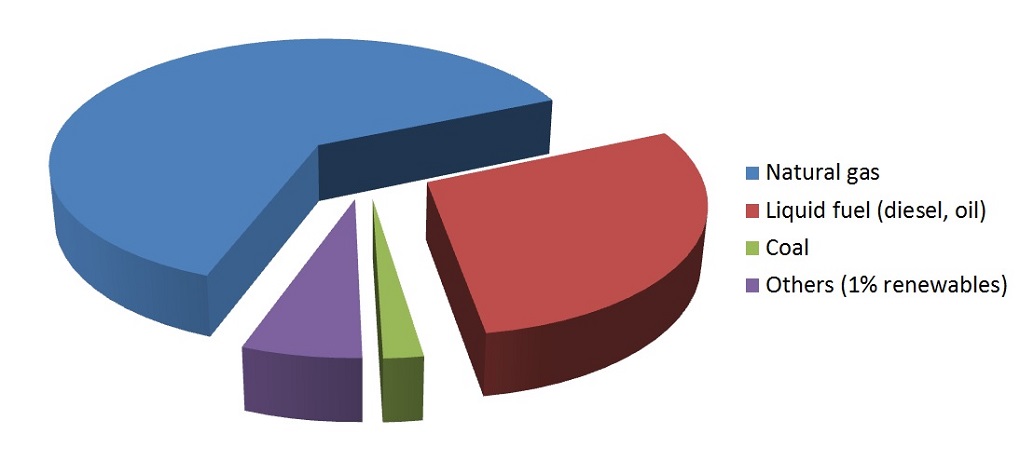
In 2010 Bangladesh had an installed capacity of 5,823 MW. By 2015 this had leapfrogged to 15,457 MW. But as electricity demand grows, Bangladesh remains locked into a cycle of producing power using hydrocarbons – primarily its own gas reserves. While it has come down from 83% in 2010, gas remained responsible for 63% of electricity produced in 2015, with liquid fuel (diesel, oil) accounting for 29% and coal, for 2%. About 6% is classified as “other”, which includes only about 1% from renewable energy resources.
To maintain high growth, Bangladesh is planning to increase fossil fuel generation capacity by 2021 from 12,000 MW to 24,000 by 2021, and according to its ambitious plan, produce 40,000 MW by 2030 and 60,000 MW by 2041. To achieve this Bangladesh is focusing on building export credit agency (ECA) and development assistance-subsidised thermal power generation. These thermal power plants will rely on imported coal, diesel, oil and liquid natural gas (LNG).
Coal, coal everywhere
According to the Bangladesh power cell, Bangladesh is working on eight coal fired power plants to be completed by 2023, all ranging in capacity from 1,200 MW to 1,320 MW, with a combined total of 10,320 MW. Of these, two are joint ventures with China, and one each with India, South Korea and Malaysia.
These plans have met with stiff resistance from civil society groups, due to both the environmental impact, as well as over the acquisition of land.
See: UNESCO investigates environmental impact of Sundarbans coal plant
See: Four killed as Bangladesh villagers oppose coal-fired power plant
Focussing on renewables
A number of campaigners have argued that the focus should be on renewable energy. Their arguments were given a boost when the Institute of Energy Economics and Financial Analysis (IEEFA), published a report in November 2016 titled, “Bangladesh Electricity Transition: A Diverse, Secure and Deflationary Way Forward”.
The report emphasises that the fossil-fuel heavy mode of electricity generation being deployed will have a heavy impact on the Bangladeshi economy. The subsidies to fossil fuels will lead to greater national debt, and greater inflation, undermining growth, while at the same time contributing greatly to pollution. It states that, “fossil fuel subsidies and electricity-sector losses are an entrenched and growing drag on economic growth in Bangladesh. The Bangladesh Power Development Board (BPDB) report net losses of a cumulative USD 4bn in the last five years.”
The report suggests that Bangladesh should immediately target a 1 GW annual utility-scale solar installation program that would see 10 GW of cumulative capacity operational by 2024/25.
There was special criticism of the Rampal coal-based power plant being set up as a joint project in the Sundarbans, the world’s largest mangrove forest shared by the two countries.
The report found immediate backing from Sultana Kamal, convener of the National Committee for Saving the Sundarbans, who has recommended that the Bangladeshi government adopt it immediately.
Old tech, or new?
The key question is whether Bangladesh locks itself into a cycle of growth driven by old technology or new. Bangladesh has earned rave reviews recently in its initiative to expand home based solar energy and installed home based solar system in 4.5 million houses. This initiative not only deals directly with addressing poverty, but also has a strong adaptive component given Bangladesh’s vulnerability to climate change. Unfortunately the total production of energy from this sector is only 175 MW, or 1.1% of total electricity production in the country.
The electricity produced from windpower is negligible, and due to its flat geography there is little hydropower potential. The Kaptai hydropower plant, built in the 1960s, had a production capacity of 230 MW, but only produces 100 MW.
According to the Renewable Energy Policy 2009, the Bangladesh government was supposed to produce 5% of its total energy through renewables 2015, but is still only producing just over 1%, almost all of it from solar power. It has now committed to producing 10% of its total electricity from renewable sources by 2020, but there seems to be a significant difference in its stated aims, and its actual investments. While the Bangladesh Power Development Board makes much about the “500 MW Solar Power Mission”, this is less than half the capacity of any of the eight coal power plants it is building. Even if successful, the electricity generated would be less than 5% of the amount being produced by the new coal plants, not to mention the amount being produced by gas power plants, which still dominate electricity production.
Given its vulnerability to climate change, Bangladesh must ask itself the hard question of which path it is committing itself to, and whether that path will lead to greater vulnerability – and thus poverty – of its citizens, or to their greater good.