Solar-powered desalination plants are offering a lifeline to communities in the most climate-ravaged part of Bangladesh’s coast, where rising sea levels, floods and tidal surges are pushing salt water inland.
The lives and livelihoods of tens of millions are believed to be at risk from this salinisation, which is contaminating freshwater sources in Bangladesh’s coastal districts. The World Bank estimates that, in the south-west coastal region alone, 2.5 million poor people already suffer from water shortages. In a worst-case scenario of salinity intrusion, it projects this number doubling by 2050.
“There is plenty of water around you but you will not find a drop to drink. All waters are saline,” says Rahima Begum, who lives in Grambhamia village in Satkhira, a south-western coastal district. “During the monsoon season, we harvest rainwater to drink. In the dry season we drink pond water, despite these being saline and unsafe.”
These salt levels are fuelled by climate change, which is driving sea levels higher and increasing the frequency of flooding, as well as bringing lower levels of fresh water due to droughts.
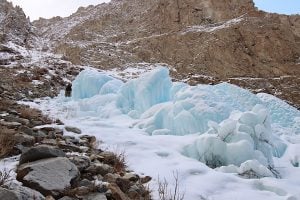
Humanity’s greenhouse gas emissions are causing global heating and significantly changing Earth’s climate. Higher temperatures are causing ice on land to melt more rapidly and seawater to expand. Both are driving sea level rise.
Glaciers are now melting faster than they can be replenished by snowfall, the impacts of which can be seen not only in sea levels, but also in water cycles and weather systems.
In February 2025, Nasa noted that the rate of sea level rise is speeding up. In 1993 it averaged 2.1mm per year but by 2024 this figure was 4.5mm per year.
In 2021, Dialogue Earth published an interview with Robert Kopp, a lead author of the Intergovernmental Panel on Climate Change’s Sixth Assessment Report, which was released that year. Kopp said: “There is clear evidence tying the melting of glaciers and the Greenland Ice Sheet, as well as ocean warming, to human influence.
“Sea level rise is leading to substantial impacts on coastal communities, including a near-doubling in the frequency of coastal flooding since the 1960s in many sites around the world. These advances confirm that sea level is going to continue to rise for many centuries to come, creating an escalating threat for coastal communities.”
Satkhira is particularly vulnerable to climate hazards. But now, solar-powered reverse osmosis water desalination plants are springing up as a solution. Three plants have opened this year alone.
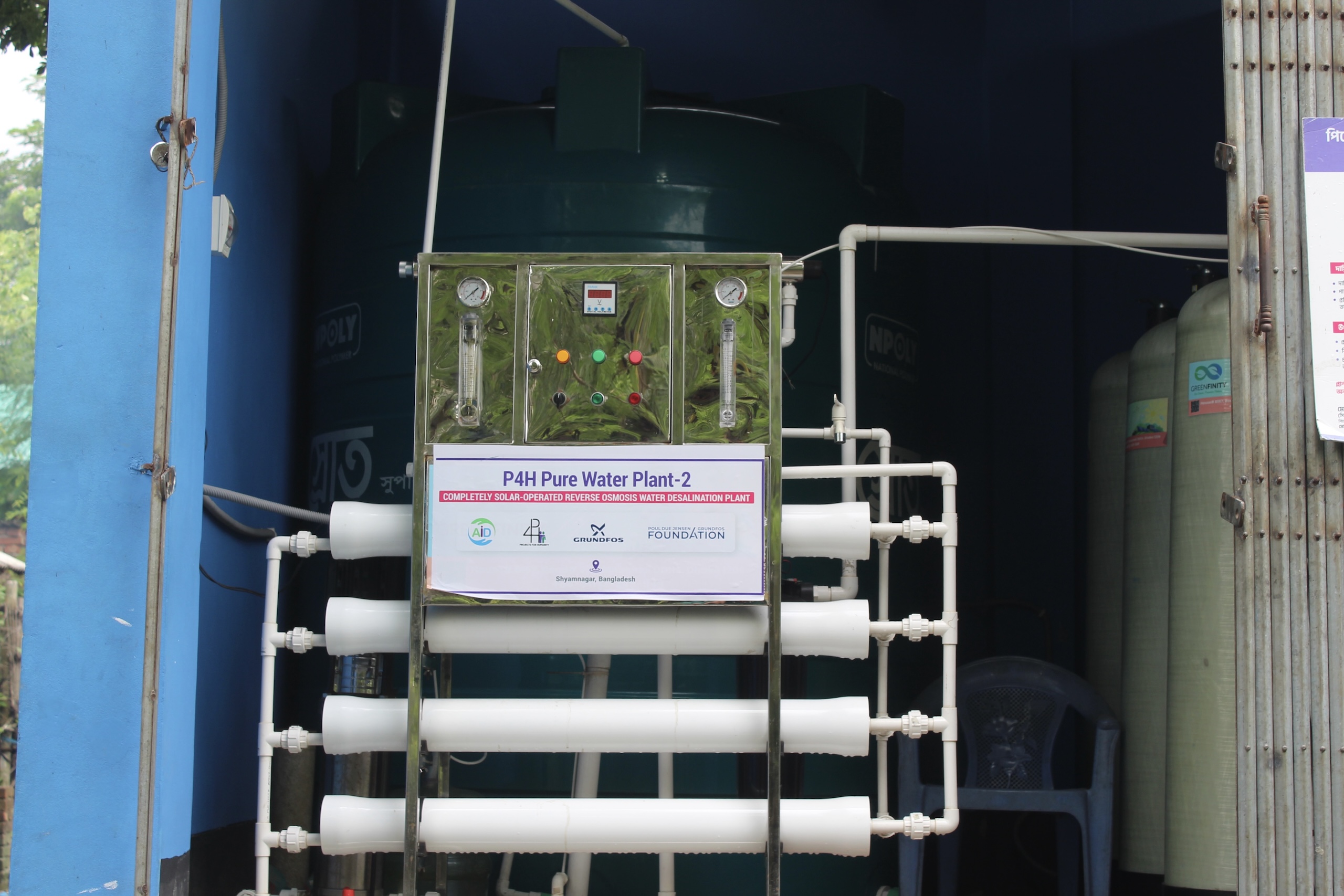
“Each plant has a capacity of producing 1,000 litres of water per hour,” explains Tamim Chowdhury, who leads on renewable energy at Change Initiative. This Dhaka-based think-tank is providing engineering support to non-government organisations Projects for Humanity and the Poul Due Jensen Foundation, which are funding the plants.
The reverse osmosis process is not new, but patchy electricity supplies have historically meant that desalination plants could not reliably produce drinking water in the area, especially energy-intensive plants that rely on grid energy. The solar-powered plants do not suffer this problem and can remain operational for up to five hours even without sunlight, thanks to batteries.
A solution to salinity
People living on the coast say this technology has brought a radical change to their quality of life.
Halima Khatun, a mother of three in Satkhira’s Nildumur village, says she has had to bring drinking water from a conventional purification plant three miles away ever since her childhood. She had to travel by boat due to the lack of roads and often waited in a long queue for water. Khatun could not bring fresh water every day, which forced her six family members to regularly drink salty water. The lack of clean, fresh water meant diarrhoea and water-borne diseases like cholera were very common.

Rokeya Begum, another Nildumur villager, underlines another way the climate is undermining drinking water supplies: “After Cyclone Aila damaged all the freshwater sources, inundating all ponds, I had to walk around three kilometres every day to fetch water.”
Nildumur is one of the villages served by the new solar-powered desalination plants. “Now, we collect safe water from the water plant,” Khatun tells Dialogue Earth. “And after drinking the pure water, we are not falling sick from water-borne diseases anymore. We are well now.”
How it works
The water plants being installed in Satkhira combine two systems: reverse osmosis for desalination and a solar system for power.
Water is collected from various sources including ponds, rivers and wells, then filtered into a 5,000 litre tank to remove dirt, sand and rust particles. The water is then pumped through further filters to remove suspended particles and organic contaminants.
Next, a high-pressure pump forces the water through reverse osmosis membranes. These barriers only allow water molecules to pass through, blocking dissolved salts, heavy metals and other contaminants. The desalinated water is treated with ultraviolet light to kill bacteria, then stored in a distribution tank. The waste water must then be disposed of.
“When the sunlight fades away or it is overcast, the solar system operates the RO [reverse osmosis] system using a mixed energy mechanism,” Chowdhury explains. “This means that it powers the RO system using a combination of solar, utility grid and battery.”
During the night, electricity from the utility grid and anything stored in batteries is used.
Low-cost solar panels from China have helped make the desalination plants possible. Around USD 40,000 is needed for installation and the plants have a lifespan of about 20-25 years, says Chowdhury. “We collect solar panels and inverters from China; motors from Hungary and Denmark,” he adds.
Challenges tomorrow, but water today
Ashoke Kumar Adhikary, regional project manager of the UN Development Programme Bangladesh, says reverse osmosis technology is a proven and effective method of purifying highly saline water. But there is a question over what happens to the waste water.
The UNDP is currently conducting a study in Bangladesh’s coastal regions to understand what kind of impacts desalination is having on the environment.

Adhikary proposes producing salt from the wastewater. But he worries about maintenance, saying scores of grid-powered desalination plants established in coastal districts by NGOs are now non-functional for this reason. Currently, the water from the three plants installed in Satkhira is free, but a forthcoming charge of approximately BDT 5 (USD 0.04) per 15 litres will fund maintenance.
Dialogue Earth spoke to Malik Fida A Khan, executive director of the Center for Environmental and Geographic Information Services (CEGIS), a Dhaka-based think-tank. He says maintaining desalination plants was expensive in the past, but now many Chinese companies are producing low-cost equipment.
Khan (who is not involved with the Satkhira plants) says freshwater ponds could even be created to store water in some locations, using this now-cheaper technology. Setting up desalination still has a cost, he acknowledges, “but now there is no alternative to installing such plants in the areas like Satkhira, where freshwater sources are diminished”.
Back in Nildumur, villager Rashida Khatun says around 300 families now collect drinking water from the solar-powered plant. “In fetching drinking water in the past, we often got sick … but the water of the RO plant has saved our lives,” she says.