About 40% of Nigeria’s 230 million people are without access to electricity. No other country has more without power than these 90 million Nigerians. Many more suffer unreliable electricity from power plants and a transmission grid not up to the task.
In response, households and small businesses who can afford it often fire up their own diesel generators. They are increasingly also opting for off-grid solar and battery systems, many of them manufactured in China, experts have told Dialogue Earth.
Solar companies are receiving support to sell more of their equipment through blended-finance loans that leverage both public and private capital. At the same time, the nascent Nigerian solar equipment manufacturing industry is being encouraged by some policy and enterprising companies.
The push to deliver reliable power
Nigeria is an important focus of the Mission 300 initiative, which emerged in 2024, to bring “reliable, affordable and sustainable” power to 300 million people in Sub-Saharan Africa by 2030.
Across Sub-Saharan Africa, roughly 600 million people – nearly half of the population – lack access to electricity. Mission 300, a partnership between the World Bank and Africa Development Bank, calls for half of these connections to be delivered by expanding existing national grids, with the remainder supplied by solar mini-grids and other renewable options, according to Reuters.
So far, the World Bank counts 32 million people as having been connected since 2023 through operations it has financed, representing 10.7% of the Mission 300 goal.
An example of progress in Nigeria is a project known as DARES, or Distributed Access through Renewable Energy Scale-up. Supported by the World Bank and launched in 2024, DARES seeks to deliver new or more reliable electricity access to more than 17.5 million Nigerians – almost 20% of the nation’s unserved population. The project plans to meet this target by expanding solar home systems and mini-grids and phasing out over 280,000 polluting diesel generators.
From China-made to a nascent solar manufacturing industry
Segun Adaju is former president of the Renewable Energy Association of Nigeria. He says that currently, the majority of the country’s solar components are sourced from China. Local involvement only includes assembling, retail distribution and last-mile sales, Adaju adds.
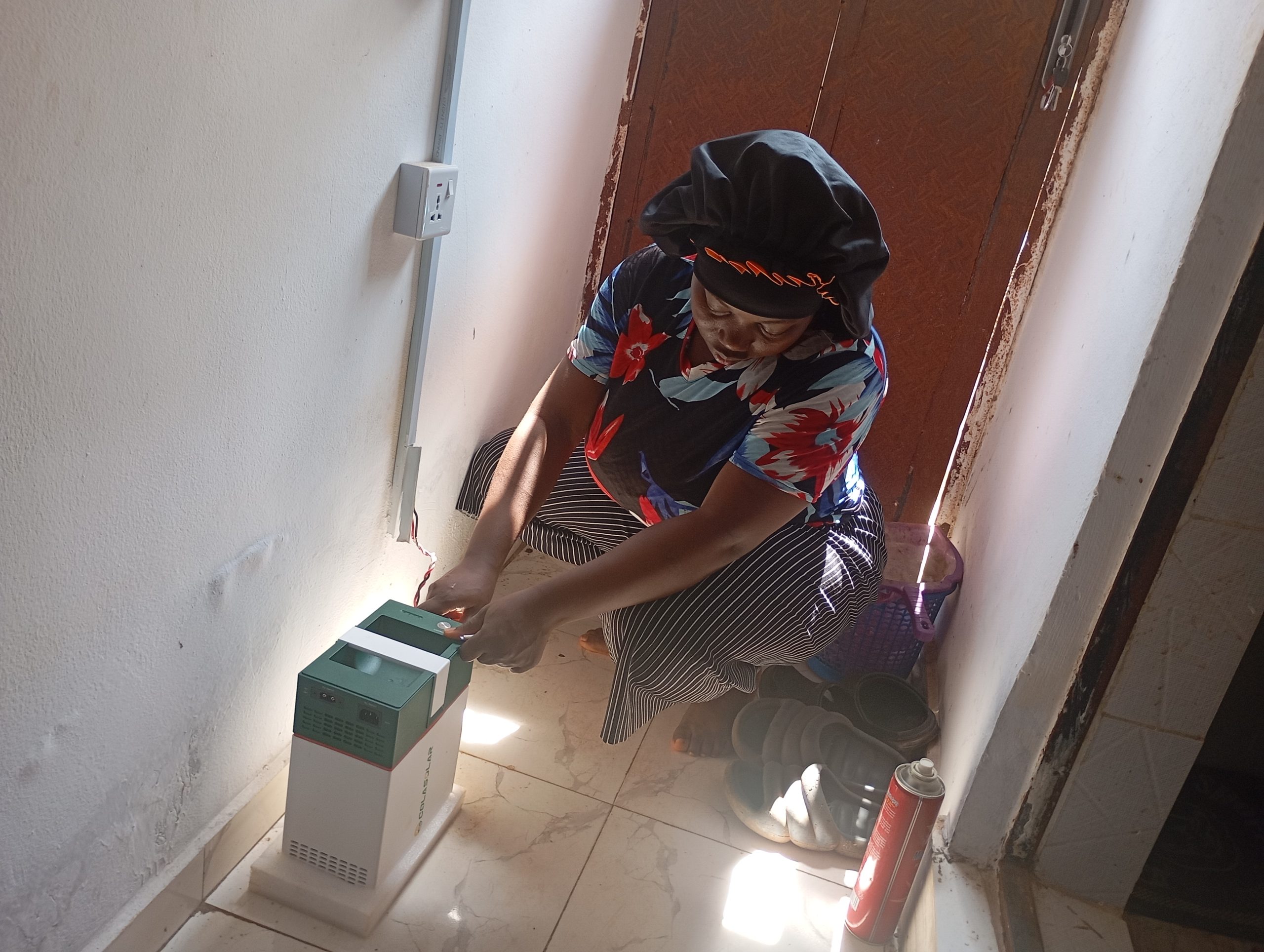
Adaju pointed to Sun King as an example of how this supply chain is evolving. The off-grid solar solutions company has so far only manufactured its products in China, but recently opened a factory in Kenya and has plans for another in Nigeria.
“Over time,” he said, “Sun King has expanded from relying on dealers to also selling directly to customers and offering pay-as-you-go models.”
Other Chinese-linked brands are following similar paths. He mentioned Qiqiang and Spark, which have introduced solar home systems designed for small households and shops. Some of these systems are pay-as-you-go, in which customers repay their cost over an extended period of time.
Adaju also confirmed that a few companies are beginning to explore assembling components locally, driven by both market growth and discussion of policies to support the industry. While companies plan to start production in Nigeria, Adaju stressed these steps are gradual, and most products continue to arrive fully built from China.
Rinret Best, program associate at Vectar Energy, a climate-tech startup based in Nigeria, explained the complexities further. Nigeria has introduced policies and frameworks to support local manufacturing and help integrate renewable energy. But the impact of these has been limited by weak implementation incentives, workforce capacity gaps, insufficient quality assurance and a lack of reliable data to build investor confidence.
As progress, Best highlights the “Nigeria First” local manufacturing push and the Green Manufacturing Policy and Investment Guide, a government-backed initiative helping the private sector and investors navigate the policy and regulatory landscape in Nigeria. Best says that together, these moves should help build a supply of solar goods produced domestically. She also highlighted the draft Net Billing Regulations published in September 2025 which provide a route for households and businesses to safely feed electricity into the grid.
She added, though, that commercial players can only achieve the Mission 300 goals in Nigeria with some help from subsidies.
While the private sector drives scale, public finance and policy can ensure equity, she said. Commercial players have the ability to achieve fast electrification, but to support profitability, Mission 300 must include strong public-private coordination, she added.
Blended finance aids power access for underserved Nigerians
Experts told Dialogue Earth that underserved Nigerian communities have been aided in their efforts to access solar equipment via “blended finance”. This mixes public or philanthropic capital with private capital to reduce risk, attracting commercial investors via grants or concessional loans.
Sun King is a good example in Nigeria. The company secured a USD 80 million, naira-dominated loan facility in partnership with World Bank Group and Stanbic bank to help scale Nigerian access to off-grid solar. Customers can repay the cost of Sun King’s solar systems in a pay-as-you-go manner over 12 to 24 months.
“Nigerian financial institutions are beginning to show interest in financing [off-grid] energy projects,” says Wilson Erumebor, senior economist at the think-tank Nigerian Economic Summit Group. “But I think they should have done that a long time ago.”
“When we started some 12 years ago,” Adaju says, “it was hard to get a bank to finance solar systems”. Nowadays, he says, a few banks provide finance. He adds that scaling of such solar-system projects has been further enabled by “wholesale funds”, which see institutions like the Development Bank of Nigeria provide concessional loans to commercial banks. The banks then use the capital to lend to solar companies on preferential terms, growing access to electricity.
But there is still considerable room for expansion, Adaju says.
Erumebor says some companies have been installing solar-and-battery systems in rural communities. Coupled with a pay-as-you-go model, this has allowed households to pay as little as NGN 200 (USD 0.14) per day, he says. Banks are increasingly supporting these small-scale firms, he adds.
Best says blended finance has helped companies scaling their pay-as-you-go portfolios to “reduce foreign exchange exposure and lower capital costs”. It has also enabled products to reach more customers and lengthened loan repayment periods, she adds.
However, Best believes the scale and equity of energy access can be enhanced by linking blended finance to measurable inclusion outcomes. As examples, she mentions the percentage of off-grid low-income households reached, as well as gender targets and community engagement.
“If not, the finance may focus on expanding only the commercial sectors, which are easier to serve,” she notes.