


![<p>The Dagachu hydropower project being constructed [image by Asian Development Bank]</p>](https://dialogue.earth/content/uploads/2016/11/Dagachu-Hydropower-Project-ADB-1-768x510.jpg)

At the Paris climate summit last year, the tiny, landlocked country of Bhutan became an unlikely star as its Intended Nationally Determined Contributions (now referred to only as Nationally Determined Contributions, or NDCs) outshone those of every other country. While other countries were haggling on how much to reduce pollution levels, Bhutan’s NDC casually stated that it was not only carbon neutral, but was indefinitely planning to stay that way. In fact, given its huge forested area – over 70% of its land – Bhutan would end up absorbing three times more carbon than it generated. While the world struggled to regulate its carbon addiction, Bhutan was on the other side of the divide, mopping up the carbon produced.
The Bhutan commitment, reflected in its short but carefully worded eight page NDC, plus one page as covering note, received widespread praise. In a conversation peppered by grim news showing that we will overshoot the 2 degrees Celsius mark, it was good to know that there was at least one country that was doing more than its share.
Important advantages
Bhutan had a set of important factors making its ambitious pledge possible. The first was a population of just over 700,000 and a land mass of over 38,000 square kilometres, Bhutan has a population density of less than 20 people per square kilometre. Its capital city is its most populous one, and had a population of just over 100,000 people. This low population density, accompanied by very strong environmentally friendly policies in place since the 1970s, has left Bhutan very forest-rich. An extremely stable polity since the establishment of the Bhutanese monarchy in 1907 has meant that Bhutan has also avoided the environmental disasters that accompany civil wars and related strife.
Maybe the most important aspect, though, was Bhutan’s hydropower projects. These run-of-the-river projects, largely built with loans and grants from the government of India, have allowed Bhutan to harness its hydropower potential to power its economic growth for a country which had, until recently, only a subsistence economy. The low population pressures meant that the relocation and rehabilitation of people living in the areas was a manageable process, involving only a few hundred citizens. Additionally, as these were run-of-the-river schemes, the massive environmental changes that come from creating vast reservoirs was obviated.
Recently, while the hydropower sector in Bhutan has come in for severe criticism on a number of issues – economic social and environmental – the leading authorities have been able to argue that it still provides a working model with the least damage.
See: The future of Bhutan’s hydropower
See: Bhutan’s PM defends hydropower dams against blistering report
The effects of climate change catch up
Nevertheless, while Bhutan has been both fortunate in its early policies, as well as the method of development it has adopted, it is still a small country in a large world being affected by climate change. The glaciers in the Himalayas are receding as the world warms, and the snowfall in Bhutan is not what it once was. As the ice and snow that provided natural reservoirs for the hydropower plants, Bhutan is faced with both lower flows to power its hydropower plants, as well as higher incidence of flooding.
As Bhutan grapples with these realities, it has now started contemplating building reservoirs for its hydropower dams. The plans for the Bunakha, Sankosh, and Amochhu power plants already incorporate reservoirs. This will have large ecological impacts that the country has been able to avoid so far. Externally, though, it will also lead to an uptick in Bhutan’s emissions. When reservoirs are built, submerged organic matter (trees, etc) breaks down, leading to large carbon emissions. Moreover, the type of emissions released from reservoirs is often methane, which a much more dangerous greenhouse gas than carbon dioxide. As and when Bhutan contemplates these changes, some of the shine from its commitments will come off.
Ambitious plans for the future
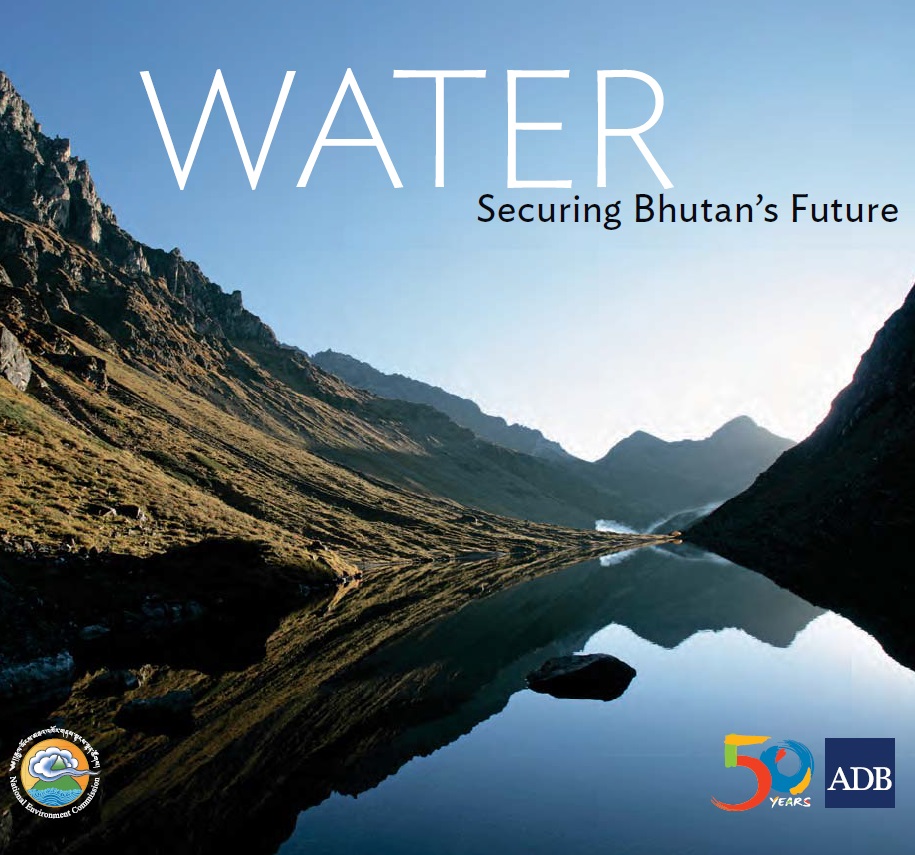
The news is not all bad. In some senses, being so closely affected by climate change, Bhutan is also one of the few countries to grapple directly with the problems. A number of these are documented in the new report by the Asian Development Bank, titled, “Water: Securing Bhutan’s Future”. One of its key new initiatives is the extensive water security policies that the country is adopting. Some of this is direct, with the government of Bhutan, “providing at least 1% of annual hydroelectricity royalties to the Ministry of Agriculture and Forests for sustainable agriculture and upstream catchment protection.”
Maybe more importantly Bhutan has now developed two key initiatives, a water security index that monitors:
- Rural drinking water supply and sanitation
- Economic Water Security
- Urban Water Security
- Environmental Water Security, and
- Disaster and Climate Change Resilience
Bhutan has also formulated an Integrated Water Resource Management (IWRM) plan that looks at river basins – not merely the water flowing in rivers themselves – as the unit to be monitored. This is a truly unique intervention in the South Asian region, where integrated basin management efforts have been hampered due to bureaucratic problems, national and sub-national borders, and an engineering mindset that sees rivers merely as water distribution networks, not as part of larger basins.
This initiative is a new one, and although the Bhutanese Prime Minister, Tshering Tobgay, heads it in his capacity as the Chairman of the National Environment Commission, no new bureaucratic infrastructure has been created. It will be Bhutan’s challenge to see if it can get its departments to cooperate to manage this very precious resource – a cooperation that has so far eluded its larger neighbours.
While the Water Security Index and the IWRM are new, they show that Bhutan is at the forefront of new thinking and practice on dealing with climate change adaptation and resilience. Given its small size, and its dependence on its water sources, it has to be. If it succeeds, though, Bhutan will bring new hope to those desperately seeking some in the field of climate change policy.