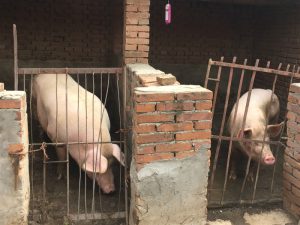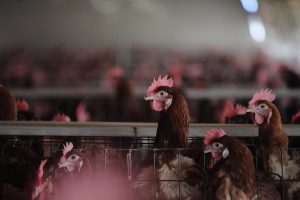
Intensive animal agriculture is bad for people, animals and the planet. This was the powerful message of a conference in London last week organised by Compassion in World Farming (CIWF). This 50-year-old pressure group promotes a “flourishing food system” based on agroecology and an increasingly plant-based human diet, rather than industrial models of agriculture.
The argument is a strong one: the current food system is wasteful and sees much human-edible grain fed to animals. There is also great inequality, with overconsumption and non-communicable diseases in rich countries and starvation and malnourishment in poor ones.
It is driving biodiversity loss, soil degradation, antimicrobial resistance, disturbed biogeochemical flows, and is a significant contributor to climate change. And it is cruel, with even basic principles of animal welfare ignored in many instances.
Which is why it’s strange that many conversations at the conference were about human population growth. Early on the first day, an audience member said panellists should focus on population as a driver of environmental change, and many seemed to agree, despite the fact CIWF aims to end the inequitable distribution of food – and is not rooted in the doomsayer perspective known as Malthusianism (after the British cleric Thomas Malthus, who argued that population growth inevitably results in poverty or degradation).
Most were quick to point out rightly that the most effective way to slow population growth is women’s rights and education. One panel chair, the British environmentalist and former politician Stanley Johnson, cited the need for women’s equality and drew on his recent trip to India to suggest such education on family planning is needed – and for men, too.
Yet Johnson has six children, and was speaking on an all-male panel. The discussion had fallen into the same trap as most discussions of population growth: it saw wealthy, western, male elites making judgements about women’s reproductive choices.
Of course, all men should support women’s equality, regardless of the environmental outcomes. But they should surely start at home, and in their own realms of experience – including the panels they speak on – rather than overseas and in the sphere of reproduction, where their interventions will quickly be perceived as invasive or worse.
Moreover, simple fixes for our environmental problems, such as having fewer children or plant-only diets, can’t address the complexity of our food systems, where questions around food security, inequality, pollution, farmers’ livelihoods, and animal welfare are inevitably tangled.
By contrast, Raj Patel, who also spoke on the first day, had a far more revealing perspective about our cruel, unequal and destructive food system.
The academic and activist, once also mistaken for the Messiah, presented his thesis of “cheap nature”: where cheap food exists to provide sustenance for workers in underpaid, “cheap” jobs, whose “cheap lives” – Patel explained how people of colour work in the worst, most dangerous conditions in the American food system – are bound up with the dispossession of indigenous land, and the despoliation of natural resources.
In short, his is a complex analysis for a complex system. Patel’s sense of the food system is not Malthusian, but neither is it rosy. There is no abundance through technology or capitalism. But liberatory impulses – to end inequality, save the environment, and end cruelty to animals – can converge to change the ways we grow and eat our food.
In short, when it comes to food, it pays to keep it complex.