Problems with food safety are nothing new – in the Tang Dynasty the poet Liu Zongyuan followed his doctor’s instructions and bought Chinese herbs to help his digestion. But the stallholder passed off other cheaper herbs as the real thing and Liu’s illness worsened – he took a year to recover.
But for food safety to have become such an issue that the whole nation is worried can be put down to two factors, the existence of both complex food supply chains and chemical-based agriculture.
In the Tang Dynasty food chains were short. Limited food production meant that most people – excluding the emperor’s kin and their mandarins – were tied to the land, producing and eating a limited range of staples, vegetables and meat. Even when market trading took off in the Song Dynasty, China’s urbanisation rate was only about 20% – the bulk of people still lived off the land, and products were brought and sold between acquaintances. And if you’re only selling to those you know, you can’t cheat them.
In those times food safety was a concern only for the aristocrats: the emperor’s kith and kin who could transport food around the country for their enjoyment. That meant they had to take the risk of eating food supplied by strangers. But there was a simple solution – specially-produced foods, and the threat of the harsh punishments of imperial times.
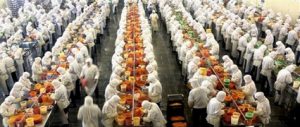
However, as more and more people left the land, food supply chains were no longer only between acquaintances. And the use of chemicals in agriculture allowed fewer farmers to support more non-agricultural workers. This allowed for more processed foods, which contributed to industrialisation and increased the range of foods available. But the food supply chain was no longer a simple common sense one from wheat to bread – it now stretches from the cocoa tree in Africa to the M&Ms in your shop and requires specialised knowledge to understand.
Growers now no longer play a crucial role in “testing” food; food supply chains stretch from African farmers to Chinese supermarkets; and food processing is becoming ever more complex, meaning more uncertainty for consumers. This, and the lack of trust throughout society, has created the chaos in China’s food supply chains.
Falling confidence in food safety
Food safety issues can be broken down into two levels: achieving quality standards, and removing uncertainties. The first ensures food is safe to eat, the second that consumers believe it is safe to eat – a sense of food security. When that is strong food safety issues can still arise, but nobody will feel they have to grow their own food to ensure their children are safe.
Why do Chinese people have so little confidence in their food? As described above, food processing is too complex to easily understand, and there is a strong sense of uncertainty about complex unknowns such as food additives. To increase confidence in food we need better public education, explaining all the additives used in industrial food production – not to wait until a problem arises and then have an expert stand up and explain.
Some urban white-collar workers and NGOs are experimenting with Community Supported Agriculture (CSA) – which rebuilds the links between consumers and producers, recreating an acquaintance society. This is no doubt laudable, but price, variety and logistical issues mean it is only an option for some.
For the majority of consumers, the food quality issue can be solved only by ensuring standards are met at every stage of the food supply chain. Identifying an action plan for supervising every step of the food processing chain will require government manpower and financing. The consumers’ role will be to hold the government to account. They are already willing to do so – but they lack the channels and guarantees to do so. Second, identifying how to use punitive damages is also part of the process of balancing consumer interests against food industry lobbying and gaining legislative and government support.
We can explain food safety issues in a variety of ways – for example, using the low status of farmers and workers in the food supply chain to explain quality issues at the growing and processing stages. But solutions will always depend on government ability to fulfil its responsibilities – be that supervision of food manufacturers, or protecting the legal rights of consumers, factory workers and farmers.
As China continues to urbanise, the small farmers who plant crops and raise livestock at the start of the food supply chain will gradually become the employees of large-scale farmers and company-owned farms. This trend is already visible in the north-east of China, and in Shandong, Anhui and Jiangsu.
This has two consequences. Firstly, some farmers are forced out of agriculture and need to look for work in cities and buy food on the market – often in third tier cities and towns, where food safety oversight is weak. The potential number of victims of food safety issues is thus increased. Secondly, the difficulties of supervision due to having large numbers of small-scale producers – a problem the government has often complained of – will be greatly reduced as producers become fewer in number. The government will be able to establish, through subsidies, a product tracking system. Once the full length of the food supply chain becomes transparent and punitive damages and consumer pressure groups are in place, the dangers of food safety should finally recede.
Wu Chen, deputy head and researcher at the Social Resources Institute
Homepage image by Yin Chuntao