Food

GM rice tastings: PR stunt, or public education?

More than 1,000 people have taken part in genetically modified rice tasting sessions across China this summer, as supporters hope to prove it is safe to eat
English

In July, internet users in six cities, including Kunming and Beijing, visited restaurants – not for a meal, but to try genetically modified (GM) rice, as part of nationwide tasting events.

Though research into GM rice was given priority by the Chinese government in 2006, many academics and the public remain unsure of its safety. A PR campaign to change public attitudes began in early May, when a microblogger using the name of “Tilling Farmer” offered to send out five bags of GM rice for the public to try. Popular science microblogger Fang Zhouzi reposted the message, and soon 200 people had requested a sample.   

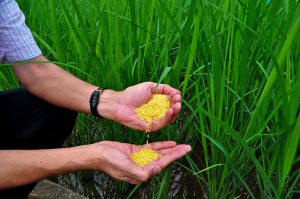
The GM rice had been developed by Huazhong Agricultural University to be resistant to butterflies and moths. ‘Tilling Farmer’ was an alias of Professor Yan Jianbing, who researches molecular breeding at the university, and is a colleague of Lin Yongjun, head of the GM rice project.

After the positive response to the offer of free GM rice, Yan announced that he was planning a larger scale event in cooperation with Fang Xuanchang, editor of the pro-GM website Agrogene.cn, a site recently set-up to persuade the public that GM technology was safe.

There were 24 people at the first GM rice tasting session, held at a hotel in the Zhujiang New City area of Guangzhou. Two months later, the Beijing Science and Technology News held another tasting, at which Lin Yongjun and Chen Junshi of the Chinese Academy of Engineering Science were present. Similar events were held in five other cities, including Nanning and Kunming, bringing the tastings to public attention.

This isn’t the first PR campaign for GM rice in China. A small-scale GM tasting session was held in Beijing in May 2011, at a time when GM foods were not yet a matter of public concern.

The Golden Rice controversy in late 2012 changed the public perception of GM rice. Chinese and American researchers fed Golden Rice, developed by Swiss biotechnology firm Syngenta, to 25 elementary school students in Hengnan county, Hunan, without parental permission. At the end of the year the Chinese government said that the rice used had been imported without approval and that the case represented a failure of research ethics and standards. While the government insisted that it did not reflect on the safety of GM food, the public was unconvinced.

“Consumers and the public still have concerns about GM issues,” said Zhu Zhen, a researcher at the Chinese Academy of Sciences’ Institute of Genetics and Developmental Biology. “Those concerns are a major obstacle to the development of the national GM industry.”

As it stands certification from the government for commercial planting has been withheld, something Fang Xuanchang believes is due to public hostility: “In China the only way to get that certification is to win over public opinion. So we hope we can change it.”

This is an edited version of an article originally published in Southern Weekend, where Yan Dingfei is a reporter and Huang Boxin an intern
Cookies Settings

Dialogue Earth uses cookies to provide you with the best user experience possible. Cookie information is stored in your browser. It allows us to recognise you when you return to Dialogue Earth and helps us to understand which sections of the website you find useful.

Required Cookies

Required Cookies should be enabled at all times so that we can save your preferences for cookie settings.

Dialogue Earth - Dialogue Earth is an independent organisation dedicated to promoting a common understanding of the world's urgent environmental challenges. Read our privacy policy.

Cloudflare - Cloudflare is a service used for the purposes of increasing the security and performance of web sites and services. Read Cloudflare's privacy policy and terms of service.

Functional Cookies

Dialogue Earth uses several functional cookies to collect anonymous information such as the number of site visitors and the most popular pages. Keeping these cookies enabled helps us to improve our website.

Google Analytics - The Google Analytics cookies are used to gather anonymous information about how you use our websites. We use this information to improve our sites and report on the reach of our content. Read Google's privacy policy and terms of service.

Advertising Cookies

This website uses the following additional cookies:

Google Inc. - Google operates Google Ads, Display & Video 360, and Google Ad Manager. These services allow advertisers to plan, execute and analyze marketing programs with greater ease and efficiency, while enabling publishers to maximize their returns from online advertising. Note that you may see cookies placed by Google for advertising, including the opt out cookie, under the Google.com or DoubleClick.net domains.

Twitter - Twitter is a real-time information network that connects you to the latest stories, ideas, opinions and news about what you find interesting. Simply find the accounts you find compelling and follow the conversations.

Facebook Inc. - Facebook is an online social networking service. China Dialogue aims to help guide our readers to content that they are interested in, so they can continue to read more of what they enjoy. If you are a social media user, then we are able to do this through a pixel provided by Facebook, which allows Facebook to place cookies on your web browser. For example, when a Facebook user returns to Facebook from our site, Facebook can identify them as part of a group of China Dialogue readers, and deliver them marketing messages from us, i.e. more of our content on biodiversity. Data that can be obtained through this is limited to the URL of the pages that have been visited and the limited information a browser might pass on, such as its IP address. In addition to the cookie controls that we mentioned above, if you are a Facebook user you can opt out by following this link.

Linkedin - LinkedIn is a business- and employment-oriented social networking service that operates via websites and mobile apps.