Food

Infographic: China’s pig footprint

The environmental impact of China's pork industry is becoming too large to ignore
English

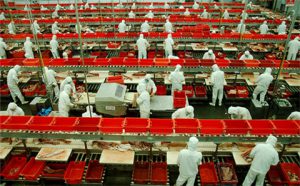
Meat invariably means pig in China, with pork accounting for 65% of the meat consumed in the country.

And after last year’s high-profile takeover of the US pig giant Smithfield by Shuanghui International, since renamed the WH Group, the largest pig producer in the world is now in China.

Although the overall resource footprint of pork is, on average, lower than beef, it is still considerably higher than vegetarian alternatives.

What is more, the long list of negative environmental impacts is reaching crisis point. For example, pig production accounts for 42% of nitrogen and 90% of phosphorus flows into the South China Sea.

More generally, livestock is now the main source of both soil and water pollution, according to data released by China’s Ministry of Environmental Protection in January.

(click on the image to see an enlarged version)

The pig industry – along with the agri-food sector as a whole  – is big business in China today. Companies such as the WH Group and New Hope, China’s largest producer of animal feed, are major employers and given generous state support.

However, as the graphic produced by the US-based Wilson Center’s China Environment Forum reveals, the costs of rising meat and intensive pig production can no longer be ignored.

High-profile environmentalists such as Ma Jun, director of the Institute of Environmental and Public Affairs, say China should turn its back on its booming meat sector and encourage more sustainable levels of pork consumption.
Cookies Settings

Dialogue Earth uses cookies to provide you with the best user experience possible. Cookie information is stored in your browser. It allows us to recognise you when you return to Dialogue Earth and helps us to understand which sections of the website you find useful.

Required Cookies

Required Cookies should be enabled at all times so that we can save your preferences for cookie settings.

Dialogue Earth - Dialogue Earth is an independent organisation dedicated to promoting a common understanding of the world's urgent environmental challenges. Read our privacy policy.

Cloudflare - Cloudflare is a service used for the purposes of increasing the security and performance of web sites and services. Read Cloudflare's privacy policy and terms of service.

Functional Cookies

Dialogue Earth uses several functional cookies to collect anonymous information such as the number of site visitors and the most popular pages. Keeping these cookies enabled helps us to improve our website.

Google Analytics - The Google Analytics cookies are used to gather anonymous information about how you use our websites. We use this information to improve our sites and report on the reach of our content. Read Google's privacy policy and terms of service.

Advertising Cookies

This website uses the following additional cookies:

Google Inc. - Google operates Google Ads, Display & Video 360, and Google Ad Manager. These services allow advertisers to plan, execute and analyze marketing programs with greater ease and efficiency, while enabling publishers to maximize their returns from online advertising. Note that you may see cookies placed by Google for advertising, including the opt out cookie, under the Google.com or DoubleClick.net domains.

Twitter - Twitter is a real-time information network that connects you to the latest stories, ideas, opinions and news about what you find interesting. Simply find the accounts you find compelling and follow the conversations.

Facebook Inc. - Facebook is an online social networking service. China Dialogue aims to help guide our readers to content that they are interested in, so they can continue to read more of what they enjoy. If you are a social media user, then we are able to do this through a pixel provided by Facebook, which allows Facebook to place cookies on your web browser. For example, when a Facebook user returns to Facebook from our site, Facebook can identify them as part of a group of China Dialogue readers, and deliver them marketing messages from us, i.e. more of our content on biodiversity. Data that can be obtained through this is limited to the URL of the pages that have been visited and the limited information a browser might pass on, such as its IP address. In addition to the cookie controls that we mentioned above, if you are a Facebook user you can opt out by following this link.

Linkedin - LinkedIn is a business- and employment-oriented social networking service that operates via websites and mobile apps.