An annual dog meat festival in the southern Chinese city of Yulin provoked widespread outrage at home and abroad, raising the possibility the central government may target the event under the guise of a widening anti-corruption crackdown.
This is the hope of a growing army of campaigners who want Chinese authorities to shut down an event, they say, that involves the consumption of around 10,000 dogs.
Given the strength of public opinion behind the campaign and ongoing crackdown on corruption, the Yulin government’s support for this week’s event, and its refusal to restrict the number of dogs killed, are “an enormous political risk,” says Jiang Jinsong, deputy professor at Tsinghua University’s Institute of Science, Technology and Society.
Jiang is also a co-founder of Voice for the Voiceless, an animal protection website.
Animal welfare activists say many of the dogs killed for the festival are pets stolen from homes of the country’s increasingly vocal middle class, who are swelling the ranks of an increasingly sophisticated and well-organised direct action and online campaigns.
Thousands of activists who descended on Yulin during the dog meat festival were monitored by plainclothes police to prevent fights with locals, and campaigners have complained of intimidation by hired toughs.
Yulin’s city government has been reluctant to place curbs on the festival, which is heavily promoted as a tourist attraction. In response, campaigners are taking legal action, with a range of official complaints and administrative lawsuits underway.
A legal team going by the name of ‘Shoushan’ has gathered evidence of dereliction of duty and inappropriate behavior by the Yulin government, which they intend to submit to the Communist Party’s disciplinary authorities.
Cruelty
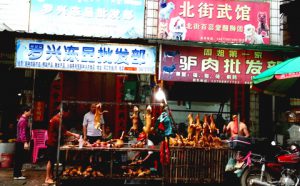
Last year, state news agency Xinhua described the festival as “only a local folk custom, without official sanction.” But the slaughtering of dogs continues apace, done in secret rather than openly in the streets.
On the eve of the Yulin festival, campaign group Animals Asia published the findings of a four-year undercover investigation covering 15 Chinese cities. Because dogs are difficult to farm on a large scale, China cannot supply the annual demand of 10 million carcasses a year, it said.
This means the dogs sold are mostly of dubious origin, likely to be pets or strays which have been stolen or poisoned.
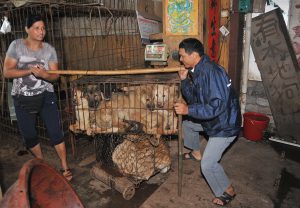
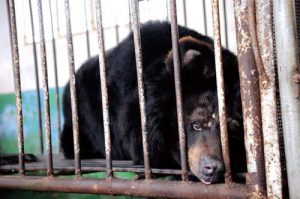
Central government has yet to respond to the controversy surrounding this year’s event, and campaigners say local officials have broken a string of promises to limit the extent of animal cruelty at the Yulin festival, where dogs are drugged and kept in tiny cages before being killed for their meat.
Crackdown?
Yet despite hopes the central government might step in to stem growing national embarrassment about the festival, enforcement would still need to come from the Yulin authorities, says Jiang.
Reporting officials to anti-corruption authorities is one way to encourage local officials to toe the line, say campaigners. China’s ongoing campaign against graft, which has led to thousands of cadres being convicted or imprisoned, has been used by Beijing to impose its will on recalcitrant local officials.
The question is whether Beijing really feels the issue is important enough to threaten local authorities.
The government could also use food safety laws – which are currently being strengthened – so dog meat would be inspected and safeguards measures enforced.
Given that much of the dog meat is rendered in filthy conditions, “if health regulations are imposed, such large-scale slaughter of dogs simply wouldn’t take place,” says Jiang.