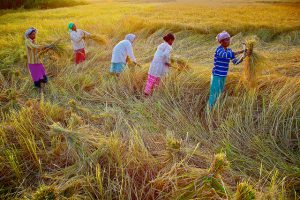

As the sea keeps rising due to climate change and affecting coastal Bangladesh, turning the soil and groundwater saline, scientists have been breeding salt tolerant varieties of rice, the main crop in the region. But the sea keeps coming in and turning everything more and more saline, well beyond the point that salt tolerant rice varieties can tolerate.
The latest salt tolerant rice variety – that the scientists released among Bangladeshi farmers as recently as November 20 – can tolerate a salinity of up to 8 deci Siemens per metre (dS/m, equivalent to 512 parts per million).
But salinity is now well above that level in more than half the arable lands in 19 affected coastal districts of Bangladesh.
Researchers say none of the existing varieties of salt-tolerant rice can survive and grow at the level of salinity that has affected both the soil and the groundwater in some of the coastal districts.
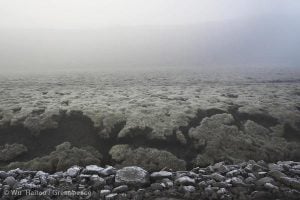
According to a study conducted by the Bangladesh Soil Resource Development Institute (SRDI), out of 8.1 million hectares of arable land in Bangladesh, 1.02 million hectares in 19 coastal districts are affected by salinity.
The study also shows that salinity in more than half the arable land in five coastal districts has gone well past the 8 dS/m level. It says out of the 560,000 hectares in five coastal districts – Khulna, Satkhira, Bagerhat, Patuakhali and Barguna – the salinity level now ranges between 8.1 and 16 dS/m. Traditional varieties of most crops can withstand salinity of up to 0.7dS/m only.
“The latest variety of rice we have released can tolerate up to 8 dS/m salinity. It will be damaged if the salinity increases even for a few days,” Jiban Krishna Biswas, director general of Bangladesh Rice Research Institute (BRRI), told thethirdpole.net.
He did hold out the hope that more salt tolerant varieties could be bred in the future. BRRI scientists have already released more and more salt-tolerant rice varieties eight times. But there is a limit to this. Researchers say the tolerance cannot go beyond 12dS/m, a level now surpassed in some areas of coastal Bangladesh.
The SRDI study found that in the last few years, an average of 6,200 hectares of fresh farmland is being affected by salinity every year. In 1973, 833,000 hectares of land in 19 coastal districts were salinity-affected. Now, the figure stands at 1.02 million hectares.
In 12 salinity-affected areas, only a quarter of arable land remains under cultivation – that too in a limited way.
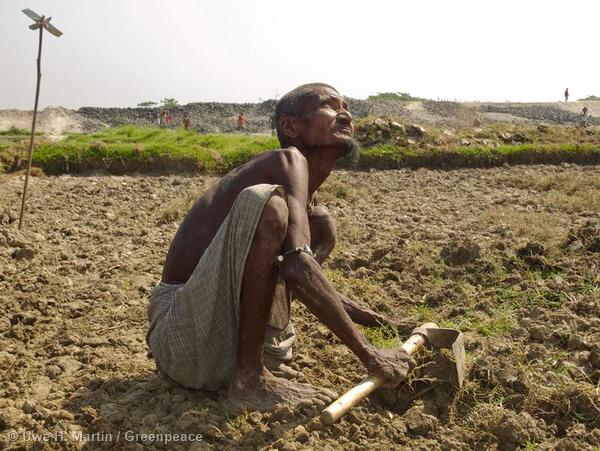
Some of the farmers who tried to cultivate salt-resistant rice varieties earlier are unhappy with their experience. Nazmus Sahdat, a farmer in Bagerhat district, said he tried one of the varieties in 2012. “Initially, the sapling was growing well. But the crop was damaged in March and April when water flow reduced and the river water became more saline,” he told thethirdpole.net. Nowadays, most of the land in and around his village remains barren.
Hydrologists say that even in areas where the soil has not turned too saline yet, the groundwater has, due to seawater intrusion. This makes it hard for farmers to irrigate their crops.
As the seawater first intruded through rivers and canals, farmers have extracted more and more groundwater over the last two decades or so. As a result, aquifer levels have fallen, hastening the process of seawater intrusion, experts say.
Anwar Zahid, deputy director of groundwater hydrology) at the Bangladesh Water Development Board, told thethirdpole.net, “We’ve found saline water in aquifers that are just 600-700 feet (183-213 metres) deep.”
Water is considered fresh as long as its salinity is within 1,000 micro Siemens per centimetre (700 parts per million). A recent study led by Zahid found that in most coastal areas, salinity level was four to five times higher than that. “In some areas, we have found the level of salinity has reached up to 40,000 micro Siemens (per cubic centimetre) in shallow groundwater,” he said.
Apart from salinity increase, sea level rise is now significant enough to measure in some parts of coastal Bangladesh. BWDB records show that at Hiron Point in the Sundarbans, water level of the Passur River has increased by 5.6 mm between 1977 and 2009.
Ainun Nishat, hydrologist and climate change expert, suggests that farmers grow other crops as they can no longer grow rice in such salinity-affected land.
“There are some experiments are going on in some pockets of the salinity-affected areas,” Nishat told thethirdpole.net. “There are some crops like soybean, maize, barley, sugarcane and some varieties of lentils that are being tried.”
Asked if he or his neighbours had tried to grow any of these crops, Sahdat – the farmer in Bagerhat district – said it was hard to get those seeds.
Officials in Bangladesh Agricultural Development Corporation – the government agency that distributes seeds – say that currently they can provide only 21% of the seeds needed in salinity-affected areas.
The crisis is going to get worse, as Bangladesh will have to grow food for an estimated 250 million people by 2050. The population is around 160 million now. Researchers say that by 2050, the country may be left with only 4.8 million hectares of arable land. It has 8.1 million hectares now. On top of that, the Intergovernmental Panel on Climate Change said in its 2007 report that due to global warming, rice yield in developing countries may decrease by 15% by 2050.