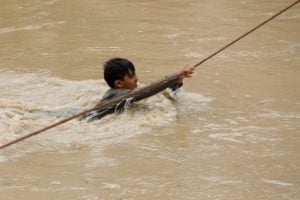
The majority of Pakistan’s second-most populous and agriculture-dependent province of Sindh was declared “calamity-hit” on 23 August. With torrential monsoon rain falling across Pakistan in the aftermath of a devastating heatwave, Sindh’s wheat harvest is down by nearly 20%. Experts say the disaster shows that the problems caused by climate change are growing, and adaptation initiatives in agriculture are needed urgently.
In July, Sindh and Balochistan received over 500% more rain than the 30-year average. In an official notification on 21 August, the provincial government announced that there have been “heavy losses which include loss of human lives, livestock, the damages to the houses and standing crops”. Agriculture is one of the most affected sectors, it noted.
“So far there is 45% loss in cotton, 85% loss in dates, and 31% loss in rice in Sindh due to the ongoing monsoon. The standing sugarcane crop has also suffered damage up to 7% due to floods, despite it being a high water-consuming crop, [which shows] the intensity of the disaster we are facing,” Ali Nawaz Channar, technical director at the provincial government’s Agriculture Extension Sindh department, told The Third Pole. “Since these all are standing crops except dates, loss could be increased by the end of harvesting season,” Channar added.
Sindh, in southeast Pakistan, is home to around 48 million people and contributes around a quarter of the country’s total agricultural produce.
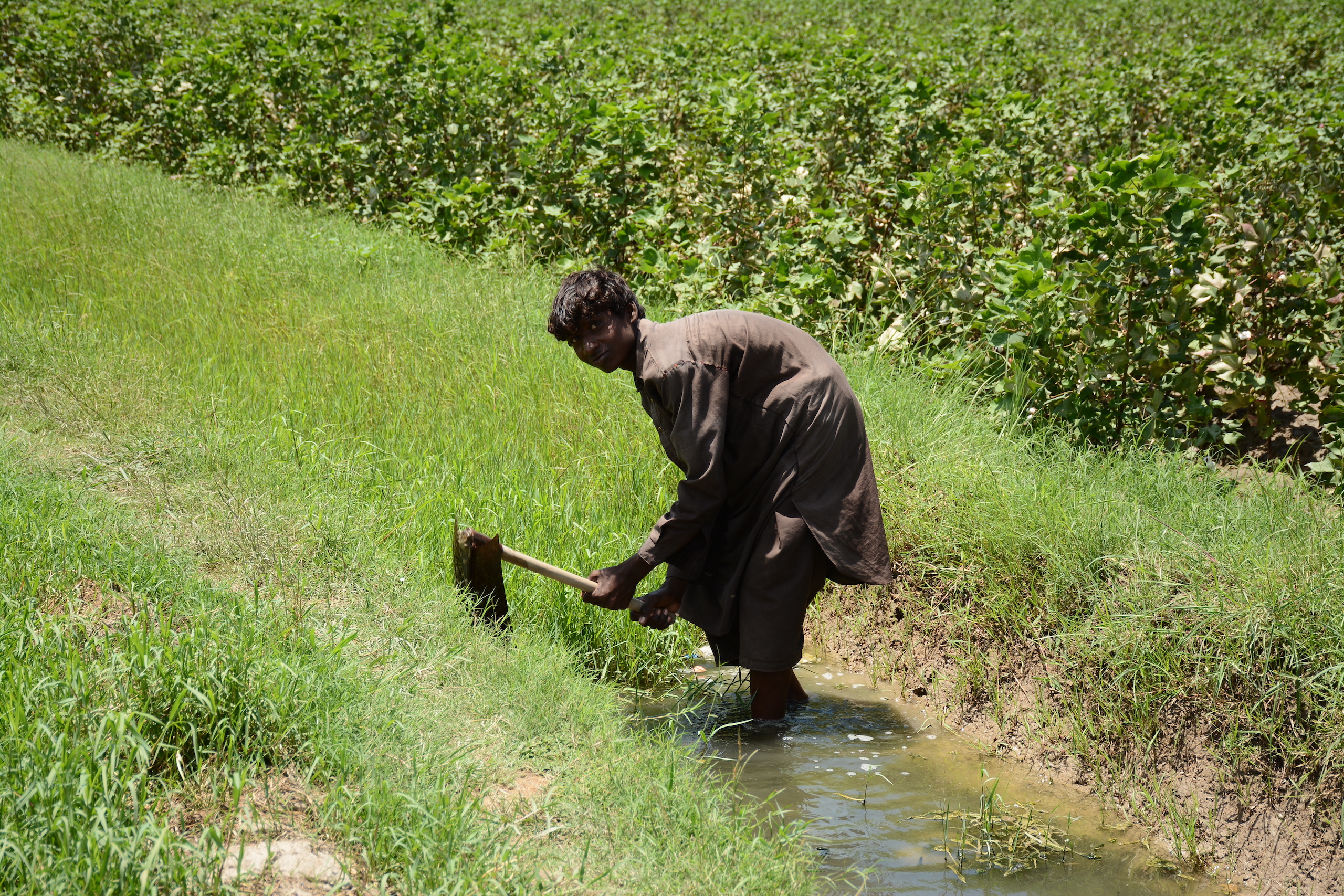
However, this year’s devastating floods are just part of the problem agriculture in the province. Channar said that this year, Sindh has “witnessed the emergence of a new declining agriculture production pattern”, adding that crops have been hit by consecutive extreme weather events in the same year: both drought and flooding.
Drought and deluge destroy Sindh agriculture
In May, the Sindh Chamber of Agriculture demanded that Sindh be declared drought-hit because water shortage had left agricultural land barren. “With Sindh being an agrarian economy this loss is worrisome for Pakistan’s future farming and also rings [alarm] bells for national food security,” said Channar.
Data shared by Channar from the Agriculture Extension Sindh Department shows that around the start of 2022, when winter crops were being sown, there was 70% water scarcity in the province. This shrank the area that could be used for growing crops. “Reduction of the area over which wheat and cotton is grown is linked with shortage of water during sowing,” Channar explained.
This loss is worrisome for Pakistan’s future farming and rings alarm bells for national food securityNawaz Channar, Agriculture Extension Sindh department
The department’s data reveals that 2022’s wheat production stands at 17% below the targeted amount, with a 2% decrease in the area targeted for production. The area used for cotton was 19% less than the target and mango yields were 30% lower than targeted.
According to the Economic Survey Pakistan, agriculture contributed 22.7% of Pakistan’s gross domestic product in the 2021-22 financial year, compared with 23% in 2020-21. This was despite the growth rate in the sector increasing to 4.4% in 2021-22, from 3.5% in 2020-21. The share of agriculture in Pakistan’s GDP has steadily declined over the years. Based on the latest data, this year the decline will likely be combined with a deep drop in output.
Data from Sindh’s Agriculture Research Centre (ARC) Tandojam shows declines in the area covered by and yields of cotton and wheat, both major export crops.
Liaquat Ali Bhutto, director at Sindh’s ARC Tandojam, said that agriculture’s contribution to GDP is unsatisfactory.
“Agriculture input in national GDP was over 50% at the time of Pakistan’s independence in 1947,” Bhutto said. “Even though we are an agrarian country, we have failed to sustain the agriculture input in our national economy. With population rising and climate change becoming more challenging every passing day we need to transform our agriculture by taking adaptive measures on a war footing.” Bhutto added that data from 2016-20 shows the area of land used for agriculture in Sindh has fallen considerably, and the province faces a decline in overall production.
Impact on women
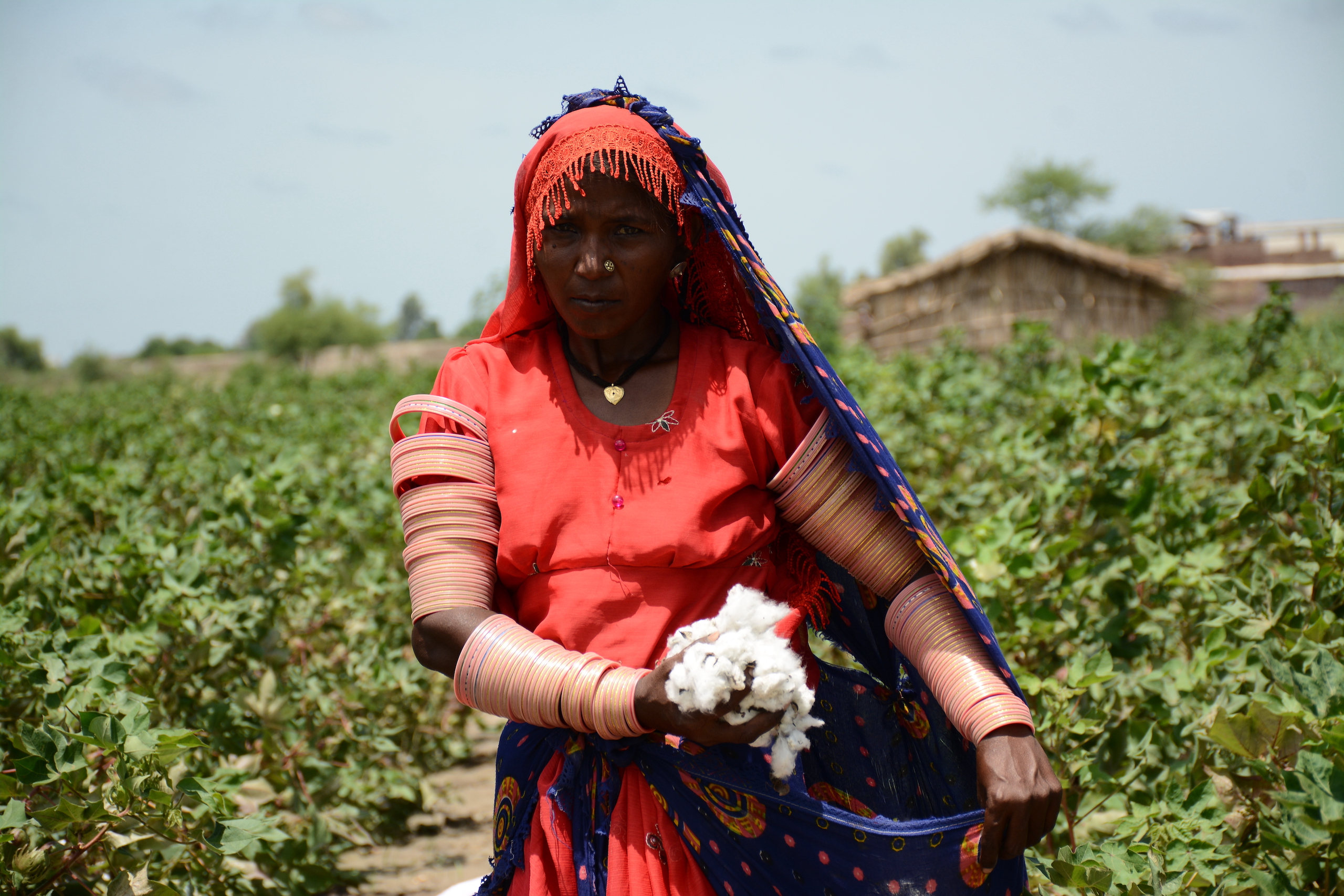
Rafia Gulani lives in Sanghar district and is an activist who campaigns for women workers’ rights, as well as being chairperson of Sindh Naari Porhiyat Council. She said that women are a major casualty of the ongoing monsoon rains.
“When it comes to Pakistan’s agriculture, women [account for] the majority [of the] workers. However, this monsoon has left farmers in general jobless, and women in particular,” Gulani told The Third Pole.
She said that farmers who travel long distances to agricultural jobs have lost those opportunities. Women’s mobility, particularly in rural Pakistan, is already difficult – and flooded roads adds to existing obstacles, leaving women facing a greater likelihood than men of losing their jobs. “This monsoon is a similar challenge like Covid-19 and the 2010 floods that devastated Pakistan’s agriculture,” Gulani said.
Adaptive measures needed in Pakistan’s agriculture
A 2020 study published in the Mehran University Research Journal of Engineering and Technology found that if Pakistan does not implement adaptation measures in agriculture, climate change is likely to reduce the sector’s contribution to GDP by around 5%. “However, the investment in agricultural technologies to increase crop yield is likely to increase the agricultural value-added to GDP by around 17% while the investment for canal and watercourse efficiency improvements would increase it by 9%,” the study notes.
Ghulam Sarwar Panhwar, a farmer from Hyderabad and a representative of the Sindh Chamber of Agriculture said his experience supports this finding. “If Pakistan wants to meet future challenges of climate change it will have to make adaptive measures in its agriculture,” Panhwar said.
He added that this includes modifying the farming system, providing farmers with training and quality seed, and increasing public development and research funding.
![Woman farmer carrying her child while cutting rice crops from the field, in village Qasim Solangi, Hyderabad [image by: Manoj Genani]](https://dialogue.earth/content/uploads/2021/02/Women-peasant-carrying-her-child-while-cutting-rice-crops-from-the-field-in-village-Qasim-Solangi-Hyd-2048x1365-1-300x200.jpg)