Landlots Kuutsi often used to experience poor maize yields due to drought. The smallholder farmer from Tikwiri village in eastern Zimbabwe would struggle to put enough food on the table for his family, let alone afford school fees for his four children.
“Those days I always woke up and headed towards my plots,” says Kuutsi. “Next farming season, I needed to work even harder.”
The weather here in Makoni district, 200km south-east of the capital Harare, is less predictable than ever. But Kuutsi now practises Pfumvudza, a zero-tillage farming method. He says the method, which has been widely adopted in Zimbabwe to retain soil moisture and nutrients, has improved his yields considerably.
The need to adapt
Zimbabwe has experienced frequent droughts since 2000 that have severely affected smallholders like Kuutsi. In response, Foundation for Farming, a Zimbabwean non-profit, worked to introduce the Pfumvudza method along with the country’s Department of Agricultural Technical and Extension Services (Agritex).
This “conservation agriculture” technique encourages farmers to work on small plots of land using simple tools: hoes for digging planting holes, strings for maintaining consistent spacing between rows, and grass for mulching to retain soil moisture.
Land preparation begins as early as July or August. Manure or compost are thrown into each hole, after which the farmer waits for the rains. Traditionally they come in late October to early November but climate change has been pushing them later, sometimes to December. The rains have also been departing more quickly once they have come. Early preparation ensures farmers are ready to plant as soon as the rains fall.
The method improves soil structure and keeps in moisture, something critical to farming in drought-prone regions. In 2020, the Zimbabwean government officially adopted Pfumvudza, training one million smallholder farmers. The government also provides the farmers with fertiliser and seed for growing maize, groundnuts, sorghum and peas.
As well as being crucial for sustenance, agriculture is central to Zimbabwe’s economy and was the third-biggest contributor to value addition in 2023, according to the government’s statistics bureau.
While Pfumvudza is a modern intervention, it shares similarities with practices used by some traditional farmers, especially those without cattle to pull ploughs. Such farmers often work the land with hoes alone. They usually farm on quite large areas that produce low yields. But holes may be dug haphazardly, without proper spacing, mulching, or the addition of organic matter like manure.
The need for farmers to better adapt to a changing climate is not confined to Zimbabwe. If the world’s agricultural sector fails to do so, global food production is set to fall 10% by mid-century and 25% by 2100, putting pressure on global calorie intake. This is the finding of a team of researchers from Boston University, Ca’ Foscari University of Venice and the Euro-Mediterranean Center on Climate Change Foundation (CMCC). The team found that people in already precarious positions are likely to be worst affected.
Switching to Pfumvudza
Since 2020, Agritex has been charged with promoting Pfumvudza in Zimbabwe. It trains and advises smallholder farmers on improved farming methods to help boost their yields. Agritex also facilitates access to farming inputs – such as providing seed via government support programmes – and offers training and ongoing technical guidance, most of which are free.
Dialogue Earth spoke to Artwell Jairos, the Agritex officer in Rusape, the peri-urban area of Makoni where Landlots Kuutsi lives. Jairos confirmed there was some resistance when Pfumvudza was first introduced. Some smallholders believed the land preparation would be too labour intensive. Other couldn’t afford the necessary fencing. Pfumvudza farming starts as early as August or September, at which point cattle are let loose during the day to graze. If an area is not fenced, cattle can roam there and disturb the prepared land.
According to Jairos, despite these challenges, more farmers are gradually embracing the method as they witness fellow smallholders achieving better yields.
Maize farmers who used the method have to put three seeds in each hole and cover the hole with a thin layer of soil before the first rains come. Once seeds germinate, the farmer takes out the thinnest of the maize plants to give the other two the space to grow well.
Most of the smallholders cannot afford to buy chemicals that kill weeds, so they pull them out by hand.
After realising that the yields from traditional farming could not sustain him throughout the year, Kuutsi adopted Pfumvudza farming in 2023, and now uses the method on his 12 plots.
“At first it was tiresome for me and my family… We had to dig holes and cut grass for mulching. But the following rainy season it was a bit easier for us as we were used to the farming method,” says Kuutsi.
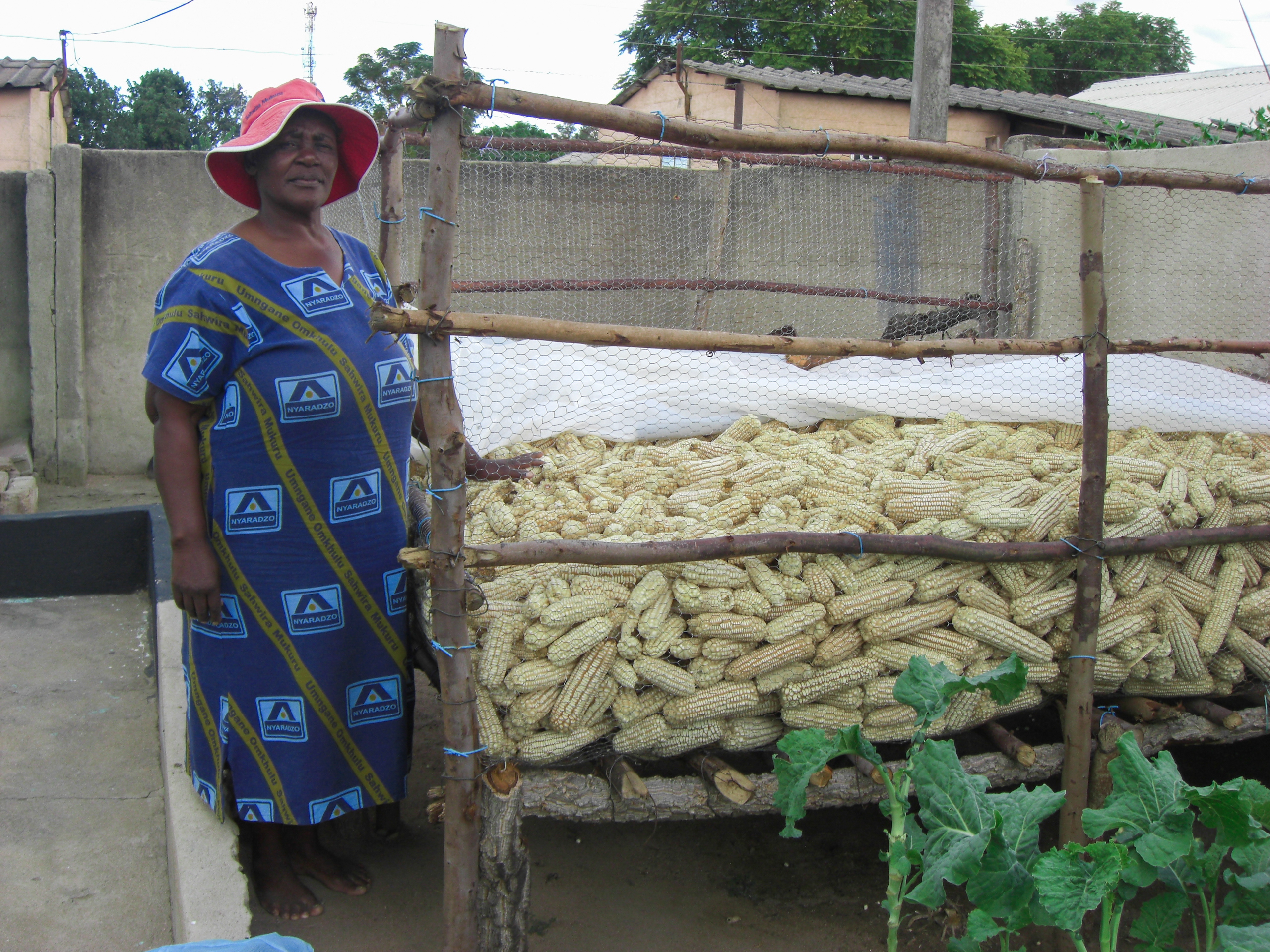
Balbina Toperesu, a resident of Tsanzaguru township, Rusape, told Dialogue Earth that she began Pfumvudza farming in 2022, since when she has been able to feed herself and her children.
Standing in her yard, where she stores harvested maize, she says: “I love this farming method as it assures a better harvest.” Toperesu is nowadays assured of more than ten 50kg bags of maize grain this year, she adds.
Two kilometres away, Annah Chipapata is busy harvesting fully grown maize crops on her plot. She tells Dialogue Earth she is thankful to the government for introducing Pfumvudza, which she is in the process of adopting.
Since 2022, she has been digging holes and adding manure, but has not practised mulching, as she struggles to find enough grass. This year, her yield is far better than previously, she tells Dialogue Earth while encouraging her son to heap the harvest in one place.
Kuutsi’s farming journey shows how smallholder farmers can improve their lives through Pfumvudza farming.
The programme was extended to more than 3.5 million in 2024, according to a report by the Zimbabwe Farmers’ Union. A separate government study in 2023 suggested that 84% of rural households had adopted the method, as reported by national outlet The Herald, with 12 million plots covering 744,588 hectares across the nation.
“I will forever continue practising Pfumvudza as I am assured of better yields that will feed my family to the next farming season,” says Kuutsi, promising that he will soon drill a borehole in his yard so he can irrigate the crops during drought.