It was 8pm and everyone in the house was preparing to sleep after dinner, but the fire was still flickering in one corner of the kitchen. Sambarman Okhati, a 66-year-old elder of the family, bore a hint of concern while hunching over a boiling pot. “The maize for tomorrow’s tos hasn’t cooked properly,” he murmured.
Editor’s note:
This article is part of Dialogue Earth’s Indigenous Voices fellowship. The eight fellows are Indigenous journalists and storytellers from across the Global South. The fellowship aims to foreground not just Indigenous issues, but also the storytelling, reporting and insights of Indigenous journalists themselves.
Tos is a land-worshipping ritual of Nepal’s Kulung community, during which locals pray for a good harvest and are advised on what crops to plant by a shaman. Okhati’s maize, one of the ritual’s offerings, was still too firm. “Without a pressure cooker, it won’t soften as it should,” he sighed.
The Indigenous Kulung people are part of the Himalayas’ larger Kirat community. They have their own language, culture, history, tradition and ancestral homeland – Mahakulung (“Greater Kulung”), located in Solukhumbu District in the eastern part of Nepal. Solukhumbu is known for being home to Mount Everest – which the Kulung and other groups call Chomolungma (“Goddess Mother of the World”) – and other high Himalayan mountains. Yet few are aware of the ancient settlements nestled below these snow-capped peaks. In Mahakulung, they sit at elevations ranging from 1,800 to 3,000 metres, surrounded by rugged hills and dense green forest.
Being from the Kulung community, I’ve always taken pride in our environmentally conscious traditions, which have been sustained across generations. Now, due to modernisation and a growing generation gap, the transfer of knowledge has been disrupted. The lack of written documentation poses an even bigger challenge.
As part of Dialogue Earth’s Indigenous Voices project, I wanted to document these invaluable practices, both to preserve them for future generations and to highlight the conservation knowledge I believe can help other communities.
During my earlier visits to the community, I had heard about tos but never had the chance to witness a ritual in person. This year, I finally did – in Chaitra (March-April) at Chemsi and Chachalung villages. What I learnt was that it is a demonstration of the community’s close relationship with the environment as much as it is a spiritual ceremony.
Documenting tos
During tos, the Kulung people worship their ancestors, and crucially, the land, mountains and large rocks that form the backdrop of their community. The ceremony takes place in sacred, communal locations known as toskham (kham means “place” in the Kulung language).
“Tos is performed in celebration and gratitude for the new crops in a field, and to seek the same generous cultivation for the future,” Okhati told me. “We also pray to our ancestors to ask for their support to fend off drought, heavy rainfall, landslides and pest infestation in our crops.”
Tos is performed three times a year at crucial points of the agricultural calendar when the seasons change, Okhati explained: “Each tos is different, so the nokchho (shaman) performs the rituals differently for each one.”
First comes yau tos, performed in the month of Chaitra after the sowing of seeds has concluded. During the ceremony, people pray for rainfall and fertile land so each seed can sprout and grow properly.
Next is yenam tos, performed in Jestha (May-June). With the rainy season approaching, people pray for the rain not to destroy their crops. This also introduces the koyo – a restrictive period with bans on a range of things, including certain foods, until the next tos.
Tho tos is performed during the month of Ashoj (September-October), when the rainy season is over and the skies are clear. Restrictions imposed during yenam tos are lifted, and the community celebrates with ceremonies and festivals, such as chakchakur (Kulung New Year), nagi (a ritual offering the first harvest to family ancestors and gods) and denam (a ritual to please their ancestors and gods). As the crops ripen in the fields, the nokchho prays for a fruitful harvest. One local shared that this tos is often attended by a larger gathering than the other two.
Individually, these tos rituals may also be performed differently in each village of Mahakulung, depending on the dominant subcaste of the Kulung community in that area. However, key offerings from the community – such as millet, wakpum (boiled maize) and chhopchhou (small pieces of pork or keratinous deer hoof) – and the collective spirit of honouring the ancestors and land are threaded through each variation.
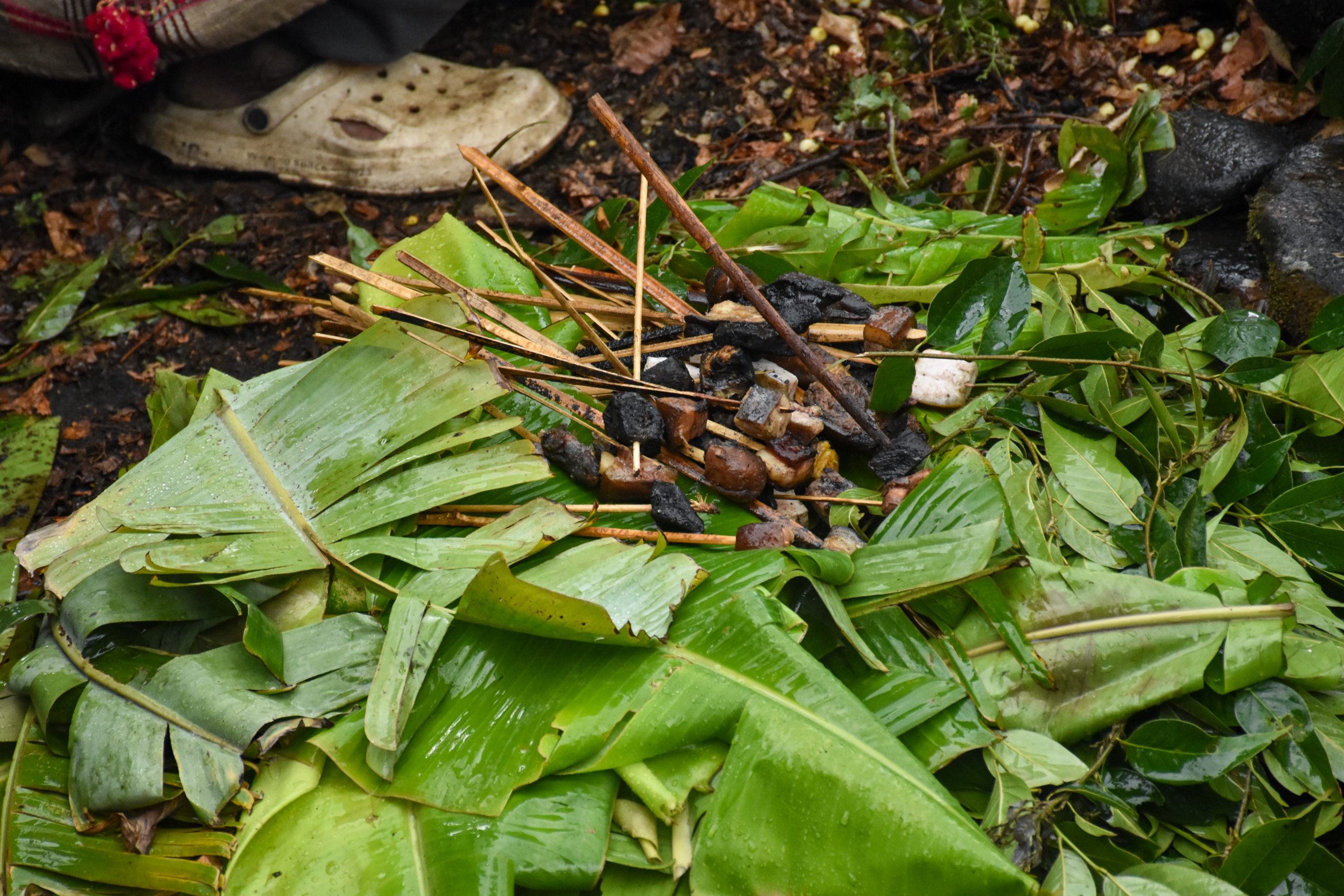
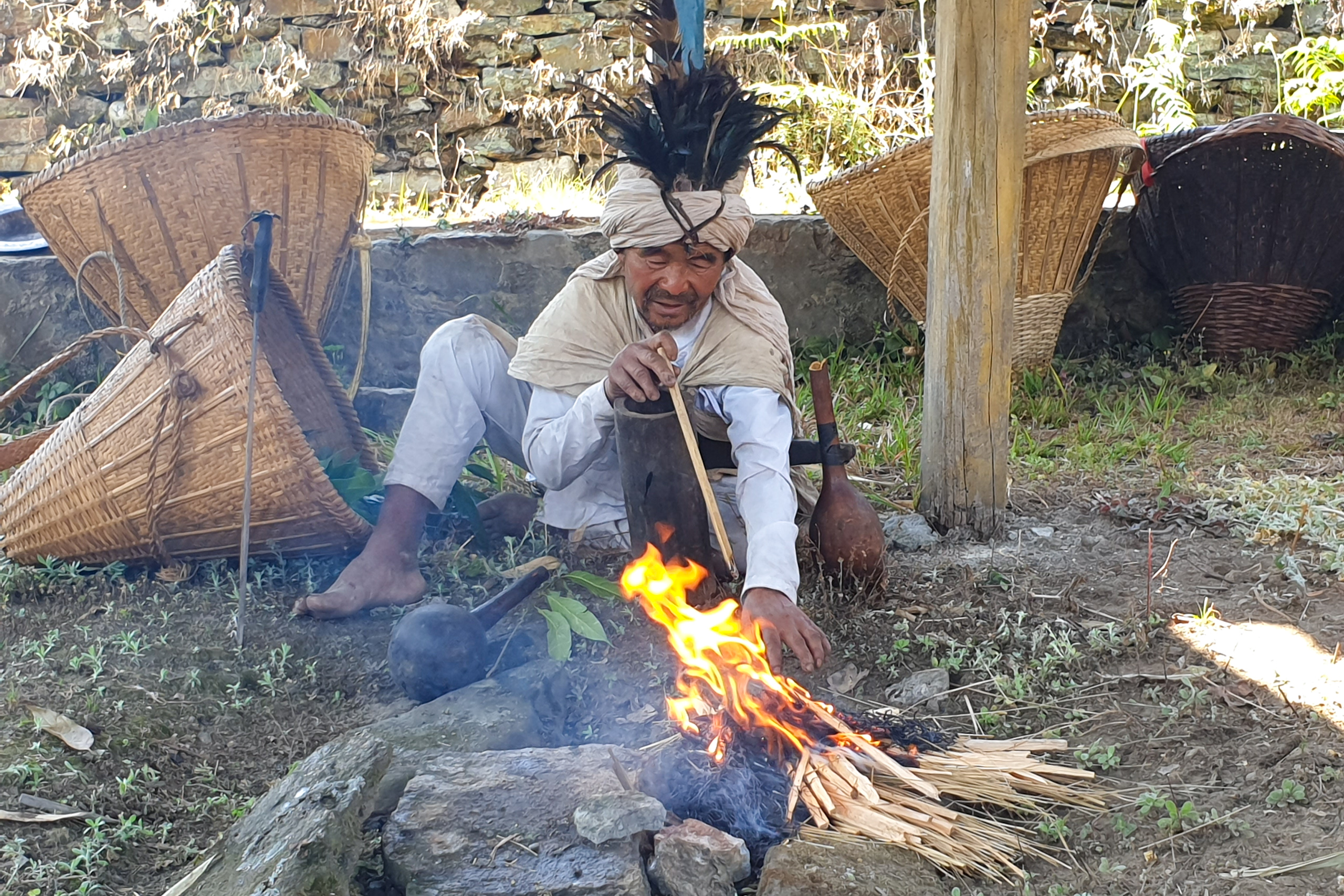
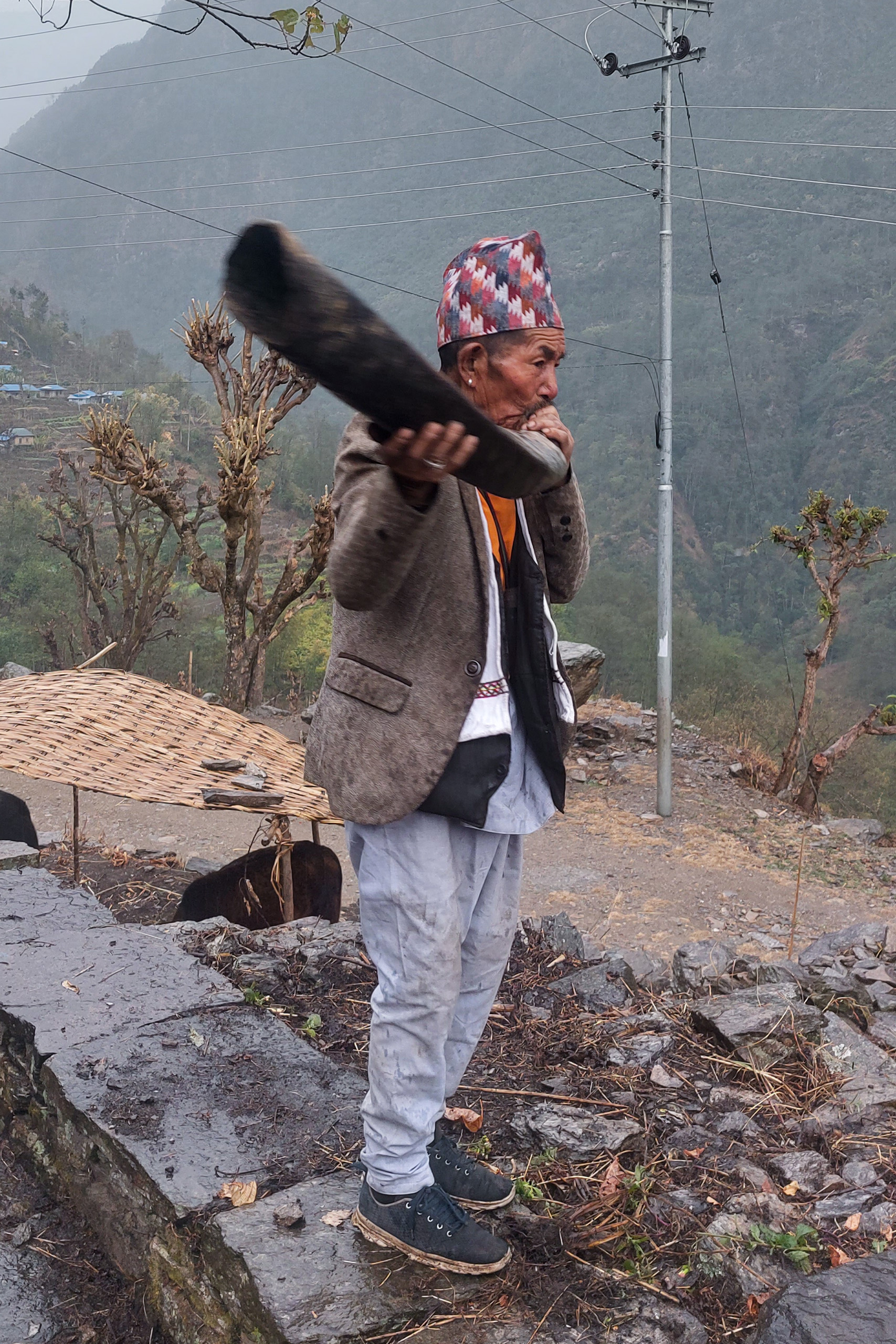
This year at the yau tos in Chemsi village, the nokchho (who is always male), clad in his ceremonial attire, led the worship with the branches and leaves of a weipou tree (a type of chestnut). He said prayers, before offering wakpum and di (alcohol made of buckwheat or millet grain) to the ancestors and the surrounding land, as well as to the yongkholung stones, which have a central role in the ceremony. Attendees played hurgel (cymbals) and pung (buffalo horn), and performed a traditional dance known as tos sil (sil meaning “dance”). In each toskham, a fire was then lit near the yongkholung, and chhopchhou was offered to ancestors and spirits.
In Chemsi, there is also a unique practice of fining households NPR 1 (about USD 0.007) if they do not attend tos. The collected fine is used to buy food for the nokchho.
Farmers are prohibited from working on the day of the tos and the following day. “For the entire year, farmers work in the fields and cause noises with ploughing and digging,” said Swasta, a 51-year-old villager from Chemsi. “The fields also need some time for rest, peace and rejuvenation, don’t you think?”
Turning over the yongkholung
Yongkholung stones are often chosen by the nokchho through divine intuition or after seeing them in a dream. Each toskham has a yongkholung. During a tos, the yongkholung is turned over to reveal what lies beneath it, foreshadowing the upcoming season’s agriculture. Certain insects foretell favourable conditions for specific crops, while others hint at possible threats.
At this year’s yau tos, the Chemsi villagers gathered with anticipation as the nokchho observed the soil under each yongkholung to find spiders and black ants laying white eggs. “Time is good for the village,” the nokchho said, “but there might be some hailstorms ahead”. With this mixed forecast, he then encouraged the cultivation of millet, stating it would produce well this season.
When asked whether the villagers follow the nokchho’s advice, Okhati responded firmly: “Of course! They are farmers, they must follow his advice on planting and prepare accordingly.”
This kind of faith is unshakeable in elders like Okhati, who know what a lean year can bring. He told me of the harsh drought of 2028 BS (1971). “There was not even a single nettle to eat in the village,” he said. “We ate whatever edible leaves and shrubs we could find.”
His words carried the weight of fragile balance between nature and livelihood. With trekking and portering to Everest and other mountainous areas offering only seasonal incomes, back then agriculture was not only a source of livelihood – it was a matter of survival, where every harvest was crucial.
Locals from Chachalung shared that they believe modern nokchhos don’t have the powerful insights of their predecessors. This symbolises the growing generational divide, which is partly seen as a split between spiritual tradition and modern logic.
One local from Bung, another village in Mahakulung, told me the powers of a nokchho are rooted not only in the spiritual world, but in wisdom developed after generations of close observation and interaction with the land. “Looking at insects under the stone and soil… may seem superstitious and even mythical to some, but there are reasons behind these traditions,” he said.
“If termites are seen, it is believed that crops may suffer from pests – termites naturally destroy wood and plants, after all. If the soil is wet, it is taken as a sign of fertility, and a good harvest is expected. If the land is dry, drought is predicted. And if earthworms are seen, people say there will be more rain that year,” he explained.
“These may not be documented in science books,” he added, “but they’re not entirely baseless. They come from centuries of lived experience and careful observation of natural patterns by our ancestors.” He did, though, agree that this way of passing traditions down means their accuracy is now compromised, a result of fewer people studiously participating in activities and rituals like the tos due to a lack of interest.
Adapting to climate change
Mahakulung is home to a population of nearly 12,000, according to the 2021 Nepal census. While a majority now work in teaching, government jobs, business or as trekking guides, agriculture is still important to the community. In the region’s harsh and cold terrain, locals grow crops like millet, buckwheat, maize and potatoes as staples. Cash crops like cardamom and tea are also cultivated, and kiwi fruit, previously unheard of, has gained popularity in recent years due to its suitability in the local climate.
However, the changing weather, environmental shifts and population growth have generally made achieving good yields difficult. Although modern inputs such as pesticides and chemical fertilisers are available, these are seen as long-term threats to soil and human health.
One of the farmers from Bung described how traditional practices are being altered: “Previously, after two years of maize cultivation, we left the land fallow in order for it to regain fertility. Now, due to growing population, that’s not possible.” Instead, they plant legumes – soybean, lentils and wheat – which restore soil fertility through the bacteria in the nodules of their roots. Trees such as Nepalese alder and kutmero are also valued for their soil-enriching properties. But buckwheat, though a staple, is planted with caution as it is believed to deplete soil nutrients. The tilling of the fields for maize, meanwhile, follows a strict calendar aligned with plant growth.
The Kulung community have a common belief that land should not be disturbed unnecessarily. “If you dig a pit and leave it empty, your life will also become hollow like that pit,” goes a local proverb. One local explained that unfilled pits collect water, weaken the soil and make landslides more likely. Generally, deep-rooting trees are planted, and shallow-rooting trees are avoided, especially in landslide-prone zones.
Amidst changing agricultural practices and emerging new beliefs, the community’s resilience lies in its ability to adapt while remaining rooted in its ancestral knowledge and communal practices, such as tos. To them, these practices are not just a ceremonial feast or recreational activity, but rather a deliberate effort to live in harmony with nature and promote communal prosperity.
Elders in the community express concern about whether these rituals will survive due to the decreasing participation of younger generations and shifting priorities such as migration to urban areas, as well as modern influences including technology.
Still, not all hope is lost. Within the crowd at this year’s yau tos in Chemsi, alongside the elders was a 27-year-old participant who was deeply engaged.
“It’s our responsibility as youth to carry forward the legacy left by our ancestors,” he told me.
In this simple affirmation is a sign that younger generations are beginning to recognise the value of these customs, not merely as traditional practices, but as valuable skills that have been shaped by the struggles of their ancestors, and now entrusted to them.