Food

Milk to meat: a Nepali village diversifies

After the 2015 earthquake, a small village in Nepal which depended entirely on making traditional milk-based sweets has diversified into poultry and fish farming
<p>Milk-based sweets ‘khuwa’, produced in the small production house of Tul Prasad Dahal Chyamrangbeshi, Kavre [image by: Nabin Baral]</p>

Milk-based sweets ‘khuwa’, produced in the small production house of Tul Prasad Dahal Chyamrangbeshi, Kavre [image by: Nabin Baral]

Surrounded by the rocky lower-Himalayan mountains, the village of Chyamrangbeshi is returning to normal after the deadly earthquakes in 2015 – but in a different way to most. The village, known for milk-based sweets called ‘khuwa’, now has fisheries and poultry coops for the first time in its history.

Chyamrangbeshi, Kavre, Nepal [image by: Nabin Baral]
“My son got the ideas from several NGOs who came here to help after the earthquake,” says Somnath Ghimire. In the village of about 50 families, almost every household relies on selling milk to the khuwa factories as its major source of income. “It’s a completely new business for us.  It’s also what we had never even thought we’d do, as we don’t eat meat.”

There are now three poultry coops in the village and several fishponds, some of which have already started selling fish. It takes some time to stabilise fish ponds to a point where they can produce fish at a sellable scale.
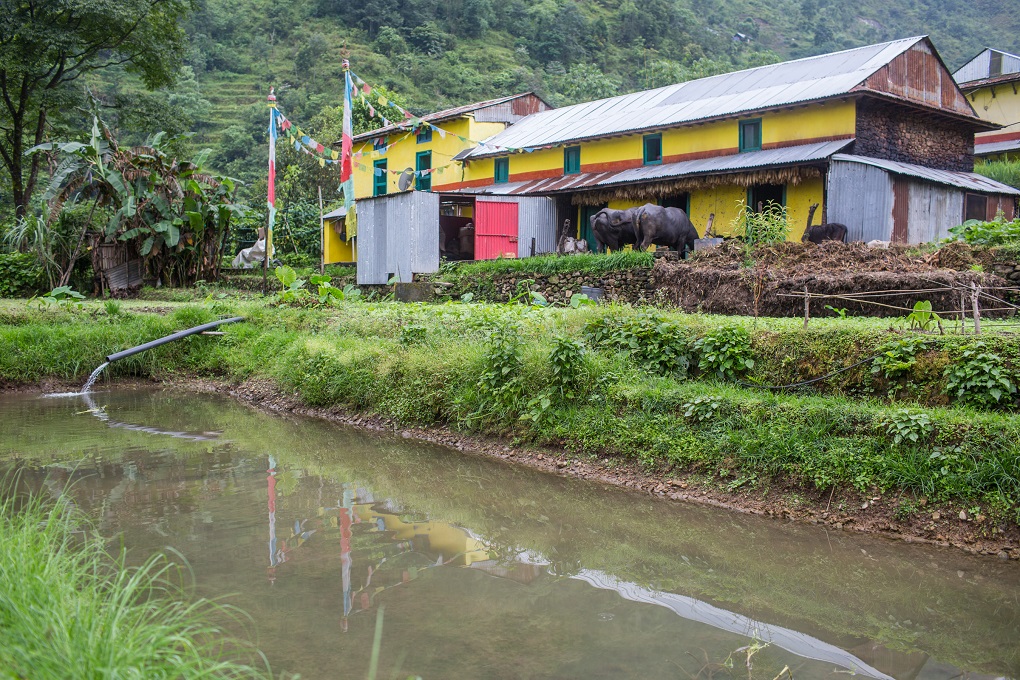
The fish pond of Kamal Lama, who was the first in the village to start fish farming [image by: Nabin Baral]
“We had subsistence farming. We continued what our parents did but after the earthquake, several organisations advised us about different ideas that could regain our economic prospects in better ways,” says Ghimire. “We realised that diversifying our economy is important, because if something goes wrong in one business we will have other options.”

The younger generation is also getting involved in these new businesses. Alongside his job as an accountant in a nearby school, Kamal Lama works in a fishery and has made good earnings from seasonal vegetable farming.

“I went to a fish hatchery in Kathmandu and bought fingerlings – they are growing now. I am hoping to sell them soon,” says Lama.

Somnath Ghimire explains how hard it is to manage financially on subsistence farming. [image by: Nabin Baral]
Not that long ago, villagers used to walk several hours to reach the southern part of the Kathmandu valley to sell ghee and khuwa. After a rough road connected the village more than 10 years ago, life has been easier.

“Contractors have signed a yearly contract with us for khuwa and buy from us every day, so there is no problem for the market and demand is increasing,” says Uddhav Dahal, who owns one of the three khuwa factories in the village.

On average, the factories produce around 100 kilogrammes of khuwa every day, using milk sold to them by villagers each morning. Manually, the production of khuwa is a tough job.
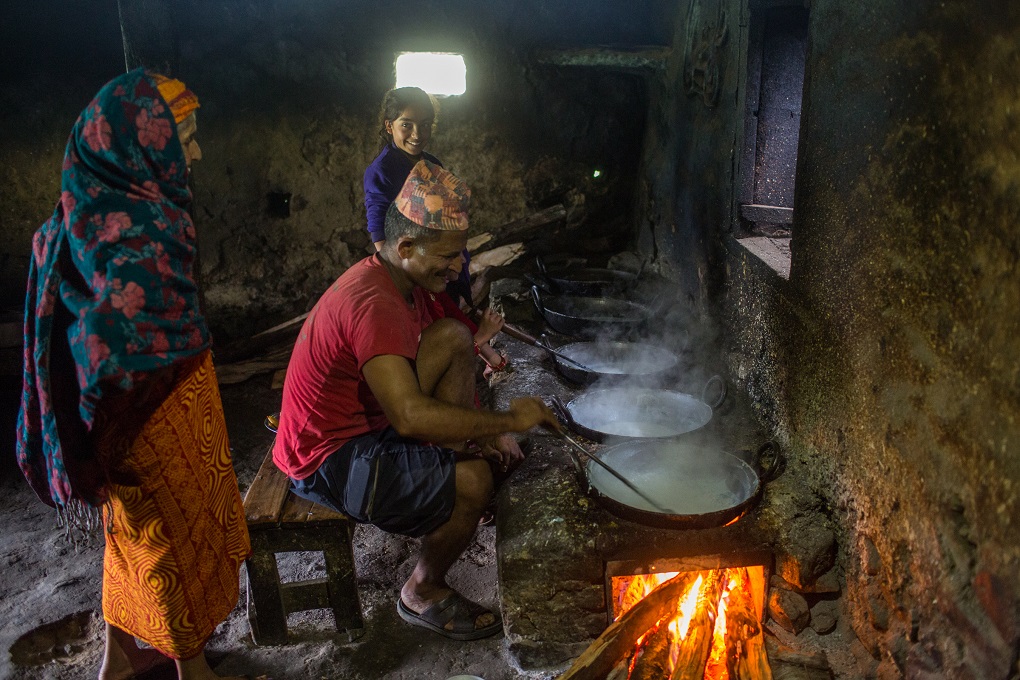
Milk-based sweets ‘khuwa’, production house of Tul Prasad Dahal Chyamrangbeshi, Kavre. Since 23 years the small production house runs on firewood. But now Tul Prasad want to bring new machines that operate through electricity [image by: Nabin Baral]
“You have to stir milk continuously for hours every day and it consume kilos of firewood. It’s bad for health and for the environment as we have to cut down trees, but it’s not easy to shift to modern technology,” said Ram Prasad Ghimire, another factory owner.

Shifting from traditional to modern methods demands both knowledge and money. Ghimire has a plan to increase production and switch to machines run by electricity, but he worries about the taste; he has heard that machine-produced sweets don’t taste as good as those produced manually.  He said: “There is too much confusion but I am seeking some support to bring in new technology.”

We want to hear from you! Tell us what you think about The Third Pole and you could win $100. Take our survey here

Cookies Settings

Dialogue Earth uses cookies to provide you with the best user experience possible. Cookie information is stored in your browser. It allows us to recognise you when you return to Dialogue Earth and helps us to understand which sections of the website you find useful.

Required Cookies

Required Cookies should be enabled at all times so that we can save your preferences for cookie settings.

Dialogue Earth - Dialogue Earth is an independent organisation dedicated to promoting a common understanding of the world's urgent environmental challenges. Read our privacy policy.

Cloudflare - Cloudflare is a service used for the purposes of increasing the security and performance of web sites and services. Read Cloudflare's privacy policy and terms of service.

Functional Cookies

Dialogue Earth uses several functional cookies to collect anonymous information such as the number of site visitors and the most popular pages. Keeping these cookies enabled helps us to improve our website.

Google Analytics - The Google Analytics cookies are used to gather anonymous information about how you use our websites. We use this information to improve our sites and report on the reach of our content. Read Google's privacy policy and terms of service.

Advertising Cookies

This website uses the following additional cookies:

Google Inc. - Google operates Google Ads, Display & Video 360, and Google Ad Manager. These services allow advertisers to plan, execute and analyze marketing programs with greater ease and efficiency, while enabling publishers to maximize their returns from online advertising. Note that you may see cookies placed by Google for advertising, including the opt out cookie, under the Google.com or DoubleClick.net domains.

Twitter - Twitter is a real-time information network that connects you to the latest stories, ideas, opinions and news about what you find interesting. Simply find the accounts you find compelling and follow the conversations.

Facebook Inc. - Facebook is an online social networking service. China Dialogue aims to help guide our readers to content that they are interested in, so they can continue to read more of what they enjoy. If you are a social media user, then we are able to do this through a pixel provided by Facebook, which allows Facebook to place cookies on your web browser. For example, when a Facebook user returns to Facebook from our site, Facebook can identify them as part of a group of China Dialogue readers, and deliver them marketing messages from us, i.e. more of our content on biodiversity. Data that can be obtained through this is limited to the URL of the pages that have been visited and the limited information a browser might pass on, such as its IP address. In addition to the cookie controls that we mentioned above, if you are a Facebook user you can opt out by following this link.

Linkedin - LinkedIn is a business- and employment-oriented social networking service that operates via websites and mobile apps.