


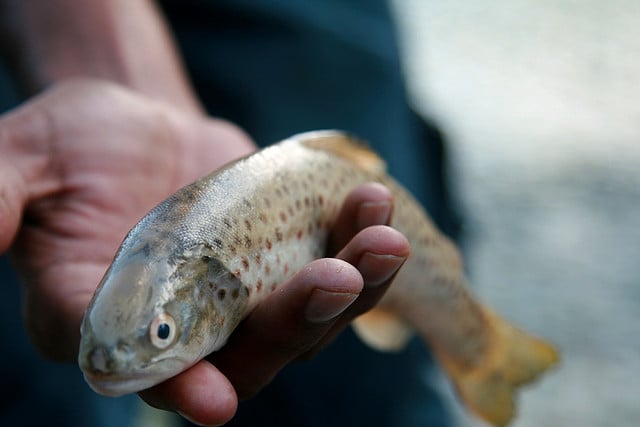

55-year old Mohammad Bashir used to make a good living from fishing trout. Today, his family business is on the brink and his two sons have left the village to find work elsewhere. “There is just not enough trout to make ends meet. Many youngsters have migrated to other places in search of work,” he says.
Bashir lives by the River Kunhar in the Kaghan valley in the north-east of Khyber Pukhtunkhwa province, part of the Indus River basin. This area is famous for its pristine rivers, lakes and glaciers which provide the perfect environment for trout.
Until the 1990s trout fishing was a major source of livelihood and provided nutrition for local communities. However, pollution and unchecked construction along the river has led to a sharp decline in trout, say experts.
Muhammad Waseem, wildlife and environment expert at WWF-Pakistan says the decline of trout has been observed in the Kunhar River “but unfortunately still time no search work done on it to give accurate population figures due to lack of facilities in government and private sector” he said.
The three species of trout in Pakistan — the snow trout, the rainbow trout and the brown trout – are now rarely seen in the wild outside hatcheries. The snow trout is indigenous to the region and the other two species were introduced by the British in the Chitral and Kaghan valley in the 1920s.
As well as being important for local livelihoods, trout plays an important role in the river ecosystem. “Trout are the top native predator and a keystone species. The presence of trout in lakes, streams and rivers supports commercial and recreational fisheries in the ecosystem and helps to stabilise the aquatic ecosystem,” said Waseem.
The local tourist industry has been hit by the decline of trout as well. Local tour guide Mohammad Asif explained that visitors to the valley want to taste the legendary fish they have heard so much about: “But we cannot always appease their palate as it is rarely available these days.” Restaurant owner Mohammad Ramzan agreed. He was doing a roaring trade in the 1990s, but his business has suffered due to lack of trout. “I would say it [trout] has reduced by 60%,” he lamented.
Fisherman Bashir misses the glory days of the 1980s and 90s when diplomats from Islamabad visited the Kaghan valley especially for fishing. “If the catch was good, we were rewarded handsomely for our services,” he said.
Today, trout fishing is restricted, yet illegal hunting by influential people continues. “While we are prohibited by the fisheries department from hunting, the concerned authorities turn a blind eye to illegal fishing by the rich and the powerful,” pointed out Bashir. Once a major part of their diet, today local people say trout become beyond their reach as it could be sold for Rs 3,000 (£19) per kilogramme.
Trout fishing is allowed for four months every year and only with a permit; a permit costs Rs 2,000 (US$20) and allows the fishing enthusiast to catch one fish using a rod. The restrictions aimed to put an end to the use of nets, dynamite or electric shocks to catch fish.
Trout fishing was first banned in 2000, before the ban was lifted subject to a permit system in 2007. In 2009 the provincial government imposed a complete ban which was lifted again in 2011 subject to a permit.
Construction pressure
Environmental degradation has also played a major part in the decline of trout.
Over the last ten years this Himalayan region has seen a host of unscrupulous development projects. Poorly planned construction of roads, dams and hotels, restaurants and houses along the banks of River Kunhar has polluted its water and damaged ecosystems.
For example, in 2005 the National Highway Authority (NHA) started the unauthorised construction of a multi-story luxury housing complex on the bed of the Kunhar, after diverting the natural flow of the river. An inquiry report, prepared by the Hazara division commissioner’s office and submitted in 2014, revealed the construction had destroyed natural trout fish habitat as well as the ecosystem and aquatic life downstream.
However, there has been no study of the rate of decline of the trout population. Mohammad Zubair, assistant director of the fisheries department in Mansehra district, admitted that while such a study was of paramount importance, it was not been possible due to financial and human resource constraints. “But a plan for the conservation of trout is in the pipeline and it will of course include a baseline study of the trout population,” he said.
The commissioner’s report revealed the NHA had violated a number of environmental laws. It also recommended that the “building must be demolished for the restoration of the ecosystem and beauty of the area”. To date, however, the NHA building remains.
Local businessman and environmental activist retired Major Abid Hussain said that during the construction of the 228 kilometre-long Mansehra-Naran-Jalkhat road — which began in 1998 and continues today — debris and construction material was thrown into the river, destroying trout habitat. He said these practices resulted in the diversion of river flow and have been adopted by private builders in the area ever since.

![A wild Bengal tiger in Bandhavgarh National Park in Madhya Pradesh [Image by: Mark Smith/Alamy]](https://dialogue.earth/content/uploads/2015/01/wild-tiger-300x200.jpg)