Forests

Mangroves: The Forests of the Tide 

New art exhibition in Yangon celebrates the strange beauty and important role of mangroves which grow where the rivers and salty sea meet
<p>Panorama of Magyi Conservation Park, Myanmar. (Image courtesy of Kate Bowen) </p>

Panorama of Magyi Conservation Park, Myanmar. (Image courtesy of Kate Bowen)

In 2008 Cyclone Nargis swept in over the Bay of Bengal and across the Irrawaddy delta, killing 130,000 people and displacing many more. Nothing broke the power of the cyclone as it hit the coast; the destruction of mangroves had left Myanmar’s coastline exposed to the devastating force of the tropical storm.

Mangroves are a delta’s natural defence against nature’s fury, absorbing the onslaught of cyclones, winds, floods and tidal surges. The dense tangle of roots trap silt and stabilise the coast, preventing erosion. The trees also absorb five times more carbon dioxide from the atmosphere than rainforests, which means they play a huge role in mitigating global climate change.

A new art exhibition in Yangon shows the strange beauty of these complex ecosystems and the important functions the mangrove forests play in the wider ecosystem.

Expansion of agriculture, shrimp farming, coastal development and rising sea levels have all contributed to mangrove deforestation worldwide.

Only 16% of mangroves in Myanmar’s delta remain,” says British painter Kate Bowen. It was time spent in the Ma Gyi mangrove conservation park that inspired her to paint the huge canvasses on display in Gallery 65.
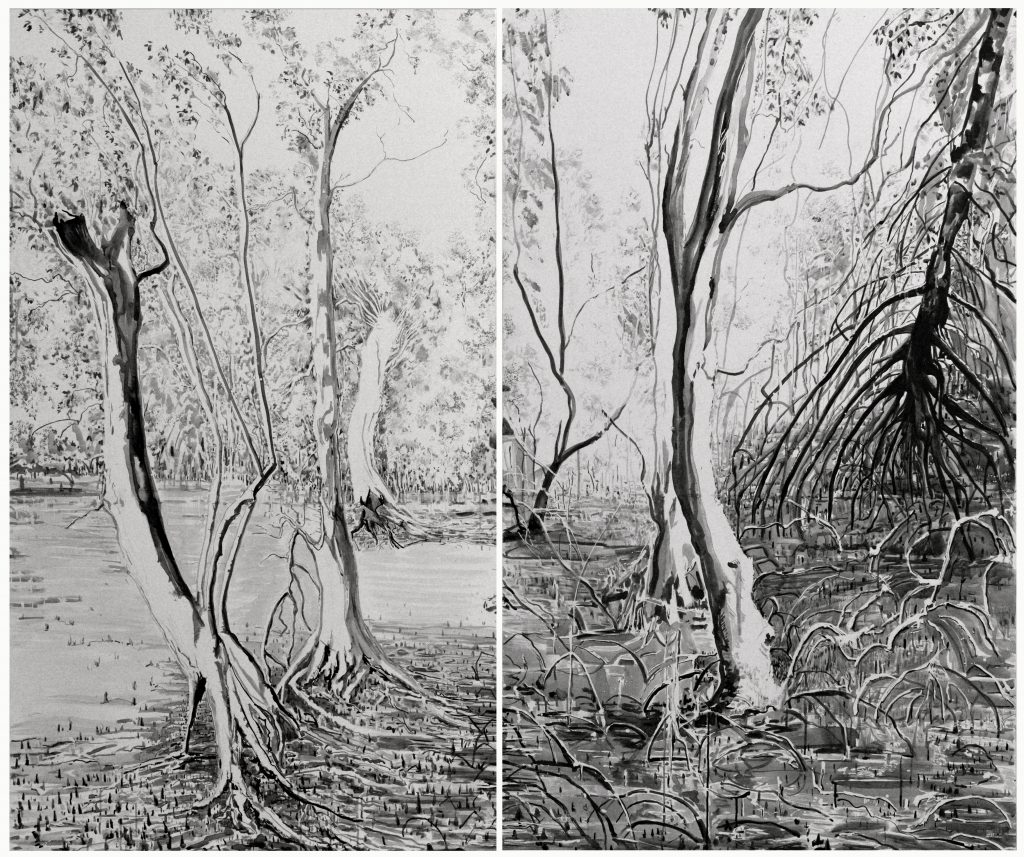
trees, Ink on canvas (Kate Bowen)
Ink on canvas (Kate Bowen)

2.5 million trees have been replanted in the Ma Gyi park with the support of Worldview International Foundation in an area where the mangroves covering 1,800 acres had been destroyed. The good news is the trees regenerate quickly, recolonizing a denuded island in ten to fifteen years.

Myanmar artist Htein Lin’s installation “Mangrave” is a charcoal sculpture of a tree. The production of charcoal is one of the primary causes of mangrove decline.

“Bogale charcoal made from mangroves is famous for its quality. Production of this charcoal in the delta was encouraged in the Ne Win era to fuel kitchens in Yangon. It led to widespread mangrove deforestation,” he told local media.
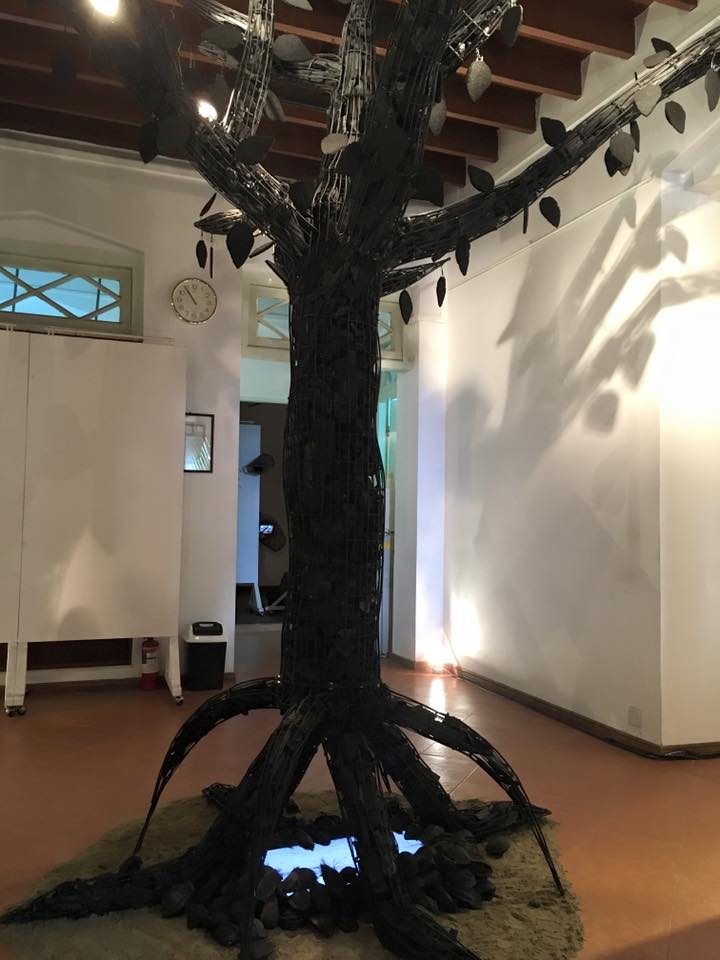
(Photo: Htein Lin)
(Photo courtesy: Htein Lin)

Since Myanmar’s opening up in 2011 new threats have emerged in the form of industrial agricultural and large scale plantations.

Norwegian artist Gunnlaug Bina Kuloy’s macro videos and sound installations capture the teaming life of small creatures hidden in the tidal forests and their role in the bigger ecosystem. Crabs that dig holes in the mud, for example, provide oxygen to mangrove roots keeping the forests alive.

[This video is an extract from Gunnlaug Bina Kuloy’s exhibit]

Experts warn that if current trends continue Myanmar’s mangroves could disappear completely in the next few decades.

Mangroves across South Asia face a similar fate. The Sundarbans that straddle Bangladesh and India are now threatened by logging and shrimp farming, coal factories, shipping, rising sea levels and dwindling fresh water from the Ganga River.

The densely populated deltas around the Bay of Bengal are sinking because of a set of problems including, the loss of mangroves, the reduction of river flow and silt held behind dams upstream. At the same time sea levels are rising – as well as rising in temperature.

“Locals [in the Irrawaddy delta] are really concerned about the rise in sea temperature, which is much warmer than last year,” says Kuloy, which will affect fish and marine life. “People aren’t aware of the basic functions of mangroves – protection from cyclones, coastal erosion and the health of the ocean. I hope to raise their curiosity.”

Mangroves: The Forests of the Tide is showing in Gallery 65 in Yangon until the 5 December.
Cookies Settings

Dialogue Earth uses cookies to provide you with the best user experience possible. Cookie information is stored in your browser. It allows us to recognise you when you return to Dialogue Earth and helps us to understand which sections of the website you find useful.

Required Cookies

Required Cookies should be enabled at all times so that we can save your preferences for cookie settings.

Dialogue Earth - Dialogue Earth is an independent organisation dedicated to promoting a common understanding of the world's urgent environmental challenges. Read our privacy policy.

Cloudflare - Cloudflare is a service used for the purposes of increasing the security and performance of web sites and services. Read Cloudflare's privacy policy and terms of service.

Functional Cookies

Dialogue Earth uses several functional cookies to collect anonymous information such as the number of site visitors and the most popular pages. Keeping these cookies enabled helps us to improve our website.

Google Analytics - The Google Analytics cookies are used to gather anonymous information about how you use our websites. We use this information to improve our sites and report on the reach of our content. Read Google's privacy policy and terms of service.

Advertising Cookies

This website uses the following additional cookies:

Google Inc. - Google operates Google Ads, Display & Video 360, and Google Ad Manager. These services allow advertisers to plan, execute and analyze marketing programs with greater ease and efficiency, while enabling publishers to maximize their returns from online advertising. Note that you may see cookies placed by Google for advertising, including the opt out cookie, under the Google.com or DoubleClick.net domains.

Twitter - Twitter is a real-time information network that connects you to the latest stories, ideas, opinions and news about what you find interesting. Simply find the accounts you find compelling and follow the conversations.

Facebook Inc. - Facebook is an online social networking service. China Dialogue aims to help guide our readers to content that they are interested in, so they can continue to read more of what they enjoy. If you are a social media user, then we are able to do this through a pixel provided by Facebook, which allows Facebook to place cookies on your web browser. For example, when a Facebook user returns to Facebook from our site, Facebook can identify them as part of a group of China Dialogue readers, and deliver them marketing messages from us, i.e. more of our content on biodiversity. Data that can be obtained through this is limited to the URL of the pages that have been visited and the limited information a browser might pass on, such as its IP address. In addition to the cookie controls that we mentioned above, if you are a Facebook user you can opt out by following this link.

Linkedin - LinkedIn is a business- and employment-oriented social networking service that operates via websites and mobile apps.