



For two years Fazalur Rehman and other villagers have been fighting a determined court battle in the Chitral district of northwest Pakistan against the powerful logging industry.
The band of villagers, who live on the fringes of the last remaining cedar forests in Khyber-Pakhtunkhwa province, have been charged under the anti-terrorism act for obstructing deforestation by what they call the ruthless timber “mafia”, working with the government forestry department.
Local villages also allege that law enforcement agencies are bribed to arrest and prosecute anyone disrupting the logging.
Years of illegal logging has destroyed swathes of forests in northwest Pakistan. The country has the highest annual deforestation rate in Asia, leaving it vulnerable to devastating floods.
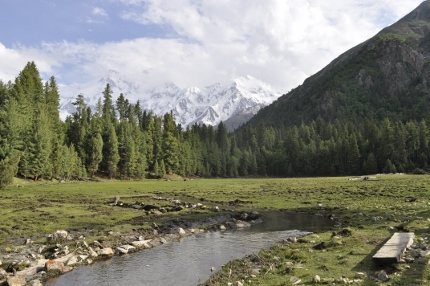
“We are punished for protecting the forests of Pakistan and raising our voice to the fact that they are felling green trees,” said Rehman from the picturesque alpine village of Ayun. “Every time a case is dropped, new ones are filed.”
The commitment to protect their forests has cost them dearly. “For every trip we make to the court, we spend about Rs.200,000 (US$1,117) in transport, meals, and overnight stays,” said Rehman.
Local struggles find a global platform
Inspector general of forests Syed Mahmud Nasir believes the only effective way to control the logging industry and persuade politicians to pay heed to fast depleting biodiversity is to show them there are “dollars” attached to a mitigation strategy. While the forest dwellers in Ayun have been fighting to stop deforestation at the local level, environmentalists are bringing up the issue in the international arena. Indigenous and scientific knowledge both point to the same fact – forests are carbon sinks and more forest cover is essential for the well-being of the human race.
Environmentalist are advocating for REDD and REDD+ – Reducing Emissions from Deforestations and forest Degradation – a global initiative designed to pay countries to protect forests and reduce greenhouse emissions.
REDD+ tools will help address the governance challenges of protecting forests, argued Nasir, by strengthening laws and allowing more meaningful participation of communities dependent on forests, especially women. It is now mandatory for countries wanting to access international funds to conserve their forests to show that they are involving local forest-based communities in their efforts, and ensuring their livelihoods are safe.
Having worked in the forestry department for thirty years, Nasir said he is well aware of the problems of corruption. For the last three years he has been preparing a proposal to implement REDD projects and conserve what little is left of the forests in Pakistan, including the ones Rehman and his comrades are fighting for.
Pakistan is among the 12 countries vying for the US$4 million World Bank-led fund operating REDD projects, with the announcement due in the second week of December.
Community participation essential
However, funds alone is no guarantee for success, said Zaffar Pervez Sabri of the Pakistan Poverty Alleviation Fund (PPAF). “The biggest issue is how empowered are the communities themselves,” he told thethirdpole.net. PPAF works with 112 partner organisations in more than 90,000 settlements spread across 120 districts in Pakistan.
Another challenge Pakistan may face, said Sabri, is in the area of carbon finance. “Our experience in certain hydropower projects show that getting the funds is a complex and a cumbersome task.”
In his view, part of the problem lies in the government’s “slow decision-making”. Those leading the REDD+ project may soon find themselves in the same situation.
Ali Tauqeer Sheikh, Asia director of the Climate and Development Knowledge Network (CDKN), has some other reservations too. “I wonder if there are systems already in place and if the policy or these propositions have gone to the parliament and been vetted and validated by the different relevant standing committees? Has the policy been approved by cabinet or explained to the communities or made without their input?”
At home, one of the biggest challenges for conservationists is to get everyone from the country’s four provinces to be on the same page. After the devolution of powers through the 18th constitutional amendment in 2010, forestry became a provincial subject. But for the REDD+ strategy to succeed, it needs acceptance from all.
“Because if we implement it in one province, chances are the loggers would move to another province and the success will come to naught,” explained Nasir. After endless meetings with all the relevant government officials, over the last months, all stakeholders seem to be on board.
Rapidly thinning forests
Pakistan is among 55 countries defined as having low forest cover (less than 10% of land under cover), but is pushing for more support under REDD+ negotiations.
“It is about time REDD+ included the low forest cover countries as well in its scheme of things,” said Nasir. “Pakistan’s forest cover is less than 5% of the total land area,” he added. Internationally even this figure is disputed, with reports claiming it to be as low as 2.1%.
Climate Change Secretary Raja Hassan Abbas has said the federal government will coordinate with and facilitate the provinces to honour the international treaties Pakistan has ratified; the Food and Agricultural Organisation (FAO) also made the right noises of cooperation.
According to reports, WWF has promised to get experts from its organisation in Nepal to conduct training for forest carbon measurements and monitoring. PPAF will also start pilot projects in at least three sites with immediate effect – including the juniper forests in Ziarat, a declared world heritage site, in Balochistan province.