![<p>Cows wandering the streets of Gorakhpur in UP, where the current Chief Minister was the MP from 1998 to 2017 [image by: Suboor Ahmad]</p>](https://dialogue.earth/content/uploads/2019/04/cows-gorakhpur-1-768x576.jpg)
This is the third in a series of articles on India’s general elections and environmental issues. You can read the first two articles here and here.
The shortest route from Prime Minister Narendra Modi’s parliamentary constituency Varanasi to Uttar Pradesh (UP) capital Lucknow is a road under construction. Trucks raise choking clouds of dust, through which one can dimly see huge herds of cows blocking most carriageways.
“Yes, they have become an absolute menace on the roads,” says Shashi Tyagi, owner of a new restaurant in Jaunpur, a town on the way. “You know how this BJP government has stopped cow slaughter. So what will farmers do after a cow has stopped giving milk? They can’t afford to keep feeding old cows. So they’re just pushing the cows out of home, and all these cows are ending up on roads and in garbage dumps.”
Protection of the cow – considered holy by many Hindus – has been one of the biggest unifiers of supporters of India’s ruling Bharatiya Janata Party (BJP), now in the middle of elections to elect the country’s next government. Since the BJP came to power in 2014, cow protection vigilantes have proliferated. They have attacked people on the suspicion of eating beef and dairy traders transporting cattle have been set upon and sometimes killed on roads because the vigilantes believed they were taking the cows to slaughter. According to the data journalism site IndiaSpend, 56% of those attacked have been Muslims (in 18% of the cases the ethnicity was not verified), who make up approximately 15% of the Indian population. Dalits, an historically repressed caste within the Hindu community, have also been savagely beaten up for allegedly skinning dead cattle.
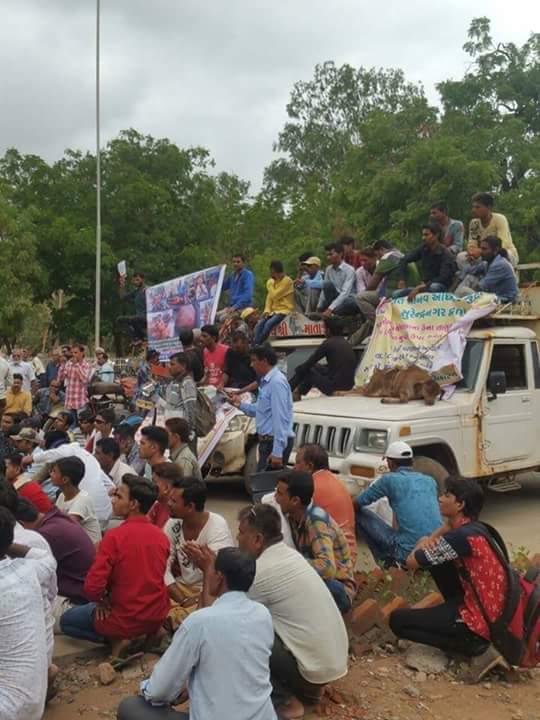
Thousands of homeless cattle now dot the countryside, blocking roads, eating whatever they can out of garbage dumps, getting into farms whenever they find one unguarded. Farmers have been complaining bitterly. In one UP village, they herded all the stray cattle inside the local school and locked the gate. The government’s response has been to open cattle shelters. But they are few and far between; plus, they are underfunded, so the cattle do not get enough to eat, and mortality rate is high. Getting rid of the carcasses is the next big problem.
Fatal obstacle
The road to Lucknow passes through two of the highest profile parliamentary constituencies in India – Amethi, from which the president of the principal opposition Indian National Congress (INC) party Rahul Gandhi is the sitting MP and the candidate, and then Rae Bareli, where his mother and ex-president of the INC Sonia Gandhi is in the same position.
At the border between the two constituencies, Sanjay Chauhan runs a roadside tea stall next to his one-acre farm, from which he has just harvested potatoes and sown lentils. “Just five kilometres down the road, two people were killed the other day. A cow dashed into the middle of the road, their car swerved to avoid it and hit a truck. Once my potatoes were almost ready for harvest, someone from my family had to stand guard all the time lest cows get in and start eating the plants. Now we have to do the same with the lentils. It’s a major headache.”
A number of Chauhan’s friends are lounging around the tea stall. All are sure that Sonia Gandhi will retain her seat, but Rahul “will face a tough challenge from Smriti Irani” of the BJP. Their talk quickly moves to the way BJP campaigners have been talking about building cattle shelters though there are so few of them. “This (BJP) government is a great one for showmanship,” says a young man, “and its timing is great. They started building this road a year ago, so that now construction is in full swing and people think they are doing a lot of work. They have just finished painting all the government schools and primary health centres.” The nearby freshly-painted health centre did not have anyone inside though it was the middle of a working day, and the state of the toilet left much to be desired.
State capital no exception
Stray cows were battling stray dogs at a garbage dump in Lucknow’s Kaiserbagh neighbourhood. Rampal Singh, a guard at a nearby hotel, said he had to keep the gates closed at all times to save the potted plants in the driveway. “Otherwise, these cattle just barge in and start munching. Can’t blame them, really. Look at these cows. You can count every rib. They are so desperate for food that they are munching discarded plastic bags all the time.”
Non-issue for the polls?
Exiting the Lucknow-Agra expressway to go towards Kannauj, Behrin is the first village on the way. Grocer Jagdish Singh is sure the BJP will win the parliamentary polls. “Who else has the guts of Modiji,” he asks. “Unko ghar mein ghuskar mara (entered their house and beat them).” He is referring to the February 26 strike by the Indian Air Force at a suspected terrorist base in Balakot, Pakistan, following the February 14 terrorist attack in Pulwama, Kashmir, which killed over 40 Indian paramilitary personnel.
It is a line heard repeatedly from shopkeepers, lawyers, restaurant owners and people in similar professions. Ask them about the problem of stray cattle or any other local problem, and they agree the problem is serious, but refuse to blame the Prime Minister for it. “Do you expect Modiji to clean every drain in the country,” Shashi Tyagi of Jaunpur had asked. “It is the job of the state government [which is also a BJP government]. We know they are not doing their job. At the next (state assembly) election, we shall punish them for it. Why should we blame Modiji?”
In Behrin, Jagdish Singh agrees that stray cattle is a major menace, “but what can Modiji do? It is the job of the state government. It is Modiji’s job to keep the country safe, and he’s doing that.”
Farmers and labourers have a different reaction. “How does the strike on terrorists in Pakistan matter to me,” asks Jagdish Kushwaha, who runs a bicycle repair shop in Behrin, apart from farming his two-acre plot. “This BJP government has only increased my problems by imposing this ban on cow slaughter. Now there are stray cows everywhere and they get into farms to eat the crops. We have to stand in our field with a stick through the night. I’m 55, I’m falling ill having to do this every night after working the whole day.” What about the cattle shelters the government promised? “There’s none here. This government is all talk. We’re voting for the Samajwadi Party.”
The opinions are as divided as the seats are likely to be.