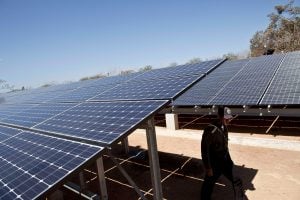
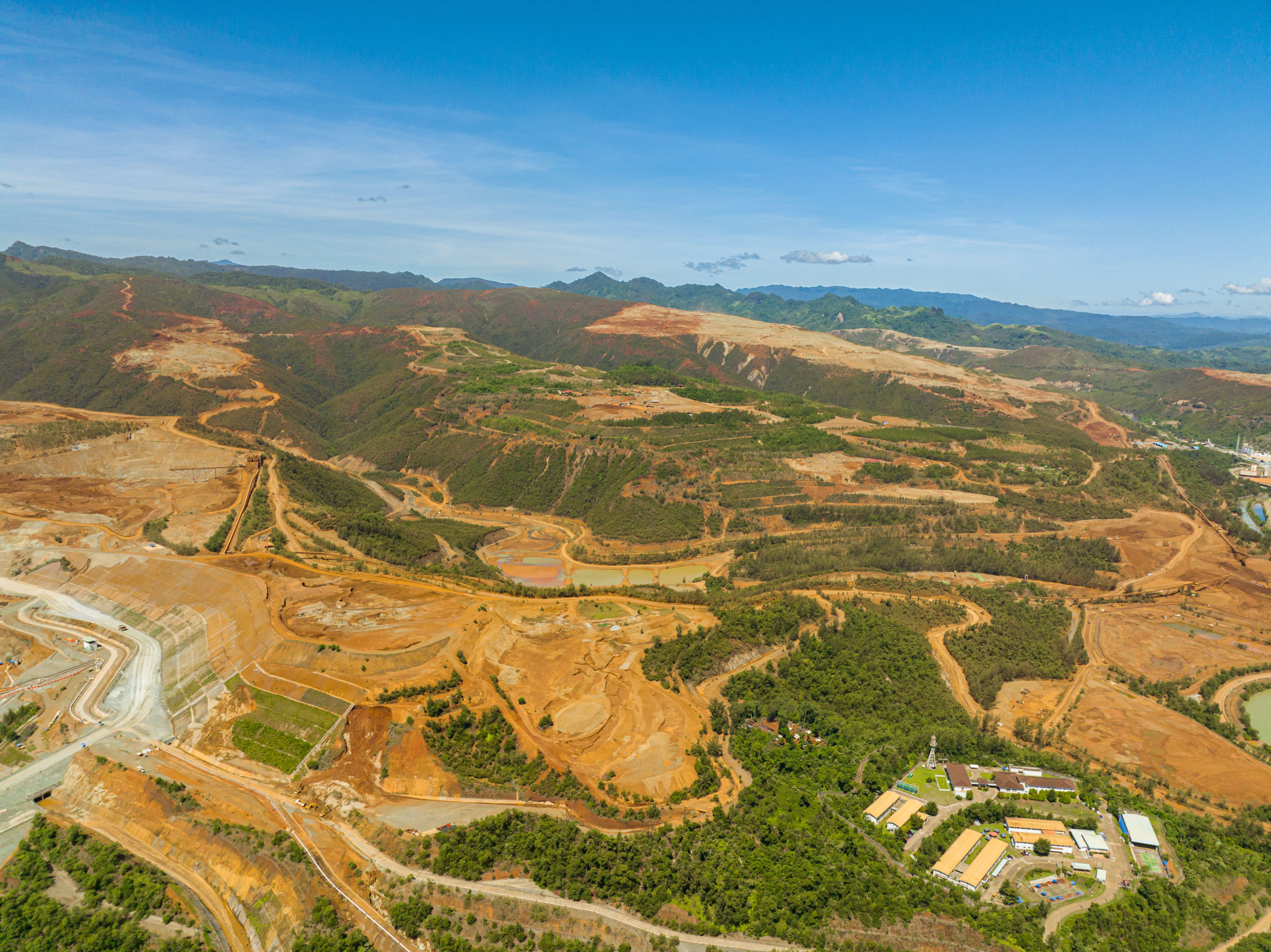
The Philippines has emerged as a major supplier for the global energy transition, thanks to its reserves of minerals like class 1 nickel, which were valued at PHP 238.9 billion (USD 4.16 billion) last year. During 2022, only Indonesia produced more nickel than the Philippines. However, this boom is fomenting violence against Indigenous people in the country, whose ancestral homes are increasingly threatened by the mining.
According to the 2023 “State of Indigenous Peoples Address” report, published by the Legal Rights and Natural Resources Center (LRC), land and environmental conflicts in ancestral domains increased by 6% year-on-year, with more than 70,000 additional hectares affected.
Efenita Taqueban, executive director of the LRC told Dialogue Earth: “When we talk about resource conflict, the conflicts that occur on the ground, these have mortal implications for Indigenous peoples. Their lives are really on the line.”
The communities have trouble understanding ‘just transition’, because they see no difference between what is ‘just’ and what was not ‘just’ before, since the impacts are the sameBeverly Longid, national convener and international solidarity officer for the National Alliance of Indigenous Peoples Organizations (Katribu)
The report finds mining expansion to be the main driver of these conflicts. It says another 223,000 hectares of land were signed off for mining projects between 2022 and 2023, while 45,070 Indigenous people were affected by a human rights abuse – a 62% increase from the 2022 report.
Behind these numbers are stories of killings, arrests and harassment. Indigenous people are being red-tagged (falsely labelled as terrorists or supporters of communist insurgency). Examples of these abuses being directly related to transition minerals include the “people’s barricades” in the country’s western Palawan province. These physical blockades were deployed against a nickel mine in the coastal town of Brooke’s Point during February 2023.
Dialogue Earth spoke to Beverly Longid, national convener and international solidarity officer for the National Alliance of Indigenous Peoples Organizations (Katribu): “One thing we are trying to address is this issue of ‘just’ minerals, ‘just’ energy, because it’s becoming like an excuse to legitimise the many mines and dams or energy projects in the Philippines.
“The communities have trouble understanding ‘just transition’, because they see no difference between what is ‘just’ and what was not ‘just’ before, since the impacts are the same.”
Flawed consent
The ancestral domains of the Philippines’ Indigenous peoples are mostly located in upland areas rich in natural resources, including minerals. As of 2012, an estimated 60% of national mining operations took place in these ancestral domains. While the Indigenous Peoples’ Rights Act (IPRA) has been in place since 1997, some experts say it is flawed.
Under IPRA, Indigenous peoples have ownership rights to their ancestral lands if they secure a Certificate of Ancestral Domain Title. Title holders have the power to approve or reject projects that affect their homes, such as mining operations. However, securing the certificate can be a long and tedious process. For instance, it took the Pala’wan tribe seven years to secure the title for their land in Mount Bulanjao, Palawan.
“We have always been critical of the IPRA because the entire framework of the law itself is not responsive to Indigenous peoples’ rights specifically to land,” says Longid, herself one of the Bontok-Kankanaey, a subgroup of the Indigenous Igorot people from the Philippines’ northern Mountain Province. “Even (the) land ownership, it’s not basically recognition of the native title. It is Indigenous peoples going through the process dictated by the state to get a title.” The Kankanaey have also been in conflicts with mining companies.
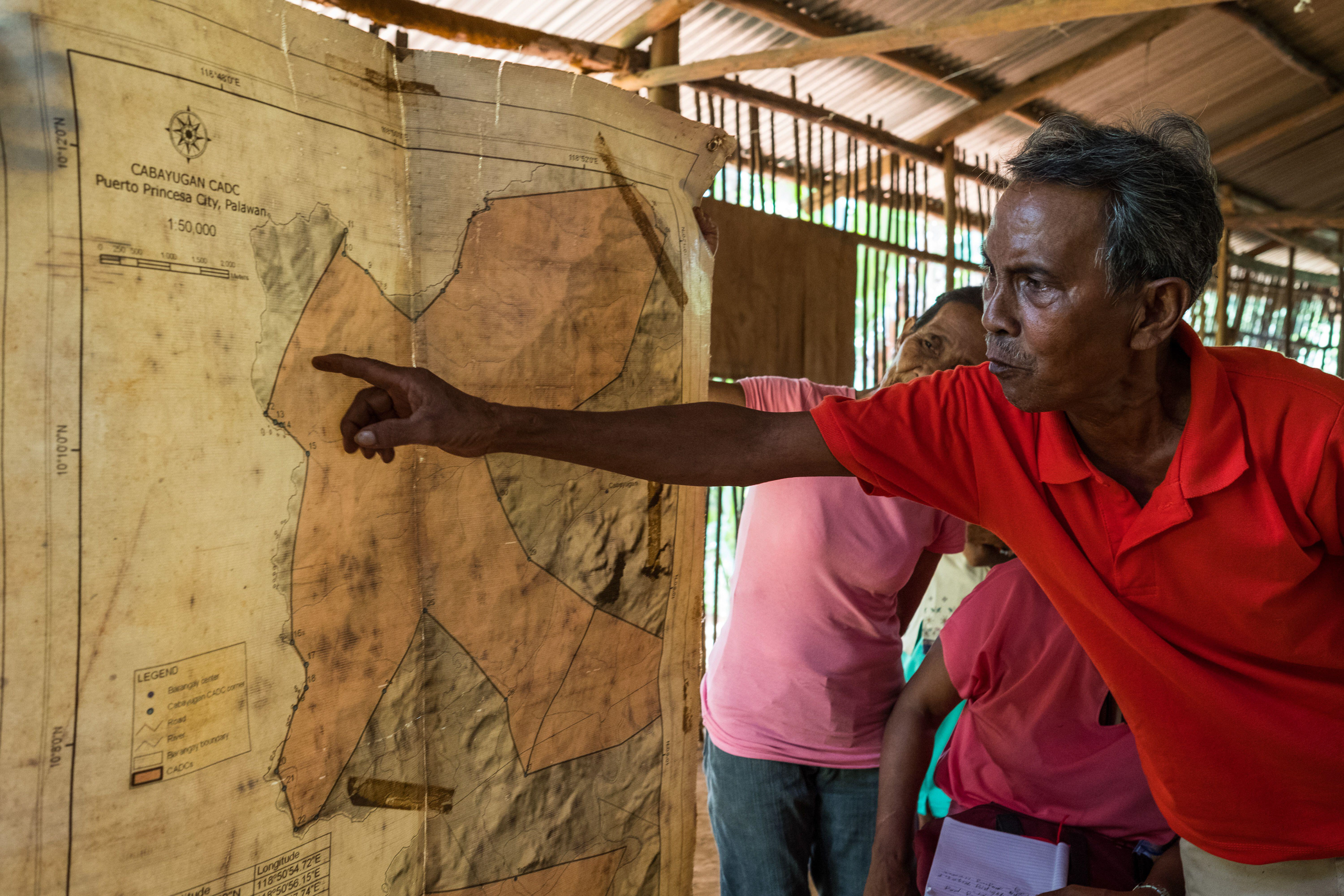
According to the records it showed to Dialogue Earth, the NCIP has so far issued just 264 certificates from 1,000 applications. In total, these titles span more than 15 million hectares, or around half of the country.
The NCIP’s director of ancestral domains, Arthur Hermann, says much time is spent on reconciling each application with conflicting titles issued under laws that predate the IPRA, such as the public land act and the forestry code.
“That’s the bulk of our problem: it’s a case of overlapping with the patents and other instruments issued by other agencies of the government,” says Hermann.
The LRC has also outlined cases of alleged violations of the law’s provision on Free, Prior and Informed Consent (FPIC). Companies must obtain this from Indigenous communities, “in accordance with their respective customary laws and practices, free from any external manipulation, interference and coercion, and obtained after fully disclosing the intent and scope of the activity”.
FPIC is about allowing people to give or withhold consent for projects that may affect them. Its main and original focus is Indigenous peoples, but it is also considered best practice for local communities of all kinds. FPIC is enshrined in the UN Declaration on the Rights of Indigenous Peoples, the Convention on Biological Diversity, and the International Labour Organization Convention 169.
When it comes to Indigenous peoples of the Philippines, the LRC claims FPIC is often reduced to a single meeting that withholds critical economic and environmental information. The LRC report also describes instances of coercion and bribery, such as excluding from FPIC processes those Indigenous people who oppose the project. In extreme cases, community members’ handwriting has been taken from attendance sheets as proof of consent, for example.
“The way it’s understood is that it’s merely [a] consultation,” explains Taqueban. “They just reach out to hold a meeting, the communities attend, that’s it. It’s part of an administrative, bureaucratic process to inform, but that’s only one part of the Free, Prior and Informed Consent process.”
The NCIP has detailed guidelines for obtaining FPIC, which include conducting a substantial series of field-based investigations, and community assemblies and consensus-building. Only then should the NCIP issue a Certificate Precondition, thus allowing a project to proceed.
Hermann says the NCIP is constantly monitoring the meetings and other steps of the FPIC process, but admits to receiving complaints about violations. He says such allegations usually arise from conflicts within Indigenous communities, when members are divided on a project’s distribution of shares. In such cases, Hermann says they defer to the communities themselves, leaving them to follow their customary dispute resolution practices.
“We cannot promise that we can resolve all of these issues,” Hermann adds. “Why? Because it’s the communities that are fighting against themselves – more so if there are already benefits and royalties received by the community.”
Responding to Hermann’s assertions, Longid condemns the NCIP and says tensions within Indigenous communities “are not simply about royalties, but revolve around decision-making processes, control over resources, and the transparency of these systems”.
Longid adds: “The solution lies not in dismissing these issues as mere community infighting, but in addressing systemic problems, such as the lack of transparency, manipulation, and weak government intervention.”
According to Hermann, the NCIP is now working on new FPIC guidelines in response to pressure from Indigenous communities, government agencies and local government units.
A path forward
Despite the many disputes surrounding mining on ancestral lands, Indigenous peoples and policy experts still welcome measures to support the energy transition – as long as they respect the rights of affected communities.
“We are not anti-development,” says Longid. “We are Filipinos. We are part of Philippine society. We are integrated. Indigenous peoples are more than willing to share. And this might be our contribution to national development, but it should also be a contribution that will not result in the destruction of our ways of life.”
The LRC recommends integrating the means to achieve a just energy transition into existing minerals policy blueprints. Among the recommended measures (also backed by environmental groups and civil society organisations) is an alternative minerals management bill. It seeks to regulate the exploration, development and utilisation of mineral resources, while ensuring equitable sharing of benefits.
The bill also proposes a longer list of areas that should be closed to mining, by adding in critical habitats and watersheds, key areas for biodiversity, and more. It also outlines requirements for environmental and social impact assessments, and the need for plans to mitigate those impacts and to rehabilitate used land.
Several versions of this bill have been filed since 2009, most recently in 2022. There have been calls to certify this bill as urgent stretching back across multiple recent presidential administrations, but to no avail.
Meanwhile, the NCIP encourages companies to be more considerate of Indigenous communities’ interests when pursuing development projects.
“Usually what we see is that mining companies treat communities as a passive receiver of money, of royalties, but that should not be the treatment,” says Hermann. “I am more for expounding on the principles of negotiation, where the companies should listen to the host community on their way of life, not just try to give them money.”