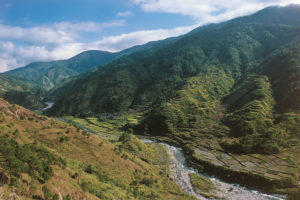
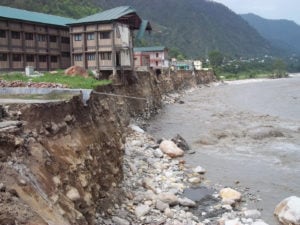
![<p>The Indus at the site of the proposed Diamer Basha dam in Pakistan. The former chief justice’s interest in the controversial project is an example of judicial overreach. [image by: Water and Power Development Authority, Pakistan]</p>](https://dialogue.earth/content/uploads/2020/07/Indus_Diamer_Basha_Dam_Site_Image_WAPDA-768x432.jpg)
Environmentalists were thrilled on the last day of 2020, when a court in Lahore temporarily halted the building of a new city along the Ravi river.
Prime Minister Imran Khan had announced the USD 30 billion Ravi River Urban Development Project (RRUDP), which aimed to meet the housing needs of a growing population and also create new jobs by developing 100,000 acres of land along 40 kilometres of the riverbank.
However, the provincial assembly approved a body to oversee the development work without an environmental impact assessment (EIA).
On New Year’s Eve, the Lahore High Court halted the development body’s work and said no work should begin until the approvals were granted by the Environmental Protection Department.
The court injunction is hardly the first of its kind in Pakistan. In a food-insecure country where pollution levels are high and water shortages are reaching alarming levels, the judiciary is often called upon by activists and citizens to weigh in on environmental degradation. The results, however, are mixed.
Environmental jurisprudence through the ages
The first public interest litigation in the field of environment took place in 1990 against the construction of a government building and its stone crushing activity in the Margalla Hills National Park.
The watershed moment for environmental issues, however, came four years later in 1994. In the landmark judgment Shehla Zia vs. WAPDA, the Supreme Court held that the right to a clean and healthy environment was part of the fundamental right to life guaranteed in the Constitution.
The Constitution of Pakistan includes a catalogue of fundamental rights – but there is no article that frames ‘right to environment’ as a fundamental right.
Parvez Hassan, an environmental lawyer and the pioneer of Pakistan’s environmental protection movement, cherishes the challenges he faced while presenting this case against the construction of a high-voltage grid station next to a residential area in the capital.
No mega project has ever been stopped because environmental laws give the pollutant an option to pay.Ahmad Rafay Alam, environmental lawyer
“The Shehla Zia case changed the jurisprudential landscape of environmental matters in Pakistan as it innovated that environmental rights, though not specifically included in the Constitution, are, as I urged, included in Articles 9 and 14 that deal with the rights to life and dignity,” Hassan told The Third Pole.
“Since 1994, the entire judiciary of this country has moved in the direction of protecting the right of the environment.”
In 2015, a farmer, Asghar Leghari, went to court against the government for its failure to carry out the National Climate Change Policy 2012 and the Framework for Implementation of Climate Change Policy (2014-2030).
The court order appointed a Climate Change Commission to facilitate the implementation of the National Climate Change Policy, saying that delay and lethargy of the state in implementing the framework “offend” fundamental rights of the citizens.
“This judgment was the second in the world, after a Dutch court, that sought to seek implementation of climate change laws and policies; this Pakistani leadership was discussed and taught in environmental law syllabi all over the world,” Hassan said.
Over the years, the superior courts have dealt with a range of issues, including the degradation of water quality by coal mining activities, solid waste management, the pricing mechanism and management of water use in the country, deforestation, climate change, the preservation of Margalla Hills National Park, or relocation of distressed animals from a zoo in the capital.
“Judicial activism has been one of the hallmarks of the environmental movement in Pakistan and has always been supportive of the conservation movement,” Special Adviser to the Prime Minister on Climate Change Malik Amin Aslam said.
“Judicial activism not only helped protect the environment but also developed laws for environmental protection,” he added.
Judicial overreach
There are instances, however, where the court’s interventions are seen as overstepping. Here, the example of Pakistan’s former chief justice Saqib Nisar is relevant, as his orders regarding the construction of the controversial Diamer Basha dam and the setting up of a fund for the purpose became the subject of criticism.
“Policymaking is not the job of the courts,” environmental lawyer Ahmad Rafay Alam told The Third Pole.
“The dam fund was wildly outside the purview of the court and amounted to a tax of sorts – and tax is something only parliament can levy on citizens. The fund also amounted to nothing, as the moneys collected are nowhere near the funds needed for the construction of the Diamer Basha Dam,” Alam added.
The chief justice’s attempt to prosecute cement companies responsible for groundwater depletion near the Katas Raj Temple complex also amounted to nothing. “Although two cement companies were dragged through the mud in a media trial, they have actually not been fined or charged for their destruction of the aquifer,” he said.
“In all, the jurisprudence from the court was not helpful in developing environmental law. In fact, in some instances while deciding environmental cases, remarks and comments by the court have had far-reaching implications on the enforcement of environment law. These implications include the violation of the right to a free trial,” Alam said.
Still, he appreciated the judiciary’s role, saying it expanded the right to life by including the right to a clean environment. He added that the judiciary needs to enhance capacity to deal with complex issues related to the environment and climate change.
New judicial solutions
As climate change litigation grows and more people become interested in the environment, judges are modifying their approach in deciding these issues.
The formation of judicial commissions comprising experts is one such manifestation.
“This has been the most durable contribution by the Pakistan judiciary to accommodate science-based and technology-led solutions to environmental matters,” said Hassan, who has himself chaired over a dozen judicial commissions on key issues.
“Environmental and climate public interest litigation has steadily gained more importance before our courts and provoked judicial activism that has changed the environmental and climate landscape,” environmental lawyer Sara Hayat told The Third Pole.
She said it was the role of the executive to enforce compliance with environmental laws. However, there has been a sustained focus on the role of the higher judiciary whereby they have at least directed the government to undertake certain measures or enforce policy and relevant laws.
Aisha Khan, the chief executive of the Civil Society Coalition for Climate Change, said judicial activism provides remedial action and also highlights the problem in the eyes of the people, giving them a sense that there is a forum they can approach.
“The judiciary should be more proactive and there should be more green benches,” she said.
In 2012, the superior courts started setting up green benches but the practice has been discontinued.
Suo-motu powers
Another mechanism the Pakistani judiciary applies while dealing with environmental issues is the use of suo-motu powers. Article 184(3) of the Constitution empowers the superior judiciary to directly take up matters involving the enforcement of fundamental rights if it considers that such enforcement involves a question of public importance.
Hayat said that those suo-motu powers should be exercised with restraint. However, where the Supreme Court exercised the powers, the results have saved the natural ecosystems of the areas.
She said the court restrained construction activity near the Margalla Hills in 2005 and saved around 5,000 acres of forest by taking suo-motu action in the New Murree project in 2010, after which the project was disbanded.
However, Alam pointed out that no appellate forum was available in case there were grievances against decisions taken by the court using suo-motu jurisdiction.
With the Ravi development project, Alam is sceptical. “No mega project has ever been stopped because environmental laws give the pollutant an option to pay,” he said.
“The government respects the court’s decision and we hope that an EIA is done with proper public consultation,” he said.
Citing the case of Maria Khan vs. Federation – where five women in Lahore are fighting against the government’s failure to prioritise clean energy projects and to abate greenhouse gas emissions – Hayat said, “Climate litigation from Pakistan is generating very nuanced and interesting decisions which are prompting the government into action.”
The case is going on, but is an indication of the awakening within members of the public when it comes to environmental accountability.