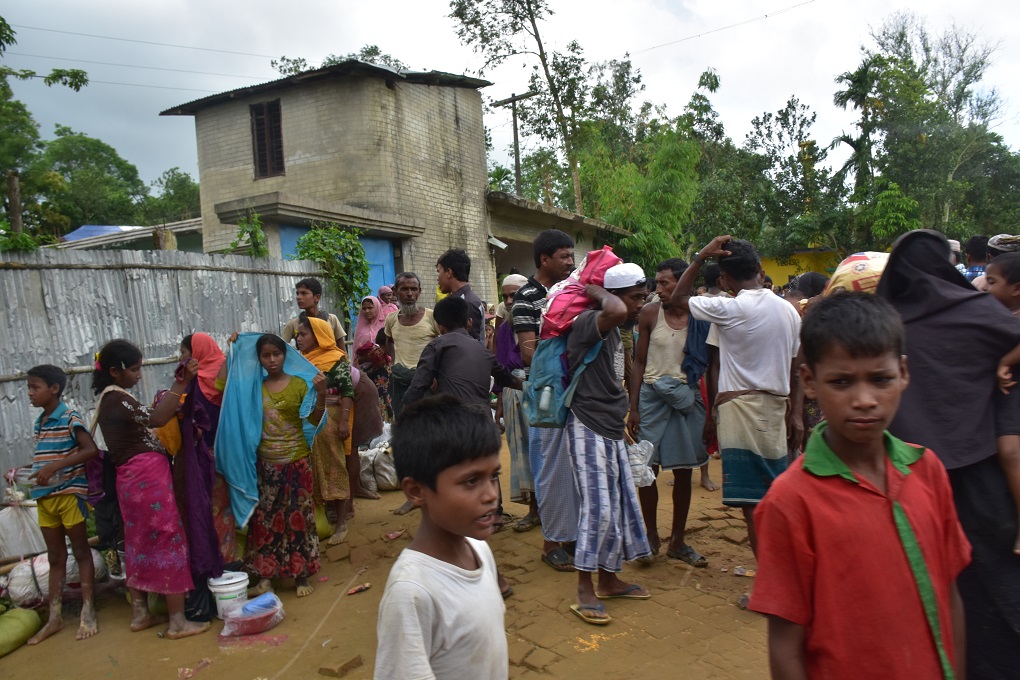
![<p>The little girl was so traumatised that she thought the camera was a weapon pointed at her [image by: Zobaidur Rahman]</p>](https://dialogue.earth/content/uploads/2017/10/The-little-girl-in-mothers-lap-was-so-traumatised-that-she-got-frightened-seeing-a-camera-as-she-thought-it-would-be-a-military-weapon-Photo-Zobaidur-Rahman-768x512.jpg)
The recent violence waged against the Rohingya people in Myanmar has been described as a “textbook case of ethnic cleansing” by the United Nations. More than 500,000 people have fled the country, but the exodus has not only been caused by ethnic tensions, identity politics and “unspeakable violence” — rampant land grabbing amid new development projects, experts argue, has also played its part. Meanwhile, pouring monsoon rains in crowded camps in Bangladesh and extreme weather events back in Myanmar pose further risks to the Rohingya.
The case highlights the multi-causal nature of forced migration, involving all three main push factors: conflict, development and disasters. The complex nature of this migration is a focus for scientists, especially in the context of climate change and variability, where poor people in marginal lands are edged out by acts of nature, neighbours and the state — though not necessarily in that order. For the Rohingya, nature plays only a side role.
Conflict
The conflict — the widely and often-exclusively reported element of the Rohingya refugee story — is intertwined with their ethnic identity and contested history. Contrary to the popular tag they often carry in Myanmar — “illegal immigrants” — the mostly Muslim minority group of Rakhine state, numbering around 1.1 million, have a centuries-old claim to their land.
The Rohingya were part of an independent kingdom in Arakan — the former name for Rakhine state — with Arab traders and sailors settling along the shores during the 12th and 13th centuries. Migrants from the neighbouring Muslim regions of Bengal joined in. Some narratives date their origin centuries before that. The word Rohingya, a Sanskrit version of Rakhine, has been used since the 1700s, though it became a single ethnic and political identity much later and much to the ire of the Rohingya, as some historians note.
More Indian Muslims came to the Rakhine region during the colonial periods of the 19th and 20th centuries, when labour migration was easy and encouraged. After Burmese independence in 1948, tensions between the Rohingya, the government and the local Buddhists — called the Rakhine — triggered a triangular conflict.
Amid simmering tensions and spurts of violence — most notably in 2012 — the Rohingya have been discriminated against for decades in Myanmar. There has been targeted violence and retaliation by Rohingya militant groups. The current crisis follows a Rohingya militant attack that killed 12 Myanmar security personnel, and army retaliation in which villages were burned and civilians were attacked.
Development
While the Rohingya have experienced discrimination for decades, this violent persecution coincides with Myanmar’s re-entry into world politics, after a process of political reforms and development activities since 2010. There has been rush of foreign investment, and quick economic growth is widely seen as an escape route from poverty for the poorest country in southeast Asia. For now, the World Bank’s outlook for Myanmar is upbeat, “As the largest country in mainland southeast Asia, Myanmar has one of the lowest population densities in the region, with fertile lands, significant potential to increase its production, yields and profits in agriculture, and a rich endowment of natural resources…”
But critics see a dark side to this commitment to fast-paced development. “In my reading of the facts, this somewhat sudden open anger at the Rohingya is at least in part connected to the massive land grabs for mining and agriculture,” says Saskia Sassen, the Robert S. Lynd Professor of Sociology at Columbia University, and an expert on migration and inequality. “The country’s opening (up) and its enabling of foreign investors coincides with a somewhat sudden vicious persecution of the Rohingya.” Sassen argues that Buddhist monks have led this assault rewrote some parts of the doctrine to justify the expulsion of the Rohingya from their land, and killings point to larger vested economic interests beyond the monks.

NGO reports suggest that the military regime in Burma was complicit in cases of rampant land grabbing, and that the opening of the economy welcomed foreign firms, giving army officers and their associates undue advantages. There have also been reports of land grabs in other minority areas. In areas of the ethnic Karen group, for instance, militias, police and government officials have been implicated in such cases.
The argument in these reports is that poor people are dispossessed and driven off their land, or are in desperate search for a decent livelihood. Rakhine state is the second poorest in the country with 43.5% of people living below the poverty line. The Rohingya often made up a large share of new migrants taking flimsy fishing boats across the Bay of Bengal and the Andaman Sea to Thailand, Malaysia and Indonesia, showing the level of desperation in this state.
A quick look at recent trends suggests an increase in migration triggered by violence, landlessness and poverty. In 2007, Rakhine had a comparatively lower rate of out-migration (31 per 1,000). The spike came after cyclone Giri, which displaced over 71,000 people in 2012, and the violence of 2012. By 2016, the Rakhine State Emergency Coordination Committee (ECC) estimated that 10,000 people were leaving the state each month, mostly in search of work in other parts of Burma.
Disaster risk
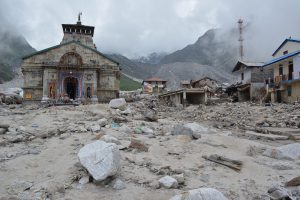
Certain geographical features of the Rakhine region make the situation for the Rohingya even more precarious. The west coast region of the state has been identified as “highly vulnerable” to climate change. Cyclone Mala in 2006 and Giri in 2010, as well as landslides and floods, have hit the place badly. The state is also prone to coastal inundation and climate models show that the intensity and rainfall of storms will increase significantly.

Bangladeshi authorities are looking at alternatives but finding space in one of the world’s most densely-populated countries is not easy. Earlier this year, Bangladesh revived a plan to relocate the Rohingya refugees to Thengar Char, a remote, flood-prone island in the Bay of Bengal, 37 miles from the coast. UN officials have praised Bangladesh for welcoming the Rohingya, but warned against sending them to risk-prone places.
And so the Rohingya, often called the most friendless people in the world, remains a reflection of our world’s forced migration amid conflict, business interests and bad weather.