



Hundreds of pilgrims and tourists are stranded in Khasa – a town on the China-Nepal border – after a huge landslide in Nepal’s Sindhupalchowk district last week blocked a major part of the Araniko highway that connects Nepal with Tibet.
According to the travel agents there are more than 1,000 pilgrims stranded. The mostly Indian and European tourists were returning to Kathmandu from trekking in Tibet.
The Araniko highway is blocked, forcing people to take refuge in Tatopani on the Tibet-Nepal border. Local airline operators say over 700 pilgrims have already been picked up and brought back to Kathmandu by helicopter.
Helicopter companies have moved their base to Dhulikhel –a city close to Kathmandu – as demands for their services have risen. Airline Operators Association of Nepals pokesman Ghanashyam Acharya said more than 1,400 pilgrims are still stranded in Tatopani.
However, officials at the Home Ministry of Nepal said about 100 stranded Indian pilgrims have already been airlifted. “As per my information about 100 Indian pilgrims stranded have already been carried to Kathmandu by choppers and airlines are bringing the few remaining,” said Jhankanath Dhakal, Chief of the National Emergency Operation Centre at Nepal’s Home Ministry.
According to travel agents, the prices of hotel accommodation and helicopter rides have skyrocketed in the region. “As choppers are limited in number, we are forced to fly our clients at their rate and hotels have increased their rate putting travel agents and tourists into trouble,” said Rajan Shrestha, Director of Kailash Journeys.
Foreign tourists hoping to make the trip to Kailash are likely to be disappointed. Chinese authorities have stopped issuing permits to foreigners until the road blocked by the landslide is reopened, according to a local travel agency. The agents have had to inform travellers who have come to Kathmandu from around the world that their trip has been cancelled.
Kim Veltman – a retired professor and writer – arrived in Kathmandu from the Netherlands to trek to Mount Kailash in Tibet, a sacred pilgrimage for millions of Hindus, Buddhist and other religions. He was shocked to receive information from his travel agent that Chinese authorities have denied permits for foreigners because of the landslide in Sindhupalchowk.
Veltman was scheduled to start his long-dreamt-of tour next week. But an email sent to him by his travel agency Kailash Journeys Pvt. Ltd on Thursday read, “This is to inform you that due to the landslide in Sindhupalchowk district in Nepal, the Chinese government is not issuing permits to foreign nationals until the road blocked by the landslide is opened.”
Nepal’s Ministry of Foreign Affairs was unaware of the permit restrictions when asked. “We have no such information regarding the issue and have received no official announcement,” said Ambika Devi Luintel, focal person at the China desk of the ministry.
Mount Kailash lies in the remote south-western portion of China’s Tibet Autonomous Region (TAR), close to north-western Nepal and India. Thousands of pilgrims travel there every year between May and September, over 80% of them Indians.
Travel agents say Chinese authorities in Tibet rarely issue any official announcements about visa restrictions and often deny permits without disclosing any reasons. This creates massive problems for tour operators in Nepal. “They don’t issue any formal announcement but we have been informed by China-India Pilgrims Service Centre (CIPSC) — an agency that connects Nepali travel agencies to Tibet, that the Tibetan authorities have said that no permit would be provided to foreigners until road blocked by landslide is opened up,” said Shrestha. “We have been informed only Nepali and Indian nationals will be provided with permits but we have got indication that Indians will also be restricted from tomorrow.”
He has already informed his clients who are about to fly from around the world, but those already in Kathmandu were at his office the whole day demanding the trip. “It’s really hard to work in Tibet as things are not that transparent, I can’t show official announcements as they don’t issue and clients don’t believe, I returned all their money today (12 clients) and convinced them that it’s not my fault,” Shrestha added. Travellers to Tibet need a special permit, and then the Chinese visa.
Slim chances of road opening soon
According to officials at the Home Ministry, efforts to drain out water from the lake formed by the landslide have been unsuccessful despite the use of multiple controlled explosions. “We are not in position to say when the road could be opened as water in the lake is at same level, but we are working towards opening it as soon as possible,” said Jhankanath Dhakal at the ministry.
The road – a major trade route – is the only one to Tibet from north-eastern Nepal.
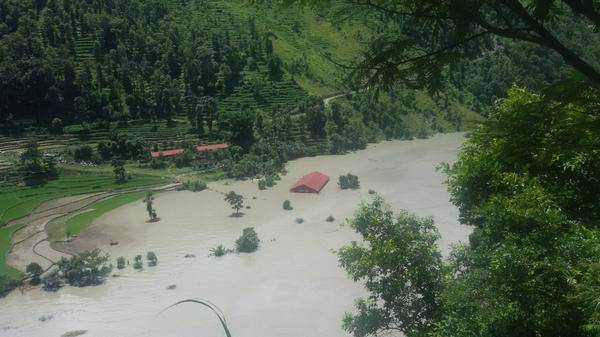
The landslide has blocked the Sunkoshi River, forming an artificial lake containing seven million cubic metres of water, according to officials. This has raised fears of flash floods downstream in Nepal and neighbouring India. The Indian government has evacuated 400,000 people from Bihar.
Residents of Sindhupalchowk district have been holding demonstrations to demand relief and compensation. They accuse the government of being slow to respond to the disaster. “We have not even received food to eat, let alone money for the property we lost in the landslide,” said one of the victims in an interview with a television station.
Home ministry officials denied the accusation. “We have built local tent facilities for victims, food has been regularly provided and relief packages distributed,” said Dhakal.