


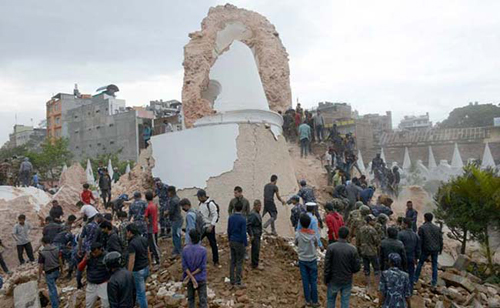

A 7.9-magnitude earthquake in western Nepal, followed by a 6.6-magnitude aftershock, killed over 2,500 people in the country, according to initial reports. There were deaths in neighbouring countries – India, China and Bangladesh – as well. The quake, which occurred just before noon local time on April 25, devastated Kathmandu and Pokhara, caused avalanches in the Mount Everest base camp, nearly wiped out the base camp for Mount Makalu climbers, and injured 40 schoolchildren in far-off West Bengal.
The tremors were felt all over northern India, Bhutan, Tibet, Bangladesh and Pakistan and forced people out of their homes in and around New Delhi, Lucknow, Patna and Kolkata, as the initial quake went on for almost two minutes. Mud houses collapsed in large parts of Nepal and adjoining areas in Bihar.
Within an hour of the quake, Kathmandu’s deputy inspector general of police Kamal Singh Bam told a news agency that the number of dead was 449 till then, and then the toll kept climbing, according to websites of local television channels. Many more were trapped beneath collapsed buildings, including the 19th century Dharara tower, a landmark in the Nepal capital. Kathmandu’s iconic Darbar Square – a UNESCO World Heritage site – suffered extensive damage.
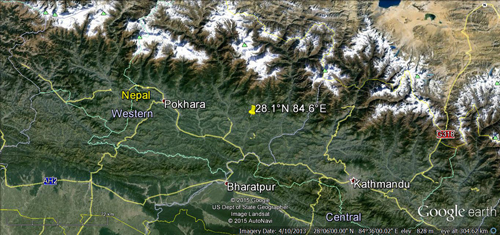
The shallow earthquake – it took place around 10 km below the surface – was centred at 28.1 degrees North latitude and 84.6 degrees east longitude, near the small town of Lamjung, north-west of Kathmandu and on the way to the tourist attraction Pokhara. It was the strongest earthquake to hit Nepal since 1934.
Nepal’s government closed Kathmandu airport as the capital was left with roads split open. There were long queues at hospitals as people were brought in from under the rubble of collapsed homes.
Mobile telephones went on the blink through most of the country, so there was little information from other regions in the initial hours. Nepal’s air force started flying helicopter sorties to assess the damage. Officials said there were casualties in Pokhara and “10-12 in Gorkha district”, but they did not have any details, about two hours after the quake.
Social media channels showed photographs of stunned Kathmandu residents cradling babies while sitting in the middle of the road, their collapsed homes behind them.
Nepal’s Information Minister Minendra Rijal told local television channels, “We need support from the various international agencies which are more knowledgeable and equipped to handle the kind of emergency we face now.” Pakistan’s Prime Minister Nawaz Sharif has promised help to Nepal.
Deaths in other countries
Initial reports from Bihar, the Indian state which shares a long border with Nepal, put the death toll there at 30. The secretary of the state government’s disaster management department said these included four deaths each in Motihari and Sitamarhi districts, three in Darbhanga district and one in Chhapra.
India’s Prime Minister Narendra Modi quickly called a meeting of ministers and bureaucrats in New Delhi to assess the situation. Union minister Rajiv Pratap Rudy has been asked to coordinate rescue and relief operations in India.
Rudy told reporters that electricity pylons had collapsed in some parts of Bihar, so power supply to northern Bihar had been switched off as a precaution. He also said that the Prime Minister had put disaster management teams on standby.
In Malda district of West Bengal, a staircase in a school building collapsed due to the quake. Forty boys and girls were injured and had to be taken to hospital.
Reports from China said seven people had been killed in Tibet, while authorities in the Bangladesh capital Dhaka told reporters that two people had been killed in the north of the country after being trapped under collapsed huts.
Avalanches and landslides
The earthquake triggered an avalanche on Mount Everest, climbers said. One climber, Alex Gavan from Romania, tweeted, “Everest base camp huge earthquake then huge avalanche from Pumori. Running for life from my tent. Unhurt. Many many people up the mountain.”
Another climber, Daniel Mazur, said the base camp had been “severely damaged” and his team was trapped. “Please pray for everyone,” he tweeted.
April and May are peak mountaineering months in Nepal, before monsoon clouds cloak the mountains.
The quake also led to a series of landslides in Nepal and the adjoining India state of Sikkim, and officials were afraid these would close down roads and make rescue and relief operations more difficult. There were apprehensions of landslides blocking streams and rivers, but officials in Kathmandu said they had received no such information in the first six hours after the earthquake.