Citizens and government officials resorted to drastic measures this year to prepare for the annual dry season in Vietnam’s Mekong Delta.
As debate rages over the causes of and solutions to the drought, the government is building large reservoirs to deal with the increasingly dry delta. Work is expected to begin on a 57-hectare artificial lake in Ben Tre province. Lac Dia will be the largest freshwater reservoir in the region once completed, and is expected to store 1.3 million cubic metres of water. On a smaller scale, farmers have turned to cement and plastic containers to store rainwater for their families and livestock for the 2020-21 dry season.
Dry season droughts have become increasingly severe in Vietnam in recent years. Freshwater may become especially scarce this year, as the annual monsoon is expected to be shorter than normal due to the influence of La Niña. This adds to the pressures of climate change, decades of mainstream dam development on the Mekong from China to Cambodia, and bad agricultural practices.
Changing the delta
“Climate change is causing more frequent extreme events, such as the droughts of 2016 and 2020,” says Nguyen Huu Thien, an independent expert on the Mekong Delta based in the city of Can Tho. “On top of that, you have upstream hydropower. Normally, this would not impact water quantity because dams do not consume water. However, when you have a drought year and very little water is flowing down, reservoirs on tributaries and the mainstream Mekong must fill in order to power dams.”
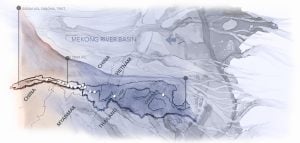
While there are no mainstream Mekong dams in Vietnam, China has 11 operational dams on its section of the Mekong, known as the Lancang. A further 11 mainstream dams are in various stages of planning and completion through Laos and Cambodia, many of which involve Chinese investment and construction.

The 12 Vietnamese provinces that comprise the Mekong Delta are not uniform, Thien notes. Upstream provinces such as Dong Thap have more access to freshwater, while those closer to the East Sea – like Ben Tre – struggle to stop saltwater from flowing upstream. The Ca Mau peninsula, in southernmost Vietnam, is not connected to the Mekong’s watershed, so is much more saline than the rest of the delta.
“In 2009, a strategic environment assessment that I worked on found that each dam on the mainstream has a retention time of about three days for the smallest, to 18 days for the biggest,” Thien said. “So it takes a long time for water to pass through a series of dams, and there’s nothing you can do about that in the Mekong Delta.”
As the damming and development of the Mekong has taken on international stakes, downstream countries have demanded more information from China. This led to an October 2020 agreement in which China agreed to share year-round hydrological data with the Mekong River Commission (MRC).
An entirely advisory body of transboundary governance for water resources. It was set up in 1995 between Cambodia, Laos, Thailand and Vietnam. It provides research, surveys and coordination of development on the management of water-related resources in the Lower Mekong Basin. China is an MRC Dialogue Partner, not a member of the body.
However, the Mekong Dam Monitor, an initiative from the Stimson Center, Eyes on Earth and the Chino Cienega Foundation, has detected several recent hydropower releases with no prior warning from the Chinese government.
Rice-first policy
In 1989, Vietnam began exporting rice, a major development for a country that had been struggling to feed its population. In the decades since, government policy has driven farmers to pursue three annual rice crops, instead of two.
This has turned the country into a global rice powerhouse, while also causing severe ecological damage. Dykes and other structures have been built to control the flow of water, while farmers have stripped their soil of nutrients in the pursuit of a third crop.
“We were driven by the rice-first policy for a long time, and we automatically took saline and brackish water as enemies to fight, so we built structures to try and maintain freshwater areas,” Thien explains, placing substantial blame for the delta’s dry season struggles on Vietnam’s agricultural policies over the last 30 years. “This expanded the freshwater ‘kingdom’ into the territory of the saline water kingdom. But in the dry season, you don’t have enough force to maintain your rule, so you make yourself vulnerable in the context of climate change.”
In 2020, this battle resulted in provinces closing sluice gates and other structures when saltwater quickly moved upstream, cutting off the natural give-and-take between river and sea, while little water arrived from further upstream.
The construction of dykes delta-wide has wiped out the Mekong’s natural floods while sending whatever sediment – which rebuilds soil health – that makes it through upstream dams into the sea.
“So the freshwater that was in the delta evaporated, and you created a situation of total drought while blaming it on climate change,” Thien said. “That’s not correct. There was subsidence in roughly 1,200 spots around the delta, causing huge damage to roads and houses because there wasn’t rainwater, and you closed the gates to keep out more water.”
Dams and the dry season
“China is right that they buffer the dry season, when they do it right… Many people think dams and climate change are the reasons for less fresh water supply, but it’s difficult to say what is causing what at what stage… It’s easy to jump to blame those two,” says Marc Goichot, freshwater lead for WWF Asia-Pacific.
In theory, China’s dams can actually provide a buffer against downstream droughts as they discharge water for power production. According to MRC data, without dam releases during the 2016 drought, the river’s flow would have been 44% lower at Chiang Saen and 38% lower at Nong Khai, two key measuring stations in Thailand.
“Three hundred years ago, the natural state of the delta was for most of it to be flooded during the wet season,” Goichot said. “Now, only 2% floods, and that’s cutting off nature.”
He agrees that blame for dry season damage is often misplaced. “Dams don’t change the wet season flow; they may delay it, but they can have a positive impact on the dry season flow,” he says. Goichot notes that strategically reopening dykes isn’t a new idea, pointing out that centuries ago the Khmer would open natural levees to replenish the soil.
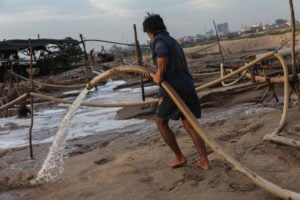
Along with sand mining, the holding back of sediment by China’s upstream dams in Yunnan province and those throughout Southeast Asia is responsible for degradation of the delta banks, washing away homes and roads in the dry season.
Resolution 120
The entire delta is sinking at a rate faster than sea levels are rising, meaning that further saltwater intrusion is inevitable. The Vietnamese government has recognised these problems. Resolution 120, a policy released in 2017, is both a response to current problems and a potential roadmap for natural solutions.
This resolution addresses poor domestic policy in the delta head-on, noting that “the negative impacts of high-intensity economic growth of the region [have] become more acute” and calls for “a new vision, strategic orientation, comprehensive, radical and synchronous solutions”.
Resolution 120 implementation has been mixed, with individual provinces still pursuing their own projects without considering broader impacts, and local governments continuing to request funding to build embankments that can compound erosion.
Beyond the domestic lens, Resolution 120 counts international cooperation as key to creating a healthy future delta, though the policy neglects to mention China. Vietnam is a member of the MRC but the advisory panel cannot stop dam development in Laos, Cambodia and China.
Meanwhile, many have already given up on the region: the Mekong delta lost over one million residents in the last decade, mostly to Ho Chi Minh City and neighbouring industrial provinces.