The people of Bone Baru village in Indonesia have historically been farmers, but global demand for a small “ornamental” fish pushed them to go to sea.
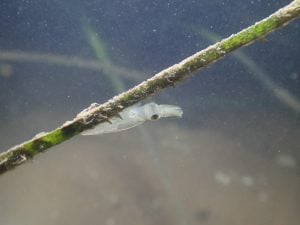
In the 1990s, the Banggai cardinalfish became a must-have for aquariums in Indonesia and around the world, coveted for its pretty white spots over stripes of white, black and silver.
Demand grew for the fish, originally found only in some of the waters around the Banggai Islands of Central Sulawesi province where it is known as Capungan Banggai.
Saleh B. Lalu, who lives in Bone Baru, tells China Dialogue Ocean that local people took notice of the price traders were willing to pay.
“Compared to fish for consumption, the price for Banggai cardinalfish is high,” he says.
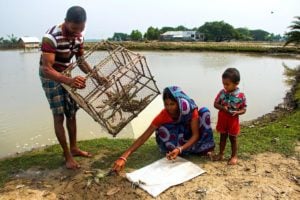
People used to working primarily as clove and coconut planters began catching cardinalfish to boost their income. Requests for the fish began to arrive daily and residents would catch extra to allow for deaths in transit and animals rejected by buyers. Increasing demand drove increasingly extreme methods: Saleh says villagers started to use bombs, and not just swimming masks and nets, to stun and catch the fish.
Things got so bad that the fish was listed as endangered in 2007, with the IUCN (International Union for Conservation of Nature) saying it believed 900,000 were being caught every year for the aquarium trade. Protection measures were brought in and wild catching plummeted. But fishing for aquariums has not disappeared in the region, and the fish is still listed as endangered by the IUCN.
Moving cardinalfish to new waters
Samliok Ndobe, a senior lecturer at the Animal Husbandry and Fisheries Faculty of Tadulako University in Central Sulawesi, has been studying the aquarium trade around the Banggai Islands.
He says there has been no fishing for Banggai cardinalfish in their natural habitat in recent years.

But in a paper published earlier this year, he estimates that catching for the aquarium trade still generated nearly a fifth of the annual income of fishers in the Banggai archipelago. Targeted species include blue tang and yellow goby, which are exported around the world, bringing vital income to local people.
Samliok says that fishing for the Banggai cardinalfish still occurs in Indonesia but has shifted from its natural habitat to areas where it has been introduced by humans. This includes Manado of North Sulawesi, Kendari of Southeast Sulawesi, Palu of Central Sulawesi, Banyuwangi of East Java, and Bali. Here, fish that failed export screening have been released to form what the government calls “export delivery sites”.
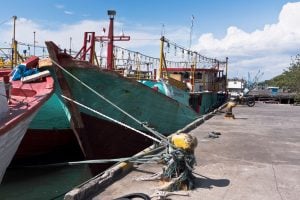
“The location is around the harbours, where they shipped fish for export,” says Samliok.
He is concerned that the Banggai cardinalfish there may breed with other species, diluting their genetic uniqueness. “There will be [species] mixed and that is our concern.”
Continuing to catch the cardinalfish
While the new populations bring problems, they also provide new opportunities.
Catching of the Banggai cardinalfish has shifted to these new populations, which are harvested based on recommendations of the National Research and Innovation Agency (BRIN).
Sarminto Hadi is coordinator of area and fish species management at Indonesia’s fisheries ministry. Sarminto told China Dialogue Ocean that BRIN usually publishes the recommendations at the end of each year, before distributing them to permit holders the following year. “The quota will be done based on the population survey data and quota permit proposals from business.”
In 2024, Sarminto says BRIN decided a total of 38,000 Banggai cardinalfish could be caught: 13,000 from Bali, 2,000 from East Java, 10,000 from Central Sulawesi, 10,000 from Southeast Sulawesi, and 3,000 from North Sulawesi.
Erwin Dwiyana, director of marketing at the fisheries ministry, says Banggai cardinalfish is a protected species under ministerial decree, meaning catches are limited to certain areas and certain times. Where they occur naturally around the Banggai Islands, they can only be fished outside of their peak spawning period of February-March and October-November.
Concerns about the trade have not disappeared and some conservation groups want it to be banned.
Regulation lacking, data too
According to Indonesia’s statistics agency, what are known as “ornamental fish” – those sold to be displayed in aquariums rather than eaten – continue to be a growth area. Exports grew from US$36.43 million in 2022 to US$39.06m in 2023, with 30% of the total going to China, 12% to the EU and 12% to the United States, according to figures supplied by Erwin.
Despite the importance of the trade to local people and the potential environmental damage that comes with it, there are big questions over how well this activity is managed in Indonesia.
Gayatri Reksodihardjo, managing director of the LINI Foundation, which focuses on sustainable fisheries in Indonesia, says demand for marine ornamental fish is “still high”. There is no overarching management for catching them, although a governance framework is currently under development, she adds.
“Because of no management, it is difficult [to obtain] data and information on ornamental fish. So, this needs to be improved,” says Gayatri.
Businesses, associations, and the government all hold different and separate data on Banggai cardinalfish, for example, stymieing efforts to understand the trade, she adds.
Sarminto, of the fisheries ministry, also says that there is currently no management instrument for ornamental fish, so protection relies on customs and export controls.
Understanding a complicated global market
Indonesia is not unique in struggling with this trade.
Gordon Watson, a zoology professor at University of Portsmouth, UK, tells China Dialogue Ocean that the ornamental market is one of the most complicated issues in fisheries and conservation. A lack of data on what is being caught and where makes understanding the issue difficult, he adds.
Last year, Watson published what he believes is the first estimate of the global trade. It suggests 55 million organisms are sold every year for aquariums at a retail value of US$2.15 billion. Watson points out that this number is equivalent to the trade in some major food fish such as tuna.
The Coral Triangle – a region encompassing Indonesia, Malaysia, Papua New Guinea, the Philippines, the Solomon Islands, and Timor Leste – is a key part of this. It covers more than 6.5 million square kilometres and is home to more than 600 reef-building coral species (75% of all such species globally) and 3,000 coral fish species (40% of the global total), according to NOAA.
Watson believes the ornamental fish trade can support livelihoods but good management and better data are needed to ensure it is sustainable. If this can happen, fish trade for aquariums could prove an effective way to incentivise protecting the world’s increasingly threatened coral reefs.
Around the Banggai Islands, trade in aquarium fish continues, but catching the Banggai cardinalfish for export has ceased, China Dialogue Ocean has been told. In Bone Baru village, Saleh says the locals are again focusing on cultivating cloves and coconuts for now.