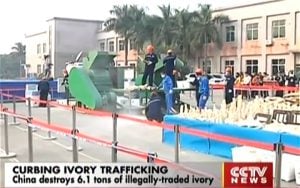
Last month, authorities in China publicly destroyed more than six tonnes of confiscated elephant ivory. Though a significant event, its ramifications for the illicit ivory trade are unclear.
Some hailed it as sending a clear message to poachers and smugglers that the black market in ivory is over; others that destroying ivory could increase prices and criminal profits, and ultimately lead to a rise in poaching; while many were puzzled by the apparent waste of a valuable commodity.
Undoubtedly, however, it was a hugely symbolic move. The official reason behind this public declaration of intent was that it would send a zero-tolerance message to poachers. Perhaps the action was also taken in view of the growing evidence of the illegal wildlife trade’s destabilising influence on international security, or a desire to protect threatened wildlife, or even to protect China’s international reputation and trade relationships with key African countries.
Whatever the rationale, there is little doubt it has raised eyebrows around the world of wildlife trade policy. And there can be little doubt of the underlying message from China—that the country is serious about dealing with ivory trafficking.
Further evidence of that determination has been forthcoming: just days later, an unprecedented collaboration between government law enforcement agencies in China and their counterparts in Kenya saw the extradition of a Chinese individual, whom, it is alleged, was one of those organising the movement of ivory between the two nations by paying courier “mules” to transport it for him. It was a welcome example of international enforcement collaboration, aimed at the kingpins orchestrating ivory movements.
Such action could set a significant precedent. Replication of such collaboration not only in Kenya, but across the African continent would have a massive impact in turning the tide against the international criminal networks which are profiting from ivory trafficking. Meanwhile, China also played a leading role in Operation Cobra II earlier this month—one of 28 countries and agencies including INTERPOL, CITES and WCO taking part in this global law enforcement crackdown on wildlife crime. In China, more than 100,000 staff took part. Seizures in various countries included three tonnes of ivory and 36 rhino horns, and 250 suspects were rounded up.
Last week, the Chinese delegation to the London Conference on illegal wildlife trafficking, convened by UK Foreign Secretary William Hague, was led by the vice-minister of China’s State Forestry Administration, Mr Zhang Jianlong. The 42 governments meeting in London underlined their determination to address wildlife crime: a firm commitment of political will to get tough and a clear signal the issue is not just one of environmental concern, but stretches far wider, reaching throughout society.
And nor were these the only recent examples of China demonstrating its national commitment. In late January this year the Chinese Embassy in Kenya convened a meeting for Chinese businesses and citizens based in Africa to address the growing issue of illegal wildlife trade and their government’s intention to co-operate with local authorities to investigate, arrest and prosecute offenders. It was the first outreach event as part of a campaign, run in conjunction with the UN Environment Program, to help scale up the fight against elephant poaching in Africa through citizen outreach. Wan Ziming, Director of Enforcement and Training at the Endangered Species Office of the State Forestry Administration of China, told those present: “The Chinese government will not relent in its support for the fight against illegal trade of wildlife products.”
Can China make the difference?
As the world’s most significant marketplace for ivory, China’s actions can have the biggest single impact on the dynamics of both demand and supply for the global illicit ivory trade. But even a country the size of China cannot do it alone. The entire international community needs to play their part in solving this global issue at three levels: stopping the poaching; increasing law enforcement effectiveness to break trafficking chains and penalising those involved; and achieving consumer behavioural change to reduce demand in end-use markets. While China is certainly showing every sign of stepping up to the plate to crack down on wildlife trafficking, the challenge now is to maintain the momentum that China and other countries have generated to ensure wildlife criminals are put out of business permanently.
The continuing prioritisation by China of efforts to address the illegal wildlife trade, including allocation of resources for action at home and in partnership with other countries, is central to spearheading concrete progress from source to market. Only if the full suite of challenges is addressed in terms of the poaching, trafficking and demand components of illegal wildlife trade can the future of some of the world’s most iconic wildlife be safeguarded. Given China’s increasing global influence, its leadership of such an inclusive approach is likely to encourage many other countries and actors to follow.