Tom Levitt (TL): What are the origins of the deep-ecology movement?
Stephan Harding (SH): It originated as an idea in the 1970s as a response to the seriousness of the ecological crisis. Arne Naess coined the term in 1972. His point is that ecology is a branch of science that gives us facts about the relationship between organisms and their environment. Ecology as a science might tell us how many blackbirds there are in an English garden but it doesn’t tell us how we should live in relation to those blackbirds, which means ecology is really quite shallow. It deals with facts but tells us nothing about values.
Arne put the term "deep" in front of "ecology" to suggest that we need to take account of values and qualities as much as we do quantities. Deep ecology asks how we live in relation to the facts that science reveals to us about how nature works. Clearly our culture, including modern Chinese culture, has been unbelievably destructive of nature. We need to understand why we have been so destructive. Deep ecology offers some explanations and some ways forward out of our destructiveness.
TL: What kind of life does that mean we should live?
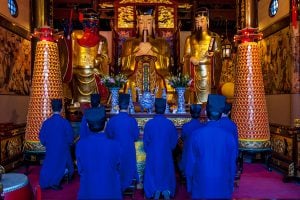
SH: It’s very Daoist. Deep ecology is a kind of western Daoism. It focuses on the notion of simple means but rich in ends. You live a very materially simple life but you have really rich experiences living very simply. This requires a deep connection with nature.
TL: Is it a life of isolation, away from everything?
SH: No, you can practice deep ecology in the city. It’s just more difficult. Imagine you’re living in a skyscraper, you could have a window box with plants, or even indoor plants or a park nearby that you can go to. You could also connect with the wild origins of the materials in the buildings itself. You can connect with the atmosphere, the clouds, the sky and air. You might connect with bird sounds, but even city sounds are in some sense sounds of the earth. Of course, it’s much easier if you get out of Beijing or any city to forest or cultivated land where you can really see nature.
TL: Is it compatible with the modern urban lifestyle?
SH: People are increasingly living in cities in China and so it’s going to be important for the rising urban population to have some connection with nature. Why? Because we know it is good for our health. In big cities it is essential to create green areas for people to go, to create as many opportunities as possible for people to be with nature. The other important thing is to create little farms in cities where people can grow their own food. These can be small plots of land that instead of just being parks for recreation, are areas for growing food. This has been very successful in the Europe and the US.
TL: How different is it to the mainstream environment movement?
SH: It underpins it. You could say the mainstream environment movement is trying to change things from the outside, by working on policies. That’s a very important approach. The deep-ecology movement is trying to work on people’s personal deep relationship with nature by cultivating a change in world view. Mainstream environmentalists still see nature as a machine that we need to repair, whereas the deep ecologist view, like Daoism, sees the world as living organism and not as a machine. Every single environmentalist has had a deep experience of the living qualities of nature and is therefore in tune with the deep-ecology approach.
TL: Where has it taken off the most?
SH: It’s a hidden current. Many people are deep-ecology practioners without ever having heard of the term. Every time someone admires a view and sits in wonder, that is deep ecology. What Arne Ness and other deep-ecology supporters did was to articulate and speak about these intuitions of awe and wonder. For example, Arne talked about the ecological self, the idea that your self is not bounded to your own body, but that your greater body is the earth itself.
TL: What do deep ecologists make of recent interest in putting a monetary value on nature?
SH: Daoist masters and deep-ecology supporters wouldn’t put a monetary value on nature at all. A beautiful tree would be valued by them because it simply exists. The key insight in deep ecology is that all life has intrinsic value, irrespective of its use to humans. So we value the tree because it exists, not even because of its beauty or for what it gives us. But now, unfortunately, we live in a world which we only value what we can measure and count and what has monetary value. However, a deep-ecology supporter might adopt a monetary approach in the short term as a strategy for helping people to begin to appreciate the importance of nature. Perhaps we can use the monetary approach to speak to the mainstream and to power, but we need to remember this way of valuing nature is part of the world view that has produced the ecological crisis.
Dr Stephan Harding is Head of the MSc in Holistic Science at Schumacher College, Dartington, UK and author of Animate Earth: Science, Intuition and Gaia. The Schumacher College is developing an MA in Economics for Transition with the South Western University in China.