If you have flooring made from taun (a type of hardwood timber) then it may have been illegally sourced from forests in Papua New Guinea on which indigenous people depend. The country exports over 85% of its logs to China and is one of its largest suppliers of tropical logs.
In fact, roughly one in ten tropical logs imported by China since 2012 came from forested land in Papua New Guinea that communities say was stolen from them in violation of the country’s laws.
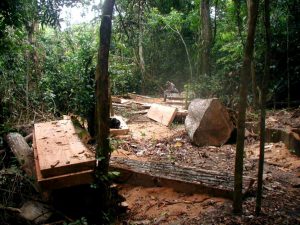
In the name of agricultural development, logging companies are clear-cutting ancient, biodiverse forests and replacing them with monoculture crops such as palm oil. To facilitate this, land that belongs to indigenous people is being leased out by the government often for 99 years and without their knowledge or consent. By 2011, about 12% of the country’s land area had been handed out under such leases.
The latest report from Global Witness, Stained Trade, describes how Papua New Guinea’s wood is made into everyday products in China. Some of these products are then exported to the US. The researchers examined the global supply chains of flooring made from taun by visiting importers, manufacturers and exporters. The report shows that flooring companies, including well-known national brands in China, are using wood potentially coming from illegal logging operations in Papua New Guinea.
One of these brands is Nature Home, which claims to be the biggest solid-wood flooring seller in China. Research by Global Witness shows that Nature Home branded flooring has likely used wood from rainforest clearance operations under Papua New Guinea’s high-risk agricultural leases. When asked to comment by Global Witness, Nature Home did not deny this. In the US, where the trade in illegal wood is prohibited, Nature Home’s US subsidiary said it required its suppliers to verify the legality of their flooring and provide documentation, but it decided to put a hold on new procurement of taun flooring while it reviewed its sourcing policies and practices. This positive step should be applauded. However, Nature Home is still promoting taun flooring as its “star product” across 4,000 retail stores in China.
Most importers and flooring companies dealing in wood from Papua New Guinea did not respond to requests for comment.
Challenging the leases
By law, nearly all land and forest in Papua New Guinea belongs to its indigenous people, who make up most of the population. Small scale farming and healthy forests are central to the way of life for most people but their livelihoods and the environment are being threatened as forests are being stripped bare.
In attempts to halt the clearances, indigenous communities around the country have filed complaints, brought lawsuits and held protests, often in the face of intimidation by police on the payroll of logging companies. Under pressure, the government launched an inquiry into the agricultural leases which found that most of those reviewed were issued illegally. In 2013, the inquiry recommended cancelling 90% of the leases it reviewed. Despite recently calling the leases illegal, the government has taken no action to cancel them.
Delaying action is exacting a heavy toll on Papua New Guinea’s people and forests. In 2011, indigenous landowners challenged one of the leases in court, claiming that an oil palm project had violated their land rights. More than five years later when the country’s Supreme Court finally ruled the lease illegal, wood worth US$65 million had already been exported to China. Indigenous communities saw their timber stolen and environment severely damaged. Even after the ruling, six more shipments were illegally exported to China, according to Global Witness research. The government took no action when we notified it of the shipments.
Green supply chains need to focus on imports
More and more companies in China are interested in “greener” business practices. For some this is a response to external pressure, such as initiatives by large brands to use their purchasing power to force suppliers to curb pollution and carbon emissions.
One of the problems with these initiatives is that they are failing to increase scrutiny over imported raw materials. Our research shows that few companies in the taun flooring supply chain are taking steps to avoid timber that is unsustainably or illegally sourced. And as China tightens its forestry regulations at home, there is a risk that unsustainably or illegally logged wood will be sourced increasingly from outside China.
As China’s biggest supplier of tropical logs, accounting for a third of its imports, Papua New Guinea is particularly vulnerable. As much as 70% of logging in the country is illegal, according to research by Chatham House. But because the environmental and ecological damage is happening outside China, most people in the country are unaware of it.
Risks for Chinese companies
Our research shows that due to US legislation prohibiting the trade in illegal wood, some large US flooring retailers have stopped importing wood where there is a risk that it has been illegally sourced, and are carrying out stricter audits of their supply chains in China. Other major export markets such as the EU, Australia, Japan and Canada have passed legislation to similar ends. These laws are making importers more cautious about where their wood is from. In China, a few leading brands in the real estate sector have started to push their suppliers to consider the legality of timber.
To protect Chinese companies and consumers, relevant government agencies should put in place mandatory measures targeting the import stage of the timber supply chain. Importers should be required to ensure that the wood they bring into China is produced in compliance with all applicable laws in source countries.
This might also be the most cost-effective measure. Our research shows that just 15 companies accounted for roughly 85% of China’s imports of logs from Papua New Guinea in 2016. Importers are usually the most familiar with the legal and regulatory context in producer countries compared to companies elsewhere in the supply chain.
Ultimately, global timber companies, including those from China, must do more to protect the forests on which their businesses, and the people of Papua New Guinea, depend.