![<p>A dolphin surfacing in the Ganga [image by: Mohd Imran Khan]</p>](https://dialogue.earth/content/uploads/2018/01/Dolphin03-768x489.jpg)
The discovery of 17 dead dolphins in the Halda River of Bangladesh over the past four months have led experts and environmentalists to demand that the river be declared a sanctuary for freshwater dolphins as soon as possible.
Fifteen dolphins (known locally as Shushuk) were found dead between October last year and January 2018. Two more bodies were found floating on January 20 and February 1.
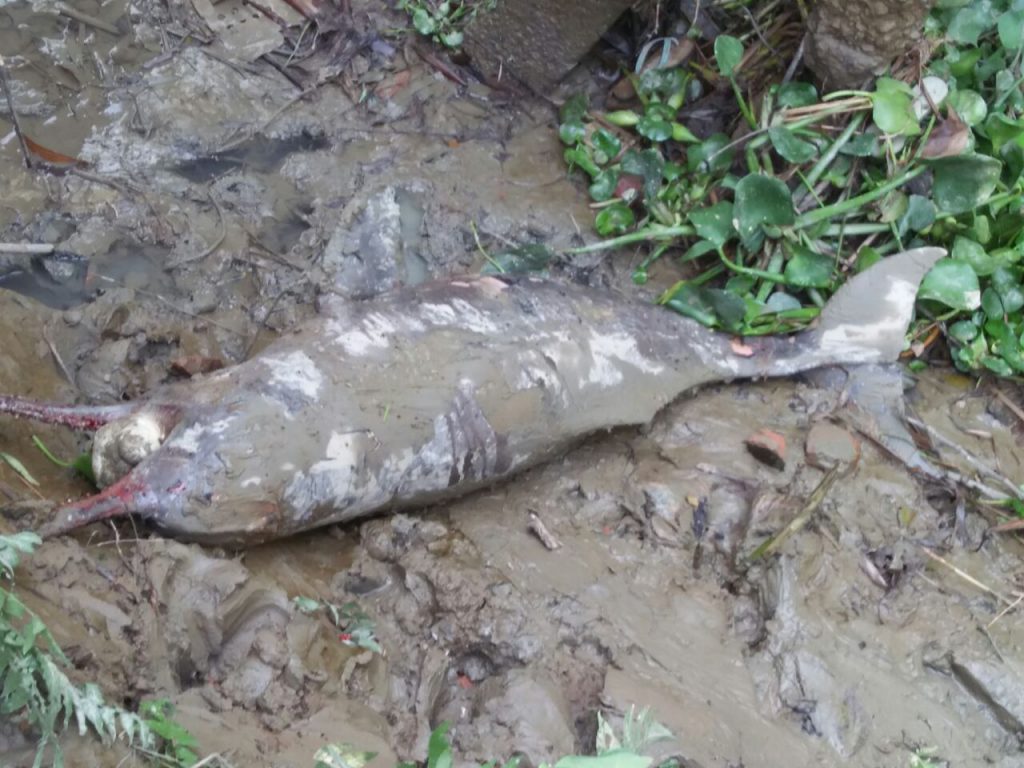 One of the 17 dolphins found dead in the Halda river (Photo: Md Manzoorul Kibria)
Yahya Mahmud, Director General of Bangladesh Fisheries Research Institute (BFRI), said that experts will form an inter-departmental committee to investigate the reasons behind the dolphin deaths.
The Ganga River dolphin used to live across the Ganga-Brahmaputra-Meghna and Karnaphuli-Sangu river systems of Nepal, India, and Bangladesh, from the Himalayan foothills to the Bay of Bengal. Today the dolphin is threatened by the removal of river water and siltation arising from deforestation, pollution and entanglement in fishing nets. The construction of barrages and dams has separated populations and destroyed their habitat.
The dolphin is now listed as a critically endangered species on the International Union for Conservation of Nature (IUCN) Red List.
Two types of dolphins are found in Bangladesh – the Irrawaddy and the Ganga river dolphin, both of which are critically endangered. The Halda, a major river in Bangladesh, hosts around 200 Ganga river dolphins.
Read also: Ganga river dolphin faces extinction
No home in the Halda
Experts told thethirdpole.net that in the Halda River rampant industrial pollution, the use of dredgers for lifting river sand, shallow water, and growing traffic from mechanized boats are the main reasons for the sudden death of dolphins.
Manzoorul Kibria, in charge of Halda River Research Laboratory, is engaged in examining the cause of the recent dolphin deaths. He said that dredgers and the propellers of boats are causing most of the dolphin deaths in the river.
“We have witnessed the injury marks on the bodies of a number of dolphins. Right now, the water level has gone down due to dry season and it is a good opportunity for miscreants to extract sands illegally by using dredgers and boats. This is causing serious injuries to the river dolphins and causing death,” said Kibria, who is also a professor at Chittagong University’s Zoology department.
Pollution could also be responsible for causing disease among the dolphins. Industrial units and households throw untreated waste directly into the river, destroying biodiversity and endangering the dolphin’s habitat, Saidur Rahman Chowdhury of Chittagong University’s Institute of Marine Science and Fisheries told thethirdpole.net. “It is high time the government took necessary steps to save the endangered aquatic mammals.”
Local people say there are other possible reasons behind the death of Ganga dolphins: the use of various pesticides in tobacco farming, cutting the bend of the rivers and the construction of brickmaking fields.
Past glories
A lot has changed on the river over the last four decades. Ninety-two-year old Sukur Ali, a local fisherman from Garduara village in Hathazari Upazila, a sub-district of Chittagong district, shared memories of his childhood days around the Halda River.
Before the 1970s, his surroundings were full of lush green farms, plenty of fish, birds, and cattle. Sukur Ali remembers waking up early in the morning to go fishing in the Halda, taking his wooden rowboat. “Still, when I close my eyes, I can see a good number of Sushuk (dolphins) in the river, floating every minute and taking shelter in the confluence of the river,” he says.
But things changed drastically in the 1990s. “Large scale industrial development, oil spillage incidents, using pesticides and chemicals in agriculture has totally destroyed the ecology and biodiversity of Halda River,” he said.
Sukur Ali’s memories are reminiscent of the description of the distributaries of the Ganga through the Sundarbans in West Bengal, India, in the famous novel by Amitav Ghosh, “The Hungry Tide”.
In the nineteenth century, Ganga river dolphins were found in ‘large schools’ close to urban centres along the river, and Kolkata was an important centre for the study of dolphins and whales. Kolkata’s Botanical Garden was run by famous naturalists, including William Roxburgh, the man who first identified the Ganga river dolphin. He had called it Delphinus gangeticus.
Nowadays dolphin groups are considerably smaller, and some may be found alone. Dolphin numbers are dwindling across the region and it is difficult to sight a dolphin in the rivers.
Halda – a pollution blindspot
Eminent water specialist Ainun Nishat said the presence of dolphins is an indicator of clean water and good health of a river. However “the more industries we have, the more we will produce pollution leading to further threats to dolphins,” he warned.
Despite the growing threat, no study has been carried out to map the direct impact of pollution on the dolphins.
A group of experts at the Bangladesh Agricultural University, Bangladesh University of Engineering and Technology, and Chittagong University, have already collected a sample of water from the Halda River. Based on the sample, the Ministry of Fisheries and Livestock made some recommendations and formed an action plan to clean up the river. Last month, Najubur Rahman, Principal Secretary to the Prime Minister, chaired a meeting to review the action plan. Later, he told thethirdpole.net that he has asked respective departments to implement the plan.
Creating a safe haven
As a tidal river, the Halda River is also the only natural carp spawning ground in the world.
In 2016, the government said it was planning to declare the Halda an Ecologically Critical Area (ECA). But environmentalists and experts argue that the government must go further and declare the Halda a sanctuary for river dolphins.
The government has already declared three stretches of canals covering 32 kilometres in the Sundarbans – the world’s largest mangrove forest spread across India and Bangladesh and an important dolphin habitat – as dolphin sanctuaries.