


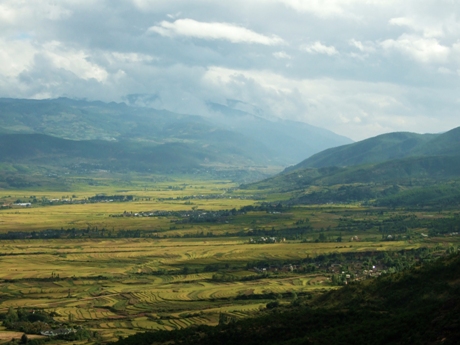

Guest post by R. Edward Grumbine in Yunnan.
Over the next several decades, Asia, with China in the lead, is projected to push most of the worlds’ economic expansion, population growth, and urban development. China already is the world’s largest emitter of greenhouse gases with huge increases in the pipeline. All of these trends impact on human health from local to global levels. As EcoHealth practitioners work to knit together health, ecosystems and social concerns, what progress are they reporting from an Asia that appears to be reaching critical mass as a driver of global change?
At EcoHealth 2012 conference in Kunming, research certainly shows the pivotal importance of Asia in worldwide health. In China, diseases from food-born parasites are on the rise with 150 million people (about 50% of the US population) already suffering. Part of this increase is a result of the globalization of the world’s food supply that spreads people and pathogens around as well as meat and vegetables.
InVietnam, 13% of the population now lives in peri-urban areas, those places that are developing low density urban attributes but lack basic public services. Residents here are at greater risk of disease transferred between animals and humans.
Throughout the Greater Mekong region, innovative GIS mapping is showing that health risks increase where land- use changes are rapid, wildlife and domestic animals interact, and public health services are poor. Much Ecohealth research focuses on zoonotic diseases – those that are transferred from animals to humans and infection rates are rising across Asia. Yet non-communicable diseases – cancers, heart ailments, strokes, diabetes – are responsible for 85% of all illnesses in China, with 260 million people already afflicted. The public health burdens are enormous.
Then there is climate change. From 1970-2000 in China, the transmission intensity and rate of spread of schistosomiasis and malaria have increased as temperature, precipitation and relative humidity have changed. Some 21 million more people are now at risk from these diseases and this data does not cover the period from 2000 to the present when climate impacts have accelerated.
Ecohealth research, however, is not just about numbers and that is what gives it such promise to foster social change that could reduce human diseases and support healthy landscapes. For example, an estimated 680 million people worldwide (most of them living in Asia) are at risk from infections caused by liver flukes, a parasite that attacks the liver and can lead to cancer. The parasite has several intermediate hosts before reaching humans – freshwater snails, cyprinid fishes, even cats and dogs. Traditional control methods depend on chemicals and education, but little progress has been made.
Ecohealth research shows that an integrated approach is needed. Water management is critical to the life cycle of the liver flukes with irrigation ditches speeding the spread of the parasite. Lack of closed sanitation for humans increases disease transmission. Cultural traditions of eating raw fish puts people at risk. Gender plays a role, since more men than women eat raw fish. Agricultural economics also are important since paddies that are double-cropped host more snail vectors. And the movement of migrant workers from areas where liver flukes are endemic spreads the disease around; Thai workers in Israel have infection rates of over 50%. Water resources, health infrastructure, culture and gender, economics, labour migration: all these factors must be addressed.
Many Ecohealth workers are exploring how to bring such integrated research to bear on policy makers and government leaders. This is a challenge. People gathered in Kunming from all over spoke of the same problems: health bureaucracy that did not listen to local peoples; a lack of communication between scientists and stakeholders; funding that was restricted to narrow disciplinary research; and poor media understanding of health and ecosystem links.
But how can researchers influence decision making? Ecohealth supporters are organising efforts within their professional communities through, for example, the Asian Partnership on Emerging Infectious Diseases Research, which links researchers in five southeast Asian countries and China. They are also actively seeking to understand where the barriers and bridges to influencing decision makers lie.
But a revolution in academic research paradigms may have little impact on the lives of Laotians subject to emerging tropical diseases, or urban Chinese exposed to air pollution driven by belief in nonstop economic growth. The politics surrounding ecological health issues will almost always trump improvements in academic research capacity. How to promote ecological health when gaps persist between local stakeholders and elites, rural and urban dwellers, cultural traditions and disease prevention, and research results and policy implementation will remain the critical question for people bearing the banner of EcoHealth into an uncertain future.