
Nature

Floods boost Indus dolphin population

Floods have increased numbers of Indus dolphins in some parts of the river says WWF-Pakistan

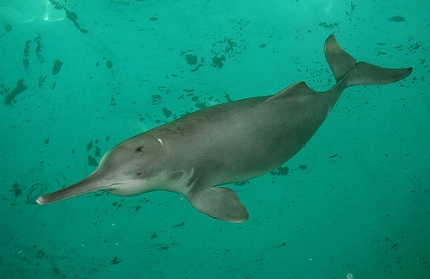
Recent floods in the Indus River have been devastating for the local human population, but these disasters have helped increase the number of Indus dolphins in some parts of the river, suggests a new report by WWF-Pakistan.

Floods waters have increased the habitat available for dolphins and allowed the mammals to move along the Indus River and establish sub-populations, thereby adding to the overall population, claims a 2011-2012 survey published by the WWF-Pakistan last week. “With less food competition and new habitats created, this could have been a blessing for the species which is unique in Pakistan,” the report claims.

However the survey does indicate the catastrophic floods killed scores of stranded dolphins and so overall numbers appear to have declined. An estimated 1,100 dolphins now exist in the Indus River, down from 1,600 – 1,750 dolphins in 2006.

Umza Khan, director of biodiversity at WWF-Pakistan, argues this needs careful interpretation: “because of the massive 2010 floods there was so much water in the river, its span was wider and there were more side channels and therefore, detection was much harder. The study also found that while the dolphin population decreased in Sindh, it almost doubled in the Punjab, so clearly its distribution has spread,” Khan said.

The Indus River dolphin is one of the world’s rarest mammals. Dolphins regularly travel back and forth into irrigation canals when canal gates are open and during canal closure the water level drops and dolphins become trapped in small pools with depleting fish supply.

Intensive fishing in canals during closure period also aggravates the risk of net entanglements of these endangered dolphins.

Several years ago WWF-Pakistan, in collaboration with the Sindh Wildlife Department, set up an Indus dolphin rescue unit to collect trapped dolphins and physically transport them back to the Indus River.  Since 1992 around 112 dolphins have been successfully rescued, according to Rina Saeed Khan who described these efforts in an article in Dawn this week.


Cookies Settings

Dialogue Earth uses cookies to provide you with the best user experience possible. Cookie information is stored in your browser. It allows us to recognise you when you return to Dialogue Earth and helps us to understand which sections of the website you find useful.

Required Cookies

Required Cookies should be enabled at all times so that we can save your preferences for cookie settings.

Dialogue Earth - Dialogue Earth is an independent organisation dedicated to promoting a common understanding of the world's urgent environmental challenges. Read our privacy policy.

Cloudflare - Cloudflare is a service used for the purposes of increasing the security and performance of web sites and services. Read Cloudflare's privacy policy and terms of service.

Functional Cookies

Dialogue Earth uses several functional cookies to collect anonymous information such as the number of site visitors and the most popular pages. Keeping these cookies enabled helps us to improve our website.

Google Analytics - The Google Analytics cookies are used to gather anonymous information about how you use our websites. We use this information to improve our sites and report on the reach of our content. Read Google's privacy policy and terms of service.

Advertising Cookies

This website uses the following additional cookies:

Google Inc. - Google operates Google Ads, Display & Video 360, and Google Ad Manager. These services allow advertisers to plan, execute and analyze marketing programs with greater ease and efficiency, while enabling publishers to maximize their returns from online advertising. Note that you may see cookies placed by Google for advertising, including the opt out cookie, under the Google.com or DoubleClick.net domains.

Twitter - Twitter is a real-time information network that connects you to the latest stories, ideas, opinions and news about what you find interesting. Simply find the accounts you find compelling and follow the conversations.

Facebook Inc. - Facebook is an online social networking service. China Dialogue aims to help guide our readers to content that they are interested in, so they can continue to read more of what they enjoy. If you are a social media user, then we are able to do this through a pixel provided by Facebook, which allows Facebook to place cookies on your web browser. For example, when a Facebook user returns to Facebook from our site, Facebook can identify them as part of a group of China Dialogue readers, and deliver them marketing messages from us, i.e. more of our content on biodiversity. Data that can be obtained through this is limited to the URL of the pages that have been visited and the limited information a browser might pass on, such as its IP address. In addition to the cookie controls that we mentioned above, if you are a Facebook user you can opt out by following this link.

Linkedin - LinkedIn is a business- and employment-oriented social networking service that operates via websites and mobile apps.