


The Brahmaputra and its tributaries have flooded the famous Dibru-Saikhowa National Park and Biosphere Reserve in north-eastern India, but Joynal Abedin is not worried.
Abedin, who heads the Dibru-Saikhowa Conservation Society, has alerted his team of volunteers in case any animals need to be rescued from the flood waters. But he does not really foresee a need, as the park weathered bigger floods in 2004 and 2012. He and his colleagues in the NGO – which works for protection, awareness and rescue of wild animals in and around the park – are far more worried about human interference that is eating away the edges of these wetlands in Assam’s Tinsukia district.

Abedin, who runs a tourist resort in the periphery of the park, explains, “Dibru-Saikhowa is full of wetlands. Sometimes, the floods are necessary to flush out unwanted elements from the wetlands.” Floods are an annual affair for this biodiversity hotspot located on the south bank of the Brahmaputra. The park is bound by the Brahmaputra and Lohit rivers on the north and Dibru river on the south. “There is 25% grassland and 40% wetland. The ecology keeps changing every year because of the flood and erosion,” adds Abedin.
Other experts agree that it’s not the floodwaters but the erosion, negligence, extensive livestock grazing, encroachment and lack of security – which leads to rampant poaching and illegal logging – that are the main threats to this rich biosphere reserve.
Santanu Goswami, a local journalist, rues that the highlands in and around the park are not sufficient during the floods to shelter wild animals. As a result, animals stray into neighbouring villages where they are poached. Plus, there are two villages within the park which are allegedly thriving centres for poachers.
Moreover, there has been no measure to combat erosion by the Brahmaputra which is eating away large chunks of the park every year.
Local residents are irked by the lackadaisical management of the park. Goswami says, “One-third of the park is wetlands. There is no motorable road inside. So the forest department personnel have to use boats during floods. They are short-staffed with only 28 forest personnel manning the two ranges of the park area spanning 340 square kilometres. There are no statistics of animals killed or affected by the floods.”
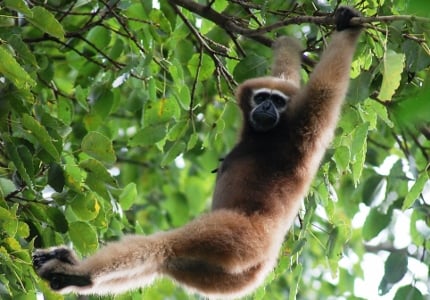
The park is famous for its feral horses, Hoolock Gibbon, Gangetic River Dolphin and wild buffaloes. Prasanta Boro, a veterinarian who had worked with the mobile veterinary unit at the Park says, “This is a good vulture pocket with mainly two species – slender-billed and white-backed vulture. However, during floods, rescue and rehabilitation was almost nil.”
Human activity biggest threat to wildlife
The surrounding human population and their livestock is taking its toll on this protected area, which is already assailed periodically by floods and changing river courses.
Wildlife biologist Firoz Ahmed says the park has been influenced by floods since the 1950 earthquake as the Dibang and Lohit and Siang brought down loads of silt to raise the riverbeds and have been causing regular floods since then. Animals have not yet had time to adapt to this. The area is now traversed by streams as the Dibang pours a lot of water through it annually. This has caused habitat loss and quick changes in the remaining habitat.
Ahmed thinks there are lots of places inside the park that do not get flooded and are used by animals as refuge, and these special ecosystems need to be studied in detail. “The problem in this park is not floods but human disturbances of all kinds,” he told The Third Pole. Floods are natural but human disturbances are not.”
Teresa Rehman is managing editor, www.thethumbprintmag.com
Climate change exacerbates human-wildlife conflicts in Sikkim