


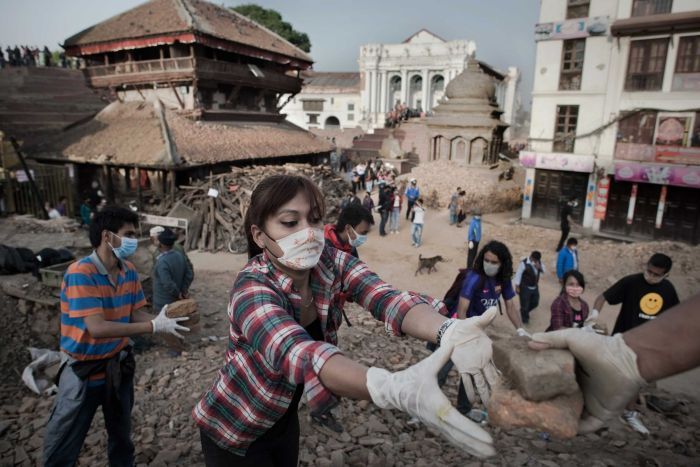

It was a gloomy Saturday when the deadly 7.8 magnitude earthquake shook Nepal. I was buying groceries in Kalimati—one of the busiest markets in the capital city, Kathmandu.
Initial tremors were mild but within seconds buildings were swinging, motorbikes were falling, vehicles were out of control and everybody rushed towards the road. An old lady came towards me, crying and fell over, wetting herself in fear. Everybody was crying, praying and looking towards sky. The world kept shaking for at least a minute.
Once the major shock dissipated I started my car. Thank god, my wife was with me so that we could support each other. But within a minute another tremor hit, less intense and lasting for a few seconds. A tall building in front of me had developed so many cracks if the tremors went on any longer, it would have fallen on to us.
We got into the car again, but we couldn’t find any open space to safely stop the car. Suddenly a third shock hit the city. We managed to reach home, our family was safe and everybody was out in the open space nearby.
People were smiling and exchanging wishes. Everyone had their mobile phones but nobody could get through to their near and dear ones. At first people were just happy to be safe but slowly they started to think about their homes. For hours, no one dared to enter their homes but as evening approached people began to inspect the damage. Almost all houses had suffered at least minor cracks.
The entire population of Kathmandu slept out in the open that night, but there was little information about the worst affected villages. Many radio stations were dead, television stations couldn’t operate and people were out of their homes without electricity. Some people were able to get information about the situation outside the city on old mobiles with FM radios.
On the second day, the aftershocks continued and the death toll began to rise. Just as people began to relax a little a huge aftershock of 6.7-magnitude hit. Buildings weakened by the first quake collapsed and the quake triggered hundreds of landslides, even blocking the highway to China in eastern part of the country.
The death toll increased by the hour and stories about villages that had been flattened started to emerge. People continued to camp out in tents or in open spaces for the third and fourth days.
Once the Internet started to work again, though terribly slowly, social media channels were flooded with information and photos of families spent days and nights in tents. The disaster brought everyone to the same level –millionaires slept in open spaces alongside people who had nothing.
After fifth day people began to return home to sleep on the ground floor, making it easy to escape if a quake hit again. People were in such a panic that even small shocks sent them rushing outside for hours. No one believed their houses were strong enough to withstand more quakes.
Rumours that another big quake was yet to come went viral on social media.
Kathmandu earthquake casualties
The initial estimation of 500 casualties rose to 7,500 within ten days and this number will increase as the situation in remote villages is still unclear. Many of the villages in the districts of Sindhupalchowk , Dhadhing and Gorkha—near the epicentre of the first quake — have been almost completely flattened, where very few lucky people have their homes still intact.
Frustration is growing over the government’s inefficient relief response, and fighting over the distribution of relief has intensified as political parties try to get the credit for efforts. Meanwhile the plight of people who lives have been devastated is being ignored.
People are struggling to rebuild their lives since the Kathmandu earthquake. Just outside my window, I saw a farmer whose cow shed had collapsed in the earthquake desperately trying to rebuild it in scorching sun so he can save this animals before the monsoon rains descend.
At 11pm on the ninth day, people were queuing up in the dark to collect water from a stone spout behind my house in Bhaisepati, southern Kathmandu. With homes left with no running water, this is one of the few functioning stone spouts in the city, and has been the only source of water for thousands of people in the area.

