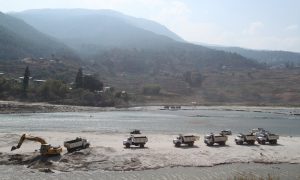
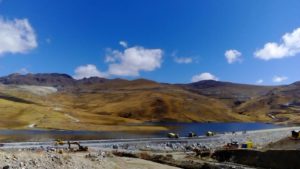
![<p>[:en]Mining in Poonch river using heavy machinery is destroying river habitats [image courtesy: Hagler Bailly Pakistan][:ne]Mining in Poonch river using heavy machinery is destroying river habitats [image courtesy: Hagler Bailly Pakistan][:hi]Mining in Poonch river using heavy machinery is destroying river habitats [image courtesy: Hagler Bailly Pakistan][:bn]Mining in Poonch river using heavy machinery is destroying river habitats [image courtesy: Hagler Bailly Pakistan][:ur]بھاری مشینری کے ذریعہ دریاۓ پونچ میں کانکنی دریا کے ماحولیاتی نظام کو تباہ کررہی ہے (تصویر بشکریہ ہیگلر بیلی پاکستان )[:]</p>](https://dialogue.earth/content/uploads/2017/05/Mining-in-Poonch-River-Using-Heavy-Machinery-Destroying-River-Habitats-768x512.jpg)
Gone are the days when a poor man would go down to the river with donkeys to load sand and gravel and then sell it by the roadside to feed his family. The game is now of investment, political influence, permits, and destruction of riverbeds on a scale that has never been seen before.
River systems comprise not just the water flowing in it, but also the sediment, the silt, sand, gravel, cobbles, and boulders that flow with the river and are deposited along the river bed and banks. Moving the sediments, the rivers maintain diversity of habitats upon which the river’s living organisms depend. Aquatic insects and algae that are the main sources of food for the fish that breed and live in cobbles; the cobbles and boulders provide refuge for fish in winters and in floods and protect the young and smaller fish from predators. Fish lay eggs on gravel beds and side channels in rivers formed by deposit of sediments in floods. Ecosystems of rivers in the Jhelum basin – part of the Indus basin shared between India and Pakistan – are typical of the Himalayan river systems in which the sediments support life in the river, and livelihoods of people in floodplains and deltas downstream that rely on ecosystem services provided by the rivers.
The importance of sediments is such that the Indus Waters Treaty – the water sharing agreement between India and Pakistan over the Indus River –gives explicit recognition to the right of downstream riparian population to the sediments, just as it does for the water. The trapping and release of sediments is regulated under the treaty, and has been a subject of frequent discussions and arbitrations under the treaty.
Jhelum and its tributaries are rich in aquatic fauna. Take the example of the Kashmir catfish (Glyptothorax kashmirensis), which is very selective about where it lives and breeds, and requires just the right size of gravel for its home. This fish is now on its way to extinction. Other species will follow, like the already endangered mahaseer and a number of endemic species such as the Kashmir hill-stream loach, and long distance migratory species such as the vulnerable snow trout. And whatever is left will be wiped out by the sewage and solid waste thrown into the rivers, turning them into sewers as cities grow.
Construction in the Jhelum basin – both in India and in Pakistan – has already irreversibly altered the flow and sediment regimes in the rivers. As if this were not enough, the ongoing construction boom is being fed by indiscriminate mining of sand, gravel, and boulders from riverbeds, which are the cheapest source of construction materials for cities and villages along the rivers.
Mining in the river bed using heavy machinery is lucrative business, but think of the damage it causes. Quite apart from destroying the river’s ecosystem, stone crushing machines that proliferate on the banks spread fine dust all around. The incidence of lung diseases in the communities living nearby is on the rise. The residents frequently complain of sleepless nights due to the noise from the vehicles and machines that operate non-stop. Their complaints to environmental protection agencies, local authorities, and public interest litigation are of little use. With loads of cash to spare, the contractors are able to buy their way through.
A way out
Is it possible to find a way out of this mess? Interestingly, it turns out that even with all our greed we use only a small part of the sand, gravel, and boulders that flow down our rivers, less than a fifth as reported in the Environmental Social Impact Assessment (ESIA) of the Gulpur Hydropower Project located on Poonch River, a tributary of the Jhelum in Kashmir.
By scientifically planning and managing the mining operations, it is indeed possible to meet the needs of the communities and minimise the damage to aquatic habitats. To make this work, however, requires a coordinated effort of the sediment experts, the geomorphologists, ecologists, hydrologists, mining regulators, and the mining community.
One such initiative now underway is preparation of a sediment mining plan for the Poonch River in Pakistan-administered Kashmir, where local and international experts will join to find solutions within the framework of sustainable development. The effort will be based on a range of scientific studies and consultation with the stakeholders. The expected outcome is a licensing and regulatory system which will be community-based, cognizant of local livelihoods, setting the limits on how much sand, gravel, and boulders can be extracted from which part of the river at what time of the year.
Part of the revenues generated from licensing will be retained by the local communities to manage the system, while the rest may be used for protecting the river ecosystems. While this may sound like a pipedream, it is just possible that the initiative will provide an example of how to respect and live with our rivers. It may even become a model that others can follow.