


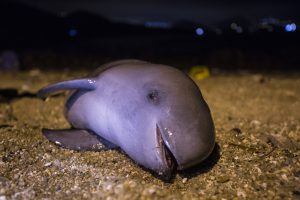
The eighteenth of July marked International Save the Vaquita Day. But with an estimated 10 of this rarest of marine mammals remaining in the Gulf of California, it is unclear if any will exist a year from now.
While they are not specifically targeted by fishermen, their population has been pushed to the brink of extinction because they get caught in gillnets – mesh nets intended for other species.
Last year’s Sea of Shadows documentary showed how the use of gillnets by Mexican fishermen to catch totoaba – a large fish whose dried swim bladder (also known as fish maw) is prized in China – inadvertently nets and kills vaquita as bycatch. The documentary draws attention to the challenges of regulating fishermen and the illicit cartel operating the fish maw trade. However, the film stops short of pinpointing sources of demand for totoaba fish maw and doesn’t mention the role of US consumption of Mexican shrimp, both crucial facets shaping vaquita endangerment.
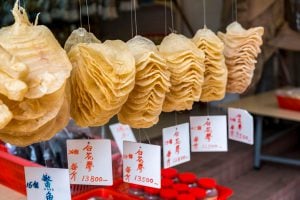
In order to understand threats to endangered species, we need to look more closely at consumption and global trade networks. Hong Kong, the world’s largest fish maw market, imports approximately 3,500 tonnes per year. The organ is said to contain high levels of calcium and collagen and is widely used in beauty products and as a supplement during pregnancy. Species such as totoaba produce large fish maw, which make them particularly desirable.
The future of the vaquita is intimately bound to totoaba, shrimp and the people who consume them.
Government representatives from Hong Kong’s Agriculture, Fisheries and Conservation Bureau confirm that there have been no cases of the legal import of the maw of the totoaba, a fish whose trade is protected under CITES (the Convention on International Trade in Endangered Species of Wild Fauna and Flora). However, data from Hong Kong customs show a marked rise in seizures of illicit fish maw from 2002 to 2019. On 4 June 2020, customs seized a record 160kg of totoaba maw worth an estimated HK$25 million. Clearly demand for totoaba maw remains strong.
In 2019, Mexico sent 29,561 metric tonnes of shrimp to the US, where annual per capita consumption is roughly 7.3kg (16lb). The US National Marine Fisheries Service announced in March that it will ban Mexican shrimp caught in the Gulf of Mexico, but has yet to set a date on implementing the ban. The future of the vaquita is intimately bound to totoaba, shrimp and the people who consume them.
What can be done?
Consumer responsibility is crucial. Several programmes exist to help people make informed decisions about the seafood they eat. WWF offers country-specific sustainable seafood guides, while WWF Hong Kong has created a more detailed guide, which includes the types of seafood it recommends as sustainable, those from sources at risk of becoming unsustainable, and overfished species to be avoided.
Similar programmes exist in the US. The Monterey Bay Aquarium produces comprehensive consumer guides that list recommendations state-by-state; Oceana produces a regional guide. US consumers, however, can make a substantial difference by ceasing consumption of Mexican shrimp caught in gillnets.
To protect the vaquita, we need to stop consuming totoaba and shrimp caught in Mexico with gillnets.
In addition, we can write to government institutions to demand immediate action to stop the use of gillnets. A petition to the president of Mexico calling for the immediate removal of all gillnet fishing in the vaquita’s territorial range has collected more than 200,000 signatures. Removing gillnets already in place is crucial to protecting the few remaining species. Additionally, people can support CETOS, a non-governmental organisation that undertakes small-vessel conservation surveys of vaquita.
Global threats to wildlife require global responsibility. This is a crucial juncture for recognising shared responsibility and taking action to conserve the few remaining vaquita.



![Residents of Thakurbari place sand-filled bags on the Koshi riverbank in an effort to save the riverbank and their homes from floodwaters [Image by: Birat Anupam]](https://dialogue.earth/content/uploads/2020/08/Nepal_Floods_2020_Koshi_1-300x199.jpg)