The Covid-19 pandemic does not appear to have hindered the distant-water fleets of China and other major fishing nations, but it has largely sidelined the fishery observers and port officials who monitor illegal fishing.
“In most of the South Pacific, fishery inspectors cannot come onboard the vessel to do inspections before authorising” the transfer of catch, known as transshipment, says Francisco Blaha, a New Zealand-based fisheries adviser.
The presence of independent observers on trawlers is a frontline deterrent to illegal, unreported and unregulated (IUU) fishing. A 2016 study found that a third of the world’s fish catch is not reported.
“The absence of observers will bring a level of uncertainly on reporting” catch, adds Blaha. “The biggest issue we have in the South Pacific is misreporting and underreporting by the licensed fleet.”
This absence comes as the World Trade Organisation (WTO) resumes negotiations in Geneva this month in the latest attempt to reach a consensus on a long-delayed agreement to eliminate harmful subsidies. These promote the IUU and over-fishing that is decimating global fish stocks.
The 600 onboard observers in the South Pacific, who monitor the region’s multibillion-dollar tuna fishery dominated by China, have remained onshore since April. That’s when the Western and Central Pacific Fisheries Commission ordered them to return to their home ports as the pandemic spread. Observers are currently not due to return to work until November.
“We don’t know what is happening” aboard fishing vessels, notes Blaha.
Normally, vessels in the South Pacific that are purse seining are required to come to port to transfer their catch and undergo inspection. But due to the pandemic, some South Pacific island nations are barring vessels from entering their lagoons or prohibiting port officials from boarding ships until crews have quarantined for two weeks.
What is purse seining?
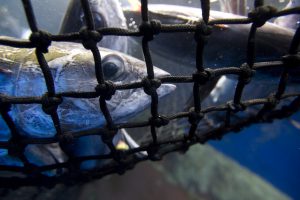
Fishing with a purse seine – a large, vertically floating net that surrounds shoals. Once the fish are in the net, the base is drawn together, creating a ‘purse’. Purse seining carries a particular risk of trapping vulnerable species as bycatch.
For instance, with the imposition of strict controls at the region’s busiest port in the Marshall Islands, fishing vessels are now transshipping their cargo elsewhere. “Many of them have moved to Kiribati, where they’re allowed to transship in the outside lagoon without formal controls,” says Blaha.
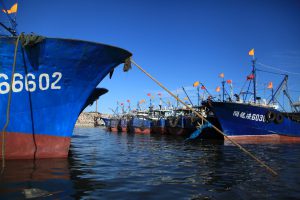
China operates the world’s largest distant-water fleet and its vessels account for 29% of purse seiners and 70% of long-liners operating in the South Pacific, according to Western and Central Pacific Fisheries Commission records.
Blaha says that long-liners fishing within a nation’s territorial waters must come to port to unload catch and be inspected. However, he says that even in pre-pandemic times there were few observers aboard those ships and none on vessels that fish on the high seas beyond national jurisdiction.
Observers left in the dark
The lack of observers on purse seiners means it’s unknown if fishing vessels are complying with regulations that prohibit the use of fish aggregation devices (FADs) during certain times of the year. FADs attract tuna, making them easy to catch, but also result in the inadvertent killing of non-targeted species. For tuna to be sold as sustainable, it must not be caught with FADs. But without observers onboard there has been no independent certification of compliance during the pandemic.
The absence of onboard observers has also eliminated a deterrent against illegal but lucrative shark fishing.
Tang Yi, dean of the College of Marine Culture and Law at Shanghai Ocean University, says the Chinese government has imposed a variety of Covid-related measures on the country’s distant-water fleet. Captains must make daily reports on crew members’ health and take action to reduce “potential risk of being infected in offshore supply activities, transshipment and temporary landing in foreign ports.”
“But for distant-water fishing fleet, there is no information showing that their fishing activities were seriously affected,” he added.
China’s Ministry of Agriculture and Rural Affairs issued a 29 March bulletin about the pandemic’s impact on fishing. “With the improvement of the domestic situation in the prevention and control of the… epidemic, ocean-going fishery companies have resumed work and production,” it stated. “Recently, ocean-going fishing boats have set off in large numbers for production in ocean-going fishing grounds, and signs of illegal production have begun to appear.”
The bulletin also directed captains of boats operating within another country’s territorial waters to abide by local regulations and allow law enforcement to board for inspections.
Tang said China apparently is not barring fishery observers from its fleet, noting his university currently has observers onboard vessels fishing for jellyfish.
But whether observers are onboard distant-water vessels depends on where fleets operate.
The west coast of Africa has been a hotbed of illegal fishing. While individual countries can mandate the use of observers, there is not a regional programme like that found in the South Pacific. To compensate for the lack of first-hand data, groups like Stop Illegal Fishing rely on satellite tracking and information-sharing among African nations to combat illicit activity.
“We have seen increased activity of Chinese-flagged/operated vessels recently – particularly in Kenya and Somalia,” says Sally Frankcom, communications officer for Stop Illegal Fishing.
In recent years, conservation group Sea Shepherd has dispatched its ships to west Africa to conduct joint patrols with national governments to deter illegal fishing. Sea Shepherd vessels are currently patrolling off Liberia and Gabon.
“There’s been a reduced presence of overseas trawlers in some places and domestic trawlers aren’t going out,” says Captain Peter Hammarstedt of Sea Shepherd. “Usually there’s a big European presence in Gabon.”
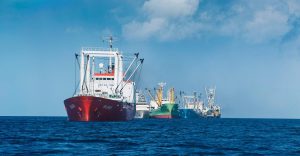
The pandemic doesn’t appear to have affected fishing on the high seas. Industrial trawlers can spend months or even years in the remote ocean thanks to refrigerated carrier vessels that rendezvous with them to offload catch and resupply fishing vessels with crew and provisions.
Global Fishing Watch’s new transshipment portal tracks encounters between tuna fishing vessels and carrier ships. Between 1 February and 31 May 2020, there were 2,679 likely transshipments for all vessels compared to 2,310 encounters for the same period in 2019. Between China-flagged ships, there were 127 likely transshipments in that 2020 period compared to 54 in 2019.
WTO efforts to end harmful subsidies
Covid-19 adds new urgency to a nearly 20-year effort by the WTO to ban subsidies that promote IUU and overfishing. While the pandemic interrupted negotiations, talks that began in September are scheduled to continue with the goal of reaching agreement by year’s end.
China has the most at stake because it operates the world’s largest fleet, catches the most fish and issues the most fuel subsidies that allow its trawlers to travel to faraway fishing grounds.
A 2018 study found that without US$4.2 billion in subsidies, more than half of high seas fishing would not be commercially feasible. China alone was responsible for 21% of high seas fishing in 2014 and nearly 19% of global fish catch averaged between 2014 and 2016.
Achieving an agreement on eliminating harmful subsidies requires the unanimous approval of the WTO’s 164 member states.
Still, one close observer of the negotiations, Isabel Jarrett, manager of the Pew Charitable Trusts programme to reduce harmful fishing subsidies, says she remains optimistic that the WTO will reach consensus on rules, called “disciplines”, for harmful fishing subsidies.
“There’s consensus building around the disciplines for IUU fishing,” says Jarrett.
However, many significant details remain to be decided. For instance, who determines that a vessel or operator has engaged in illegal fishing – a member state, a port state, or the ship’s flag state? Then, what punishment should be imposed, such as withholding fuel subsidies, and for how long? And should sanctions be levied against an individual vessel or the operator’s entire fleet?
Perhaps one of the biggest obstacles to an accord is determining what “special and differential treatment” will be applied to developing countries. Member countries are allowed to determine their status and the two biggest subsidisers of fishing, China and South Korea, have designated themselves as developing countries, according to Jarrett.
While China has been supportive of reaching an agreement, “they have been quite quiet in negotiations,” she says.
Adding to the pressure to reach an agreement is United Nations Sustainable Development Goal 14.6, which requires by 2020 the elimination of subsidies that contribute to IUU fishing and overfishing.
“This is one area where governments can really make progress and land a huge conservation win by the end of the year,” says Jarrett.