In 2017, the 19th National Congress of the Chinese Communist Party set the goal of creating a “Beautiful China” by 2035. An important piece of this puzzle will be revealed in the special five-year plan (FYP) for the marine environment. There have been marine FYPs before, for fishing and the ocean economy, but this will be the first one dedicated to the environment.
President Xi Jinping is now more focused than ever on turning China into a maritime power. He has repeatedly made instructions on this and it has been included as part of the “two centennial goals”. Protecting the marine environment has been an integral part of this grand strategy.
The central government has been working on the marine environment FYP since March last year. To inform it, the Ministry of Ecology and Environment (MEE) has instructed Jinzhou, Lianyungang, Shanghai and Shenzhen to draft their own pilot plans. Those four cities lie, from north to south, on the Bohai Sea, Yellow Sea, East China Sea and South China Sea.
According to a report in thepaper.cn late last year, over 6,000 locations have been surveyed for the drafting of the FYP, 784 of which are in coastal bays. The drafting was due to be completed in the first half of this year.
Beauty as a measure of conservation
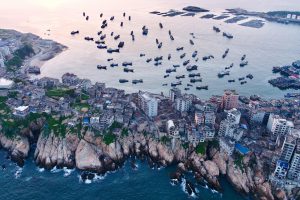
Parts of China’s coast have been damaged over the years by land reclamation, pollution and other factors. Over the past 70 years, human activity has gradually chipped away at China’s natural coastlines, with only about 33% of the coast remaining undamaged in 2014, according to research using satellite imagery. That has reduced marine biodiversity and prevented people coming into close contact with the ocean.
This means they have been “near, but disconnected, from the ocean, or having only low-quality experiences” of it, according to Guan Daoming, former director of the MEE’s National Marine Environmental Monitoring Centre, which is in charge of technical aspects of drafting the FYP. Because of this, Huo Chuanlin, former deputy director of the MEE’s Department of Marine Ecology and Environment, has said that the 14th FYP period (2021-2025) will mark the start of the Beautiful Bay push to ensure all 1,467 of China’s bays are “beautiful” by 2035, in line with the overall 2035 Beautiful China goal.
105
“The ‘Beautiful Bay’ term is to operationalise the drive to improve the coastal environment and allow people to enjoy the sea,” said Zhu Zhengguang, ocean policy manager at WWF’s Beijing office.
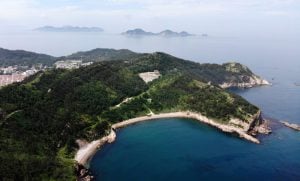
Last year, the MEE named three model Beautiful Bays – Dapeng in Shenzhen, Taizhou in Zhejiang and Taozi in Yantai. Dapeng Bay lies between Shenzhen and Hong Kong and enjoys Shenzhen’s highest forest coverage and best biodiversity. Chu Jun, assistant to the secretary-general of the Cross-border Environmental Concern Agency (CECA), says that the bay was designated as Shenzhen’s “back garden” early in the city’s development, with its economic development given lower priority. This explains why it remains undamaged. In Dapeng New District, which is home to the bay, officials are not judged on economic performance. In 2005, when Shenzhen was taking the lead in implementing ecological control lines, the forerunner to the ecological redlines system, 73.5% of Dapeng New District’s land area was included, putting strict limits on development.
Most of China’s other bays also lie in very developed areas, but have not been so well protected from environmental issues. China has said it will now explore an integrated system for managing coasts, river basins and the ocean, to ensure sustainability of the ocean environment with the principle of “land–sea coordination”. Zhu Zhengguang thinks that protecting the marine environment needs coordinated management across land and sea, with top-level planning for development and restoration of coastal areas.
Ecological restoration may have quantifiable targets
Although the city of Dalian in the northeast, and the province of Zhejiang on the Yangtze Delta, weren’t designated as pilots for drafting the FYP, that hasn’t stopped them. Both have released their own marine environment protection FYPs, with Dalian’s still a public consultation draft for the moment. All FYPs have indices, either “binding” or “anticipatory”, which should make it possible to assess the success of the plans. Dalian and Zhejiang included both types of indices for marine species. These are based on rate of retention of natural coastline, length of restored coastline, and area of wetlands restored or protected.
Dalian’s plan sets anticipatory targets for numbers of spotted seal and black-faced spoonbill, both of which are local “celebrity species” and breed in the Bohai Sea. Wang Songlin, president and founder of the Qingdao Marine Conservation Society, said this is the first time marine planning has included specific numbers of a species. “There’s a lot of consideration behind that, and it’s a gratifying step forward.” The targets will mean ensuring the reefs and wetlands where the species breed are protected from human interference, and that they have better feeding grounds. But Wang still hopes to see more scientific and systematic biodiversity targets in the national or in any future marine plans, such as those found in the UN sustainable development goal 14, for life below water.

The next five years will see China continue with ecological restoration projects designed to boost biodiversity. The upcoming marine environment FYP will set up restoration projects in 105 bays, improving 48 habitats for key species, said Zhang Zhifeng, also deputy director of the MEE’s Department of Marine Ecology and Environment.
Some wetland restoration projects have come in for criticism. In Panjin, Liaoning, migrating birds have long used the intertidal zone as a stopping place, but almost all of this has been taken over by aquaculture farms. A project is trying to turn these farms back into beaches. But when Zhou Haixiang, a member of the Chinese National Committee for Man and the Biosphere Programme, visited he found the restored areas tended to be further away from the coast and were still surrounded by the cofferdams used to enclose aquaculture farms, meaning tides did not rise and fall naturally. “And many restoration projects focus on improving the scenery, rather than the environment,” said Zhou.
Blue carbon: a rising tide?
China’s commitment to carbon neutrality, made last September, has prompted more discussions on marine carbon sinks. Zhejiang, Dapeng New District and the Shandong city of Weihai are all preparing to develop “blue carbon” schemes. In its marine environment 14th FYP, Zhejiang said it would research marine carbon sink ecosystems province-wide, looking at their distribution, condition and potential, with four cities to run blue carbon trial projects.
Wang Hong, vice minister at the Ministry of Natural Resources and director of the State Oceanic Administration, recently said that alongside the IPCC’s identification of mangrove swamps, seagrass meadows and salt marshes, China plans to add other marine carbon sinks such as fisheries and marine microorganisms that function as “biological pumps”, storing carbon in the deep sea.
Zhao Peng, associate researcher at Hainan University’s State Key Laboratory of South China Sea Marine Resource Utilisation, says that China has not yet done enough basic research and data-gathering on marine carbon. Carbon sequestration potential varies significantly across time and region, and depends on types of vegetation, climate and environmental impacts, so he thinks there isn’t enough data yet to include marine carbon in China’s work to comply with climate change treaties. “Carbon sequestration for climate change mitigation is only one small part of the ecological services provided by marine ecosystems,” he says. “Marine carbon has an important role to play in our adaptation to the negative effects of climate change. We should develop a comprehensive understanding of it, and avoid exaggeration.”