Ocean

Most of China’s coastal waters heavily polluted

Annual government survey provides sobering assessment of China’s deteriorating coastal waters
English
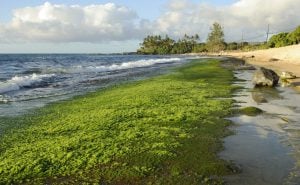
<p>Frequent algal blooms are a symptom of China&#8217;s deteriorating coastal waters. Image: <a href="http://www.greenpeace.org/china/zh/news/stories/food-agriculture/2008/06/algae/">Greenpeace</a></p>

Frequent algal blooms are a symptom of China’s deteriorating coastal waters. Image: Greenpeace

Most of China’s coastal waters are heavily polluted according to the China’s State Oceanic Administration in its annual report released today.

Of coastal areas monitored in 2014, 81% were heavily contaminated, with pollution concentrated in the Yangtze estuary and Pearl River deltas.

The report paints a grim picture of the deteriorating state of China’s marine environment. The main culprits for this demise are “environmental pollution, human destruction and over extraction of resources” according to the government report.

Over half of the 445 major pollution discharge points along coastlines failed environmental requirements, greatly compromising water quality.

The main pollutants found were inorganic nitrogen and phosphates used in fertilisers and oil and chemical waste from industry.

This report is just the latest indictment of the government’s failure to clamp down on polluters and environmental destruction despite its self-declared “war on pollution”.

Although China’s air toxic air quality keeps making the headlines, water pollution is just as urgent a problem. One-fifth of the country’s rivers are toxic, while two-fifths are classified as seriously polluted.

These fetid waters are now threatening ocean ecosystems. More than half the rivers flowing into the sea monitored by the State Oceanic Administration even failed to meet Class V standard (“seriously polluted”) — pouring 17.6 million tonnes of pollutants into the sea, a 5% increase from 2013.

Algal blooms are also on the rise. Both the number and severity of algae outbreaks have grown since 2013, according to the report. The “green tide” over the Yellow Sea this summer was the largest in five years. Algae sucks oxygen from water suffocating marine life. This phenomenon has become an annual occurrence in the region over the past six summers, causing growing alarm.

The situation in Bohai Bay, where a massive oil spill caused an environmental disaster in 2011, is apparently improving, but the ecological damage lingers on. The bay also suffers from growing problems of salt water intrusion and coastal erosion.

As a result of the degradation of China’s coastal waters, some species of fish in the East China Sea are on the brink of extinction – mangrove swamps have declined 73% and wetlands by 57% since the 1950s.

A summary of the full report is available on the State Oceanic Administration website in Chinese.

Cookies Settings

Dialogue Earth uses cookies to provide you with the best user experience possible. Cookie information is stored in your browser. It allows us to recognise you when you return to Dialogue Earth and helps us to understand which sections of the website you find useful.

Required Cookies

Required Cookies should be enabled at all times so that we can save your preferences for cookie settings.

Dialogue Earth - Dialogue Earth is an independent organisation dedicated to promoting a common understanding of the world's urgent environmental challenges. Read our privacy policy.

Cloudflare - Cloudflare is a service used for the purposes of increasing the security and performance of web sites and services. Read Cloudflare's privacy policy and terms of service.

Functional Cookies

Dialogue Earth uses several functional cookies to collect anonymous information such as the number of site visitors and the most popular pages. Keeping these cookies enabled helps us to improve our website.

Google Analytics - The Google Analytics cookies are used to gather anonymous information about how you use our websites. We use this information to improve our sites and report on the reach of our content. Read Google's privacy policy and terms of service.

Advertising Cookies

This website uses the following additional cookies:

Google Inc. - Google operates Google Ads, Display & Video 360, and Google Ad Manager. These services allow advertisers to plan, execute and analyze marketing programs with greater ease and efficiency, while enabling publishers to maximize their returns from online advertising. Note that you may see cookies placed by Google for advertising, including the opt out cookie, under the Google.com or DoubleClick.net domains.

Twitter - Twitter is a real-time information network that connects you to the latest stories, ideas, opinions and news about what you find interesting. Simply find the accounts you find compelling and follow the conversations.

Facebook Inc. - Facebook is an online social networking service. China Dialogue aims to help guide our readers to content that they are interested in, so they can continue to read more of what they enjoy. If you are a social media user, then we are able to do this through a pixel provided by Facebook, which allows Facebook to place cookies on your web browser. For example, when a Facebook user returns to Facebook from our site, Facebook can identify them as part of a group of China Dialogue readers, and deliver them marketing messages from us, i.e. more of our content on biodiversity. Data that can be obtained through this is limited to the URL of the pages that have been visited and the limited information a browser might pass on, such as its IP address. In addition to the cookie controls that we mentioned above, if you are a Facebook user you can opt out by following this link.

Linkedin - LinkedIn is a business- and employment-oriented social networking service that operates via websites and mobile apps.