One of China’s largest tuna fishing companies has outraged environmental campaigners by revealing international efforts to combat overfishing are not working.
Earlier this month, Greenpeace’s Hong Kong branch delivered a letter of complaint to the Hong Kong Stock Exchange, accusing the China Tuna Industry Group (CTIG) of underestimating its exposure to environmental and sustainability risks in its draft prospective to investors, ahead of a public listing of the company.
According to the draft prospective issued by the company, the Chinese fleet had for years breached international fisheries agreements, breaking quotas on catches of the “vulnerable” bigeye tuna in both the Pacific and Atlantic. But as neither the international associations nor the Chinese government sets any quotas for individual companies or vessels, there is no risk of them being held responsible.
CTIG submitted its application documents to the Hong Kong Stock Exchange in June. And in earlier presentations of its prospectus it said it hoped to raise between US$100m and US$150m to expand its fleet, build processing capacity and develop the Chinese retail market. Its listing has now, reportedly, been delayed.
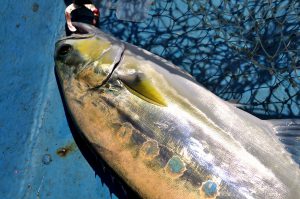
According to the prospectus, CTIG has a fleet of 24 fishing vessels operating in the Pacific and Atlantic oceans. The two premium tuna species it catches, the bigeye and yellowfin, are listed by the International Union for the Conservation of Nature as vulnerable and near-threatened respectively. In the first quarter of 2014 those two species accounted for 96.3% of the company’s profits.
According to data from two regional fisheries management organisations (RFMOs), the Western and Central Pacific Fisheries Commission (WCPFC) and the International Commission for the Conservation of Atlantic Tunas (ICCAT), China, a member of the commissions, has breached the quotas in a number of years. Quotas are allocated to different fishing nations to limit the overall catch and protect vulnerable species from extinction.
In 2006, 2009, 2010 and 2012 the actual catch by Chinese fishing vessels was in excess of the quota allocated to China by the WCPFC – by a total of 7,998 tonnes over the four years. And between 2005 and 2007 Chinese vessels also breached the ICCAT quotas, by a total of 3,799 tonnes.
According to the prospectus, assessments of fishery resources carried in 2013 and 2010 found that the bigeye tuna had not been, or was no longer being, overfished.
However, Greenpeace pointed out that the scientific committee of the WCPFC published an evaluation of bigeye tuna stocks on July 25, saying that stocks were at a warning level and an immediate halt to fishing was necessary to allow recovery.
Greenpeace also accused the company of exploiting gaps in fisheries regulation and basing share price and future profit predictions on assumptions that neither the Chinese government nor international society would in the future bolster protection of tuna stocks or impose sanctions on overfishing.
CTIG admitted that tuna stocks are limited and that any strict quotas enforced by RFMOs or the Chinese government would affect the commercial and financial circumstances of the firm. However, the company’s prospectus said the quotas set by RFMOs are not binding on member states. What’s more, it said that Chinese companies and vessels are not held to account for overfishing.
According to the prospectus, international fishing organisations have not established any sanctions for overfishing. This explains why the Chinese fleet has not yet been punished for breaching quotas. The document also quotes the company’s legal advisors, Liaoning Haida law firm, as saying that even if the international fishing organisations do implement sanctions, China will not be punished for historical violations.
With Tuna stocks falling, there are likely to be stricter catch limits in the near future, suggest observers. In December 2013 the WCPFC adjusted national quotas: up to 2017 China’s bigeye tuna quota will be gradually reduced to 7,049 tonnes, from 10,673 tonnes in 2013. Elsa Lee, senior business advisor with Greenpeace, said that the company’s failure to acknowledge that bigeye tuna catches are very likely to decrease, “should be of genuine concern to potential investors”.
The company prospectus did not reveal actual catch figures, but sales and profits figures indicate that sales of premium tuna species have increased annually: by 1.6 times between 2011 and 2013, to more than 7,000 tonnes.
According to consulting company Frost & Sullivan, the China Tuna Industry Group is China’s largest tuna fishing company, with profits accounting for 22% of the sector’s total.
The Chinese government rarely makes any public response to overfishing by Chinese vessels in far-off waters, despite frequent international criticism. Canadian marine biologist Daniel Pauly and others wrote in 2013 that between 2000 and 2011 the actual average annual catch by Chinese vessels was about 4.6m tonnes—far more than the 368,000 tonnes the country reported to the UN Food and Agriculture Organisation.