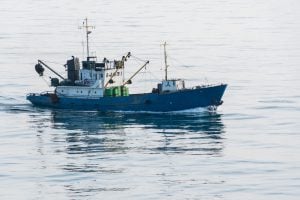
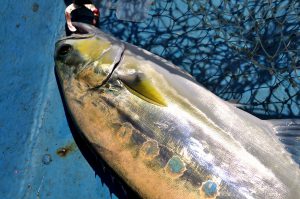
It is well-known that overseas fishing fleets are more cavalier in terms of respect for laws and regulations than their domestic counterparts. There are innumerable examples from all over the world of fishing with gears that are not part of agreements, or catching amounts of fish above agreed quotas.
China’s fleets are no exception to this and, as the largest of any country in the world, could be having a particularly acute impact on the resources of host countries.
Overseas fleets, also known as “distant-water fishing fleets”, are a country’s fishing vessels which operate inside the 200 mile Exclusive Economic Zones (EEZs) of other countries, and less commonly further offshore, in the High Seas.
For a small fee, some countries – Panama, Liberia, Belize, for example – will provide so-called “flags of convenience” to the vessels of distant-water fishing countries, disguising the vessels’ true country of origin.
Most distant-water fishing takes place in the context of a paragraph of the United Nations Convention on the Law of the Sea (UNCLOS) which states that the “surplus” of fish not caught by a given country in its EEZ must be made available to the distant-water fleets of other countries against a fee that is part of a negotiated “access agreement”. Most of these agreements are international public documents, and are published by the United Nations, or the European Union.
A lack of respect for law in overseas fishing fleets is compounded by problems with the regulations themselves. Negotiated access agreements, when they do exist, tend to award very small sums to the host country, well below any reasonable value of the fish that are caught. They generally are, to use a famous term, “unequal treaties”.
China’s distant-water fleets share all of these characteristics, but also have additional noteworthy features:
1) China’s own, official publications show that its distant water fleet is huge, much larger than those of other countries;
2) They operate largely without access agreements, or under access agreements that are secret, in which case one cannot establish whether they are as unfair as those offered by other distant-water fishing countries, or not; and
3) The Chinese authorities and scientists are not publishing catch statistics or stock evaluations for any of these fisheries.
Thus, many knowledgeable people assume that China’s distant-water fleets – legally or illegally – catch well above the surplus in the countries where they operate and hence deprive the host countries of fish they could have caught.
This is particularly acute in Africa where Chinese distant-water fleets are massively deployed, again on the basis of secret agreements, or even in the absence of any agreements. There, they may directly compete with local artisanal fisheries, which in several countries fail to provide fish for consumption to the local population, leading to unemployment and endangering long-term, local food security.
It is, therefore, important to assess the impacts of such distant-water fisheries, including China’s, on the host countries’ fisheries resources.
To investigate the extent of the catches by China’s distant-water fleets in the absence of any detailed catch statistics provided by China, we have undertaken a study consisting of four steps:
- Step 1: assessing the presence of Chinese vessels during the period 2000-2011 from both Chinese government and fishing company websites and the press of all maritime countries in the world, including reports in 16 languages;
- Step 2: assigning a number of Chinese fishing vessels to each country where we had evidence of Chinese vessel presence. We did this for five different types of fishing vessels (trawlers, purse seiners, etc.). We also assigned a range to the number of vessels, thus reflecting their uncertainty;
- Step 3: multiplying the number of vessels in each country from Step 2 by the annual catch typical of fishing vessels of this type, which we knew from earlier work on the economics of fishing. We then summed this catch across all countries, by continents;
- Step 4: repeating Step 3 for 10,000 times to account for the uncertainty in steps 2 and 3, and assess the uncertainty in the total catch estimate.
We found in Step 1 that China operates in over 90 countries, and all oceans and regions of the world, except in the Caribbean, the North Atlantic and the Arctic. Steps 2-4 did not provide an exact value for the catch of distant-water fleets by China, but rather estimates ranging from 3.4 to 6.1 million tonnes per year between 2000 and 2011, with a most likely value of 4.6 million tonnes per year.
We do not think that our estimate is definitive, only that it is a possible estimate, and one that is more likely than the official estimates of China’s distant-water fishing catch as submitted by China to the Food and Agriculture Organization of the United Nations (FAO).
We hope that our publication will generate a debate in China and in the countries in which China operates, notably in West Africa, where it takes the bulk of its catch, about three million tonnes per year.
Now that China is a fully participating member of the international community, it will have to adhere to its rules. In fisheries, this means an adequate level of transparency and the provision of reasonable catch data to national, regional and international fisheries management organisations, and which scientists of various countries can use to make inferences on the state of the stocks.
We personally believe that this will happen and we look forward to working with Chinese colleagues on this.