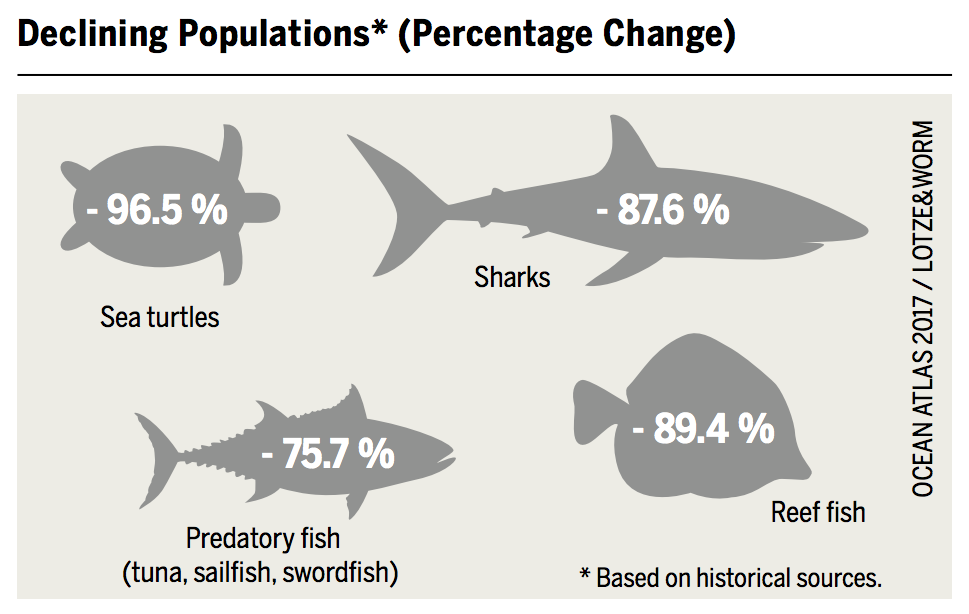
Illegal fishing accounts for as much as one in three fish caught in parts of Africa and South Asia, and an estimated 15-30% of global annual catches, according to some studies. This is both depleting our seas and also impoverishing local communities that rely on fishing, encouraging economic migration, and increasing the risk of people trafficking and human right abuses for those involved in the trade.
As the world’s largest seafood markets, Europe and China are both in a position to do something about it. Europe is the largest importer of fish but China is expected to overtake it in coming years according to the United Nations Food and Agriculture Organization. China is also one of the biggest seafood producers, accounting for approximately 20% of fishing vessels, so it has a major role to play in tackling illegal fishing activities.
We caught up with María José Cornax, Europe policy and advocacy director for Oceana at the recent Our Ocean Conference, organised by the European Commission in Malta.
Cornax is at the vanguard of the fight against illegal, unreported and unregulated (IUU) fishing, and contributed to the new European Union strategy on curbing this practice.
The interview has been edited and condensed for clarity.
Charlotte Middlehurst (CM): What are the big challenges to stopping IUU fishing?
María José Cornax (MJC): The main challenge that we are facing is gathering international cooperation in the first place. Secondly, transforming these commitments into real action.
There are two main aspects to fighting IUU fishing globally. One is how to control the fleets. Controlling the fleet’s flag [the country under which it is registered] is the first step. We cannot, for example, have fleets flagged to Mongolia – an inland country – fishing in contentious waters.
The second aspect is controlling the market. The European Union, Japan and China are major global markets for fish. These three countries should harmonise a truce, along with the United States, in order to ensure that all vessels passing through marine boundaries are legal and their origin and practices are completely verified and sustainable.
This is a major challenge that needs to be tackled through a number of rules, starting with proper traceability of fish products. Secondly, full control of the catching vessel that is exploiting this fish. This is essential, because if legal fish doesn’t have a market then it doesn’t have a reason to exist.
CM: On transparency, you announced a European public database with information about all registered catches that enter the European market. Can you explain a bit more about the need for transparency and how this database will contribute to that?
MJC: Transparency is an essential tool for eliminating IUU fishing. Just to simplify the issue a little first, tackling illegal fishing cases one-by-one is impossible – the environment and the oceans cannot afford this given the magnitude of this practice. Therefore, we need to know exactly who the fair players are in the game, who are authorised to fish, where are they operating, what are they fishing, and how.
We need a regulatory framework for these private agreements that fishing companies are signing with host states as a key weapon against bribery, corruption and other forms of wrongdoing that are happening on a daily basis. Transparency and public access to the data is an essential tool not only for fighting illegal fishing but for the sustainable management of fisheries.
CM: China has set out an ambitious marine expansion strategy in its latest 13th Five-Year Plan as part of an ambition to develop its Blue Economy. It is already expanding into the Antarctic through its tourism and fishing sectors. And there’s also a plan to grow its deep water fishing fleet to take the pressure off its coastal waters. What do you think China can do in terms of international engagement and domestic policy to work towards tackling illegal fishing?
MJC: First of all, to develop a 21st century industry, China needs to adapt and put in practice 21st century standards. In fisheries this means securing full control of all the fishing fleets regardless of where they are fishing, or from the country whose flag they are flying. China’s fleet is not only flagged to China, its fleet is also flagged to Panama, flagged to Belize. All these countries have a responsibility.
They also have to care about their nationals involved in IUU fishing, as all the countries are doing. We follow the money. Responsibility for illegal fishing activity does not belong to an individual vessel, it belongs to a company based in a country. China has many companies inland that are, let’s say, perpetrators of IUU fishing activities at the global level. A strong sanctioning system against the companies benefiting from these illegal practices is essential to move forward and tackle illegal fishing.
And the third aspect, the crucial one, concerns the role that China plays in the market and rising fish consumption in China. China is not only a superpower in terms of a fishing fleet, it’s also a superpower in importing fish. It’s the market that companies are all looking for, meaning that they have an extraordinary responsibility in ensuring that imported fish is legal and sustainable.