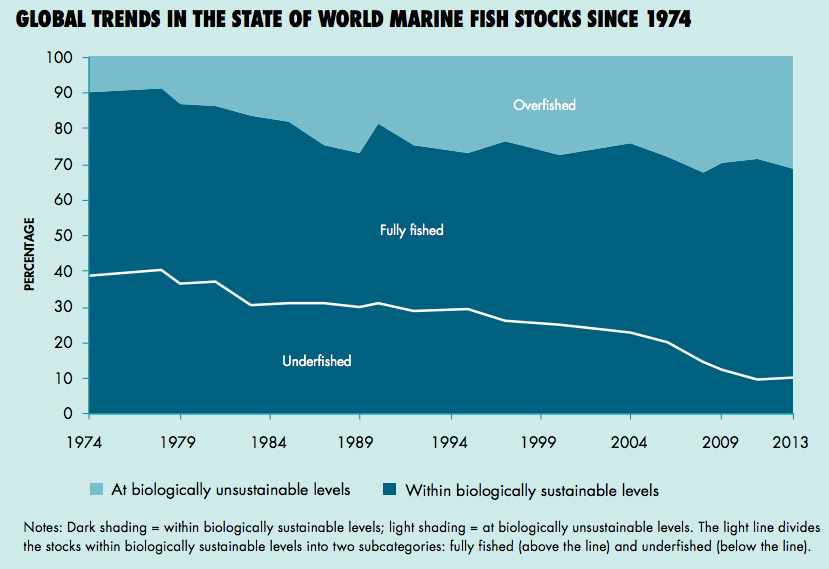
It is estimated that over the last fifty years almost half of the world’s fish species and population have disappeared. This is due to the vast expansion of global fishing fleets, increasing exploitation of seabed resources and climate change, which humanity has so far failed to prevent. Traces of human activity and interference can now be found from the summit of Mount Everest to the depths of the Mariana Trench.
The state we’re in
One billion people worldwide rely on the oceans for their food but over-exploitation and damage of marine environments is threatening this vital source of nutrition. To ensure that oceans remain alive and plentiful, the United Nations in 2015 made the protection and sustainable use of marine resources one of its 17 sustainable development goals (SDGs), a set of shared ambitions designed to reduce poverty and ensure prosperity for all.
There has long been a scientific consensus on the reasons why fish species are disappearing and stocks shrinking: over-fishing, destruction of marine habitats, and environmental damage caused by climate change are all responsible.
A consequence of over-fishing is that fish populations cannot recover, which has a devastating impact on marine food chains that are highly interdependent. Meanwhile, oil drilling and mining damage the sea floor. Oil leaks often result in widespread death of surrounding marine organisms.
Climate change is also having an impact on marine environments. In 2016 one quarter of the coral in the Great Barrier Reef died due to rising temperatures and acidification. Two thirds of the world’s largest reef already suffers from “bleaching” (the loss of algae). If global emissions are not sharply reduced there may be no coral left anywhere in the world by 2050. And as coral reefs collapse, so too do the marine systems which they support.
This is the paradox of development that humanity faces. Technological advances – from sailing vessels, to diesel-powered ships, to GPS (Global Positioning System) guided navigation – have taken us into deeper, richer waters. But as fishing boats have followed and as offshore drillers have become more experienced, the ocean has become a victim of our progress.
China and the future of the oceans
In contrast with the enthusiasm with which we have taken from the oceans, conservation efforts have always lagged behind. It was only after years of unregulated industrialised ocean fishing that the huge harm caused by illegal, unregulated and unreported fishing (IUU) was recognised. Only in 2006 was a comprehensive ban on the practice of bottom trawling, where nets are dragged along the sea floor causing devastation to marine habitats, put in place.
There are now management bodies in place for some of the world’s major fishing regions. For example, the Convention for the Conservation of Antarctic Marine Living Resources, which manages catches of shrimp and cod in the Antarctic Ocean; and the International Commission for the Conservation of Atlantic Tunas, which manages the catches of species of tuna and skipjack.
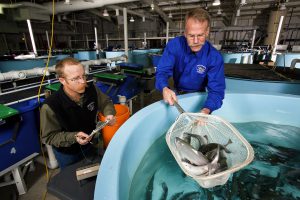
These bodies set and adjust fishing quotas to help maintain balanced fish populations. There are also policies designed to prevent over-fishing at all stages of the industrial chain. Meanwhile, captive fish farming is increasingly used to reduce pressure on ocean fisheries.
But illegal fishing continues, with vessels working under flags of convenience (FOC), whereby a merchant ship is registered in a country other than that of its origin, which makes illegal fishing activities difficult to track. The practice of offloading catch on to other vessels is also on the rise. Known as transshipping, the undocumented transfer of caught fish, though not illegal, makes it easier for criminals to operate.
Closer to shore, fish farming brings its own problems. Intensive farming and antibiotics used in feed pollute inshore waters. Much of the feed for farmed fish consists of “fish meal”, which is made of fish caught from the ocean, adding considerably to the burden already placed on global stocks. Fish farming has changed the way in which we exploit our oceans, not prevented it.
Will management of our marine resources continue to be decided by ad hoc, short term thinking? What are the gaps in national fishing policies? What constructive action can we take to reduce pollution from fishing and fish farming? How will new technology help us better maintain fish stocks? And is there a way to reduce the impact of climate change and development of the oceans and coasts?
Solutions must recognise the need to protect resources at the same time as ensuring communities that rely on the sea can continue to develop.
What is China’s role in tackling these questions? China’s fishing fleet is expanding rapidly, and the country accounts for 18% of ocean catches worldwide and over 60% of fish farming, according to the Food and Agriculture Organization of the United Nations (FAO). The country’s distant-water fishing fleet grew by nearly 2,600 vessels (the US has one tenth as many) in 2014-2016 alone. Can China find a sustainable way to provide a population of 1.3 billion people with fish?
Over the next two years China Dialogue Ocean will publish a series of articles on fisheries and the marine environment, covering the damage caused by illegal fishing, the protection of the oceans during development, restoration of inshore environments, recharging of fishery resources, loopholes and improvements in fisheries laws and policies, marine pollution, and the impact of climate change on the oceans, as well as new approaches, ideas and solutions to combat these problems. During this process we will focus on China’s role in both the development and the protection of the oceans.
Our oceans are not a mere source of food, they are an essential part of the global ecosystem upon which we all rely for our survival. The health of the oceans is our own health, and concern for the future of the oceans is concern for our own future.