This month the Economist World Ocean Summit in Abu Dhabi brought together policymakers, business and tech leaders, scientists and civil society groups to discuss the threats to the world’s oceans and the steps needed to create a sustainable ocean economy.
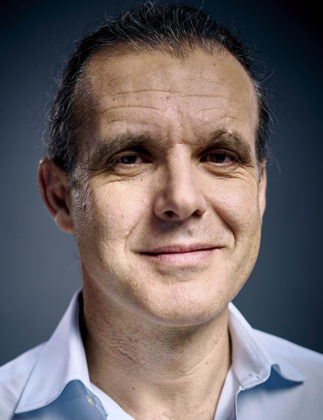
chinadialogue attended the summit and talked to Enric Sala, National Geographic’s explorer in residence, about his mission to help protect the world’s last pristine marine ecosystems.
What does it mean to be an explorer in residence, can you explain your mission?
Explorer in residence sounds like an oxymoron, but my job is to help protect as much ocean as possible. So I work with research and scientific expeditions, economic analysis and policy discussions to inspire country leaders to create national parks in the sea.
What is the focus of your work?
In the last 10 years we have been focusing through our National Geographic Pristine Seas project mostly on areas that are still in good shape. Some of them are near-pristine and we want to save them before it’s too late. But unfortunately we’re running out of these places. And in the next 10 years we are going to be working in places that are closer to human use and human habitation.
Is there one place where human impact on our oceans has affected you more than others?
We’ve been to uninhabited coral reef islands in the middle of the Pacific. No people. You jump in the water and you are surrounded by sharks, beautiful corals … but then you go on the beach, and it’s full of plastic. This is really, really shocking. But I grew up in the Mediterranean Sea, which is historically the most overfished sea in the planet. So I started with a pretty shifted baseline.
It seems every week there is a new story highlighting the human impact on the oceans. It must be quite confronting to actually see it.
The human footprint is everywhere, and it’s really sad. Plastic is everywhere now, from the shallows to the deepest part of the ocean. And most of the plastic in the oceans we actually cannot see, as it’s in the form of microscopic particles. But there are still a few places that have not been fished, that still show us what the ocean used to be like thousands of years ago, and that can give us hope.
You left a career in academia to become a full-time conservationist, can you tell us more about that?
Yes, I used to be a professor at the University of California, and my job was to study the impact of humans in the ocean: fishing, climate change. And then one day I realised that all I was doing was rewriting the obituary of the ocean with more and more precision. So I decided to quit academia and dedicate my whole life to ocean conservation.
Do you think we need more people to follow your example?
Yes! We also need the academics though, people to research and monitor changes. But we cannot continue just writing the obituary of the ocean – we need to act. Some politicians and some industry people say that we don’t have enough data, but this is denying the obvious. We have enough science to know what the problems are, and we know what the solutions are. So we need scientists, but we need many more people working on applying the scientific findings to actual action that is going to reverse the ocean degradation.
Who is leading the action?
Some countries are leading. Palau for example, this little country with big waters around them in Micronesia, decided to close 80% of their waters to fishing. Chile has protected 42% of their waters, the UK is almost at 30%, the US also has more than 20% protected – so it can be done.
Do you think that’s the most important thing that needs to be done fast – protecting these marine areas in parks and reserves?
There is an international agreement to protect 10% of the ocean by 2020, but the science is telling us that we need half of the ocean in a natural state. We are going to be pushing with many other partners on 30% of the ocean protected by 2030 as a milestone.

How can we get people to care about these remote and wild marine areas, that they most likely will never visit, in the same way as famous terrestrial national parks like Yellowstone or the Serengeti?
What we need is people to care about their own environment, their local environment. The way we are going to be able to scale up the success stories is if everybody feels this sense of awe and wonder and loves their local creek, their local beach, their local forest. And works hard with their community to make sure they are not destroyed.
What is the biggest challenge right now in terms of getting ocean conversation moving forward?
There are three main issues: climate change, pollution – now mostly plastic – and overfishing. We know how to fix overfishing, it just takes political will. We need to fish less. But there are entrenched interests, of course, with high political power and there are organised national and transnational mafias – basically organised crime around some of the large industrial fisheries. For the pollution, it has to be a combination of government regulation that forces the industry to develop plastic that is degradable, recyclable, but also to reduce the amount of single-use plastic. And then the consumer consuming less. But you cannot put all the burden on the consumer – government and industry, especially industry, has a bigger responsibility. And then when it comes to climate change there is only one thing which needs to be done which is to reduce our emissions. We need to go carbon neutral by 2050 – that’s it. Everything else is just tactics to achieve that goal.
Does it frustrate you that plastic gets so much attention at the expense of other threats to the ocean, or do you think if that’s someone’s way into wider environmental awareness then that’s a good thing?
Unfortunately, plastic pollution has become such an issue, but hey, whatever it takes to make people see the problem!
What’s your next big expedition?
We just came back from Antarctica, in partnership with Chile and Argentina’s governments to support a proposal they have to create a series of marine protected areas around the Antarctic peninsula. And now we are going on an expedition to southern Costa Rica.