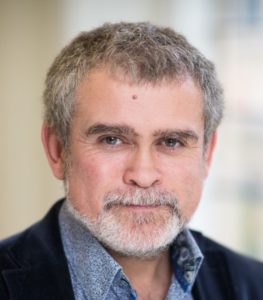
Professor Alex Rogers is one of the world’s preeminent marine biologists, who has advised the UN, Greenpeace, WWF and G7 countries on ocean ecology. He is science director of the REV Ocean foundation, a visiting professor and senior research fellow at Oxford University and was a scientific consultant on the BBC’s Blue Planet II series. He has three marine species named after him, including the zombie snot worm, Osedax rogersi.
His book, The Deep: Hidden Wonders of Our Ocean and How We Can Protect Them, was published this year. It’s full of engaging anecdotes about childhood holidays which led to his fascination with the sea, and vivid descriptions of the adventure of discovering hydrothermal vents deep in the Southern Ocean. But it also catalogues the many ways in which humans are destroying marine life through overfishing, pollution and climate change.
Jessica: A key UN report this year showed that human actions have “severely altered” the biodiversity in nearly 66% of marine environments. What are the biggest drivers of loss?
Alex: Overfishing and bycatch – it is still going on rampantly throughout the oceans. And it is still being done in a way which is highly damaging to the broader ecosystem.
Do you find it frustrating that there is currently so much focus on plastic pollution when fishing is arguably more damaging?
I certainly do on a personal basis. Daniel Pauly, a famous fisheries ecologist, recently put it like this: imagine you have a patient lying in hospital with all the most fantastic modern equipment available, and yet nobody will treat the patient. We know exactly what the problems with fisheries are and how to solve them, yet greed, self-interest and corruption are preventing them from being tackled on a global basis.
How will daily life be impacted if we don’t protect marine biodiversity?
One obvious way is that we will lose out in terms of food that we can harvest from the ocean. That may not directly affect us in developed countries… but certainly in developing countries, that will translate to impacts on food security and damaged livelihoods. It also affects tourism, and coastal protection – loss of ecosystems like mangrove forests, seagrass beds, kelp beds and coral reefs exposes coastal zones to the increasingly severe effects of storms and sea-level rise which we are seeing from climate change.
This year’s UN climate talks in Chile are being touted as the “blue COP”, with a drive to place ocean health high on the agenda. Do you think that’s right?
Absolutely. The ocean is by far the largest, labile pool of carbon in the Earth’s system. It’s taking up about a third of CO2 emissions that we are producing at the moment, and of that, one-third is taken up just in the Southern Ocean alone… It’s more than past time that the IPCC [the UN’s Intergovernmental Panel on Climate Change] and governments paid more attention to the ocean’s role in terms of climate-change mitigation and also to the influence of climate change on the oceans.
There is a growing climate emergency movement. Are we at the same tipping point with the oceans? How bad is it?
At the moment, we are facing two crises that are interdependent. Firstly, the climate change crisis, and frankly that should have been treated as a global emergency 20 years ago. The only reason that the public is finally waking up to the problem is that the changes in climate are becoming so extreme.
The other crisis is the biodiversity crisis. Essentially we are in a situation of accelerating biodiversity loss in the ocean … and there may be far more extinction going on than we actually realise. Despite so many international conventions and agreements calling for monitoring of the marine environment and of biodiversity, it’s just not happened. And that really needs to change.
How important are mechanisms like marine protected areas (MPAs)?
MPAs are extremely effective at maintaining biodiversity, increasing the abundance of animals within them and increasing resilience of the ecosystem to overfishing and climate impacts. The problem is that there are not enough of them – and not enough are well-enforced.
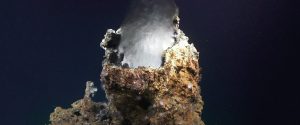
In your book, there is a fantastic chapter on discovering the deep-sea hydrothermal vents in the Southern Ocean. How do you feel about the prospect that such vents are being explored for mining?
A lot of the attention has been on the Clarion Clipperton Fracture Zone, an area in the equatorial Pacific where there are large deposits of polymetallic nodules on the seabed … And although there has been a recent spurt of scientific research in that region, all that has really told us is how little we actually know. It hasn’t given us the level of knowledge we actually need to manage mining. So scientists are deeply concerned about that.
But there are other mineral deposits as well: cobalt crusts on seamounts, and seabed massive sulphides on vents. And those are even more concerning in some ways, because hydrothermal vents have a very high level of endemism [species found nowhere else], they are rich in terms of biotechnological potential … And also vents are actually quite small and therefore very vulnerable to disturbance.
What’s your view on a moratorium?
This is a decision that should be made by society. I am a conservation-minded scientist so obviously I don’t want to see another large-scale activity impacting our ocean, which is already under severe stress. But if society has to make a decision … it has to have a full understanding of what the impacts of this activity are going to be and how to best manage that so it has minimal damage. And at the moment we are not even in the ballpark of having that level of knowledge. So there should be at least a 10-year moratorium on any mining in the deep ocean.
Less than 10% of two million marine species have been described. Why is it so important to know more? How will greater knowledge help conservation?
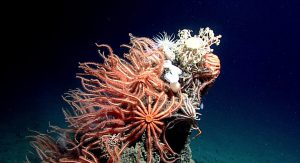
It’s important we know more about what’s in the ocean. Not just the deep ocean, but all of it. One of the problems is just lack of information. Loss of biodiversity is a symptom that things are going wrong, that the way we are interacting with our ecosystems is not right. And if we don’t have that information, then we don’t understand what impacts we’re actually having.
In your book, you say we have lost sight of what lies beneath the ocean and why it matters. What can individuals do to help?
Number one – educate yourself about the ocean. Understand what’s in there, why it’s important. But also, educate yourself about what your government is doing on your behalf in terms of managing activities that are impinging on the oceans.
You have some lovely descriptions in your book of biodiverse places. Which area for you showcases the greatest biodiversity?
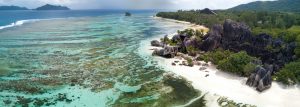
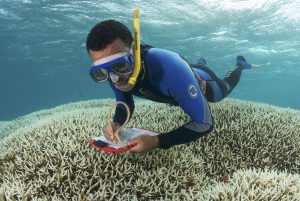
Coral reefs are just incredible. But good, healthy coral reefs are getting increasingly difficult to find … but you can see really amazing stuff just by going down to a rocky shore. You can find really remarkable biodiversity on your doorstep.
And finally, you have the honour of having a species named after you?
I’ve actually got three named after me. The Osedax rogersi, which is the zombie snot worm! I’ve also got a carnivorous sponge, Chondrocladia rogersi and a sea spider, Nymphon rogersi.