China sent a signal to the world from France last month: it wants to be seen as a responsible and engaged ocean player.
From its plenary meetings to side events, the third UN Ocean Conference (UNOC) in Nice was brimming with China’s academics, civil society representatives, and high-level officials, including vice president Han Zheng. They were keen to discuss their nation’s contributions to marine science, protecting the high seas, and more.
Showing up, and making waves
China’s positioning at the conference was in marked contrast to that of the United States.
At the previous Ocean Conference, in 2022, the then-US special presidential climate envoy John Kerry had led the US delegation to Lisbon. He advocated for multiple initiatives, including conserving 30% of the ocean. This time, the US administration only sent observers to the south of France, after denouncing the UN Sustainable Development Goals – including SDG14, which is the main focus of the UNOC.
The Sustainable Development Goals are a package of 17 interconnected targets set by the UN in 2015, which are supposed to be achieved by 2030. They provide a detailed framework for addressing the world’s most pressing social, economic and environmental challenges.
Goal 14 is to “conserve and sustainably use the oceans, seas and marine resources for sustainable development”. Dubbed “life below water”, SDG14 includes targets to reduce marine pollution and ocean acidification, make fishing more sustainable, support artisan fishers and protect and restore ecosystems. Some of these targets have already been missed.
The goals most closely linked to climate change include those on “affordable and clean energy” worldwide, and taking urgent “climate action” to limit the extent and impacts of climate change.
At the conference’s first plenary session, vice president Han said “all parties should practice true multilateralism” and “jointly observe international rules on the ocean” to achieve SDG14.
Such calls for multilateralism also came from other leaders of other countries. But while multilateralism was certainly a buzzword at the conference, Dialogue Earth noted the officials did not name the most notable absentee.
Chinese state media, though, spelled out the absence of the US, with Xinhua pointedly headlining its coverage: “UN ocean conference adopts declaration amid US scientists’ absence.” And later in June, China’s UN envoy openly called out the dearth of official US participation in the UNOC and other aspects of global governance, during a meeting of the UN Convention on the Law of the Sea in New York.
The ratification race
Ocean experts were listening out for other matters during Han’s speech.
“Vice president Han’s speech is a window on the future focus of China’s marine work,” says Zhang Yimo, director of WWF Beijing’s Sustainable Blue Economy Programme.
Sharing scientific knowledge and building bridges with other countries through ocean governance were high on China’s UNOC agenda. As Han said: “China has started to jointly build the 21st century’s Maritime Silk Road and actively work with all parties to promote marine connectivity and practical cooperation.”
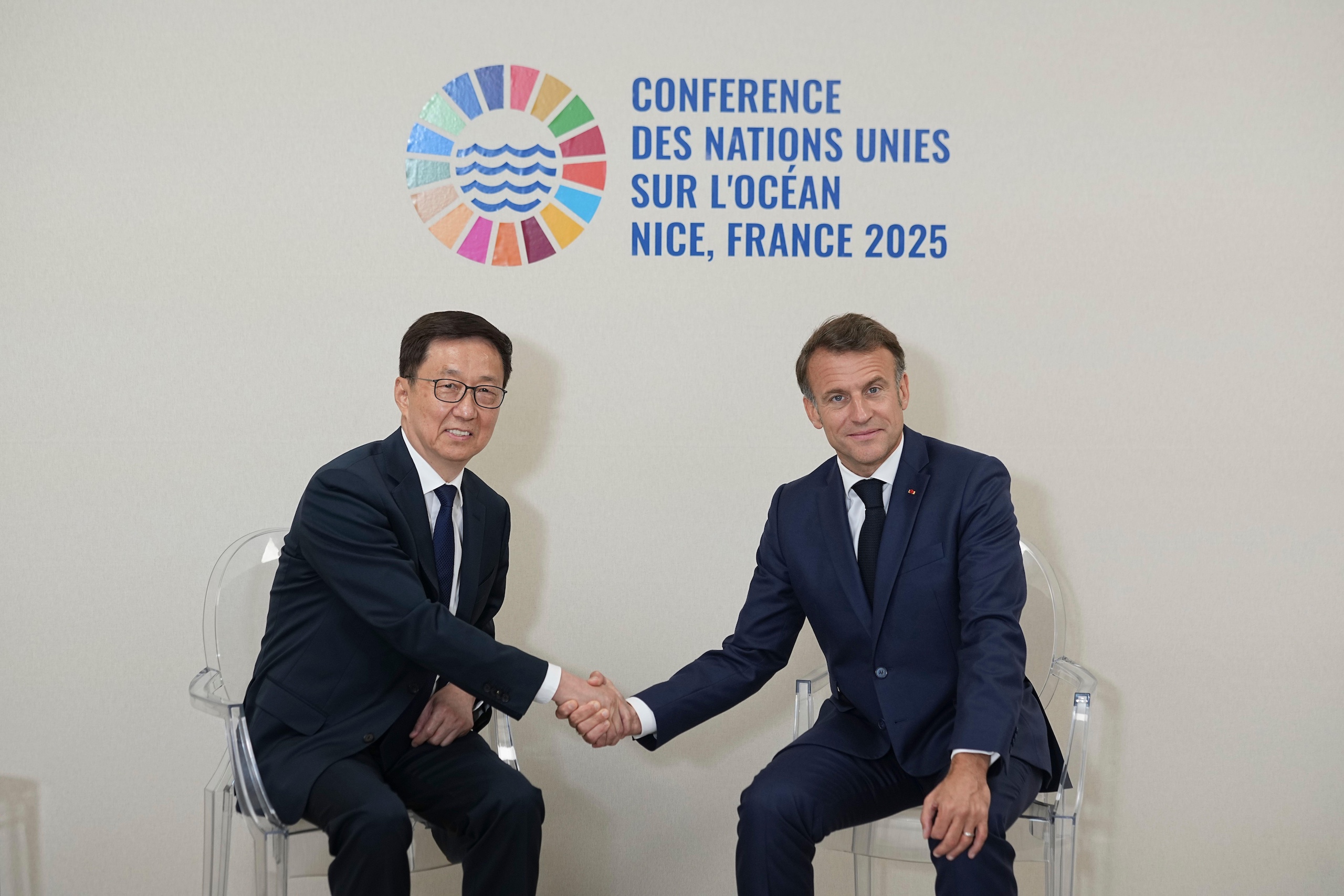
Han said China will launch over 100 bilateral and multilateral cooperation programmes to support developing countries, including small island states, achieve the UN development goals in the next three years. He promised to provide 5,000 placements for people from such countries to be trained in sustainable marine issues.
Han also said China is “actively pursuing the domestic ratification process” of the High Seas Treaty. The treaty includes conservation measures such as environmental impact assessments for human activities, sharing genetic resources and creating protected areas in international waters. It will only come into force when 60 countries have ratified it; at the time of publication 50 countries had done so. China is yet to but has indicated it will.
The speech was China’s first public announcement that it is going through the domestic ratification process, says Zhou Wei, Greenpeace East Asia’s oceans project manager.
She says China is involved in a wide range of marine activities. Ratifying the High Seas Treaty involves many governmental departments and is therefore complicated and time-consuming. Given the ocean’s growing pressures and the urgent need for protection, she says countries that have yet to ratify the treaty, including China, should do it soon. This will allow the work on protected areas and other treaty measures to commence.
Boosting marine science
Guo Hongyu, deputy director of the Beijing-based environmental think-tank Greenovation Hub, championed scientific exchanges at a UNOC side event co-hosted by Dialogue Earth.
She said successfully creating protected areas in international waters will require international cooperations of scientists, making efforts to turn the available science into tailored policy options: “Scientific consensuses lay solid foundations for policymaking.”
“As China’s research fleet and scientific capacity develop, we believe scientists from China can contribute more to high sea protection,” Guo adds.
China’s marine science received considerable attention in Nice. “Science was a thread that ran through China’s participation in the conference,” says Zhou.
This focus echoes China’s growing role in the UN Decade of Ocean Science, a 10-year framework for exploring the ocean from the surface to its depths.
The deep ocean and its organisms, vitally important to the planet’s health, remain a largely undocumented and unexplored mystery. Many in the ocean field want a scaling up of deep-sea research, an area where China has noticeably advanced in recent years.
Some of China’s deep-sea discoveries are presented on Seamount Digital Intelligent Systems, a data platform launched at the UNOC. Elsewhere at the conference, researchers unveiled the China Global Ocean Fusion Dataset 1.0. This global ocean climate dataset supports seabed-resource exploration, marine forecasts, emergency sea rescue and other ocean activities.
What about China’s far-flung fisheries?
Ending destructive fishing practices, especially in areas designated for protection, was a pressing subject for many nations at the UNOC.
China has one of the world’s largest distant-water fleets, which often faces sustainability questions. Zhang of WWF says the country is open to suggestions on the issue of distant-water fisheries. For instance, he points out that the 2023 white paper “Development of China’s distant-water fisheries” specifically recognises the value of communicating with international NGOs, such as WWF and Greenpeace. Indeed, WWF works with researchers to provide sustainable suggestions to policymakers in China.
Zhang says he has seen an improvement in China’s tackling of illegal, unreported and unregulated fishing. He is optimistic there will be more progress, especially since China joined the Port State Measures Agreement, a global treaty to curb these activities.
On the other hand, sustainable fisheries management did not appear to be a priority for China’s UNOC delegation, despite representing the world’s largest fisheries industry.
“This is due to the division of work,” explains Zhang. He says fisheries management in China is led by the Ministry of Agriculture and Rural Affairs. The UNOC side-event programme revealed that many of China’s engagements were led by the Ministry of Natural Resources, under its vice minister, Sun Shuxian.
But this does not necessarily mean the country is slowing down on sustainable fisheries governance. For example, the work underway on updating Chinese fisheries law addresses the use of harmful fishing gear, including bottom-trawl nets, says Zhang. “Therefore, we look forward to direct and strict management on trawling once the revision comes into force.”
Voices from civil society
The roles played by China-based NGOs in encouraging ocean protection do not often earn international attention. At Dialogue Earth’s UNOC side event, the Qingdao Marine Conservation Society (QMCS), Greenovation Hub and a group of other China-based NGOs explored this under-discussed topic.
Wang Songlin, the founder and president of QMCS, kicked off the event by stressing the importance of engaging China, which has the world’s largest fisheries and aquaculture industry – and many irreplaceable biodiversity hotspots.
He also underscored the efforts China has made in ocean governance. That includes leadership during the negotiations and adoption of the Kunming-Montreal Global Biodiversity Framework, which set a target to protect at least 30% of Earth’s land and 30% of its ocean by 2030.
“China has been an active contributor to the global agenda of sustainable [ocean] development,” says Wang – and it will “play an increasingly pivotal role”.