China’s Fisheries Law, which determines how those working in the sector can make a living, is being revised. The latest draft was published by the Standing Committee of the National People’s Congress last month while a public consultation process was also completed.
The revisions are intended to bolster protections for fishery resources and so promote high-quality development in the sector. Compared to the first draft published late last year, the second adjusts rules on conservation measures and permitted fishing gear. For example, it requires local governments to disclose more information on the nature, extent and duration of seasonal fishing bans.
In responding to the new draft, civil society and the media have continued to focus on the implications for fishers themselves – they say the draft’s emphasis on conservation and combatting overfishing will further restrict their work.
With the number of fishing vessels being reduced in recent years, many have had no option but to seek alternative employment. Ensuring they can find jobs is key to effective fisheries management.
One of the aims of the law is to “protect the legitimate rights of fishery workers.” This has led to debate over the best way to balance conservation with livelihoods.
Dialogue Earth discussed with fishers themselves what the revision means for their rights and futures, and also consulted experts.
Fishers’ rights: A limited response
The new draft adds protections for fishers’ rights that were not in the earlier proposal published in late 2024. It requires governments at county level and above to provide support as fishers transition into new employment, boost skills training and ensure their social rights.
Apart from that, though, the draft has little to say about the fishers. Wang Canfa, a professor at the China University of Politics and Law, explains that the point of the Fisheries Law revision is to “improve fisheries management”.
“The revision intends to strengthen oversight, management and law enforcement for the whole fisheries ecosystem. The fishers are not the focus.”
Changing the rules
The new draft clarifies some rules on fishing practices. It provides detailed regulations on how local governments should manage fishing bans, including the need to disclose their extent and the nature and duration of the restrictions. This information must be specific, well publicised and decided upon scientifically, based on the state of fishery resources.
The revision also makes changes to rules on fishing gear. The earlier draft proposed a “whitelist” of types of gear permitted for use, with the manufacture, sale and use of any unlisted gear to be prohibited.
That whitelist is not in the new draft, which instead continues the existing approach: a blacklist of gear that must not be made, sold or used. It also supports the use of gear on a separate, as-yet-unpublished list of “recommended fishing gear”.
The revision also maintains the ban on fishing by unregistered vessels that lack an official name, number, certification or homeport registration, and on the provision of any services to those vessels.
Changing jobs: Challenges and support
As the rules on fishing change, fishers must adjust accordingly or simply stop working. The new draft has little to say on compensation mechanisms during that process. It only states that when aquaculture licences are withdrawn, the authorities must pay fair and reasonable compensation for losses incurred.
Despite the lack of coverage in legislation, local governments have long been handing out compensation to affected fishers.
In the 1980s, with China’s fishery resources in decline, the government restricted the number of fishing vessels, the number of people working in the industry, and the amount of fishing allowed. Local governments offered to buy back boat registrations, encouraging fishers to quit.
A closed season affecting China’s entire coastline has also been imposed each summer since 1995. Currently this lasts from 14-16 weeks, affecting over 100,000 vessels and many hundreds of thousands of workers.
To help those who lose income during the closed season, the government has been paying out “fishery stewardship subsidies” since 2008. These are also intended to compensate fishers for their subjection to “responsible fishing measures”, such as marine animal protection rules and port entry and exit reporting regulations.
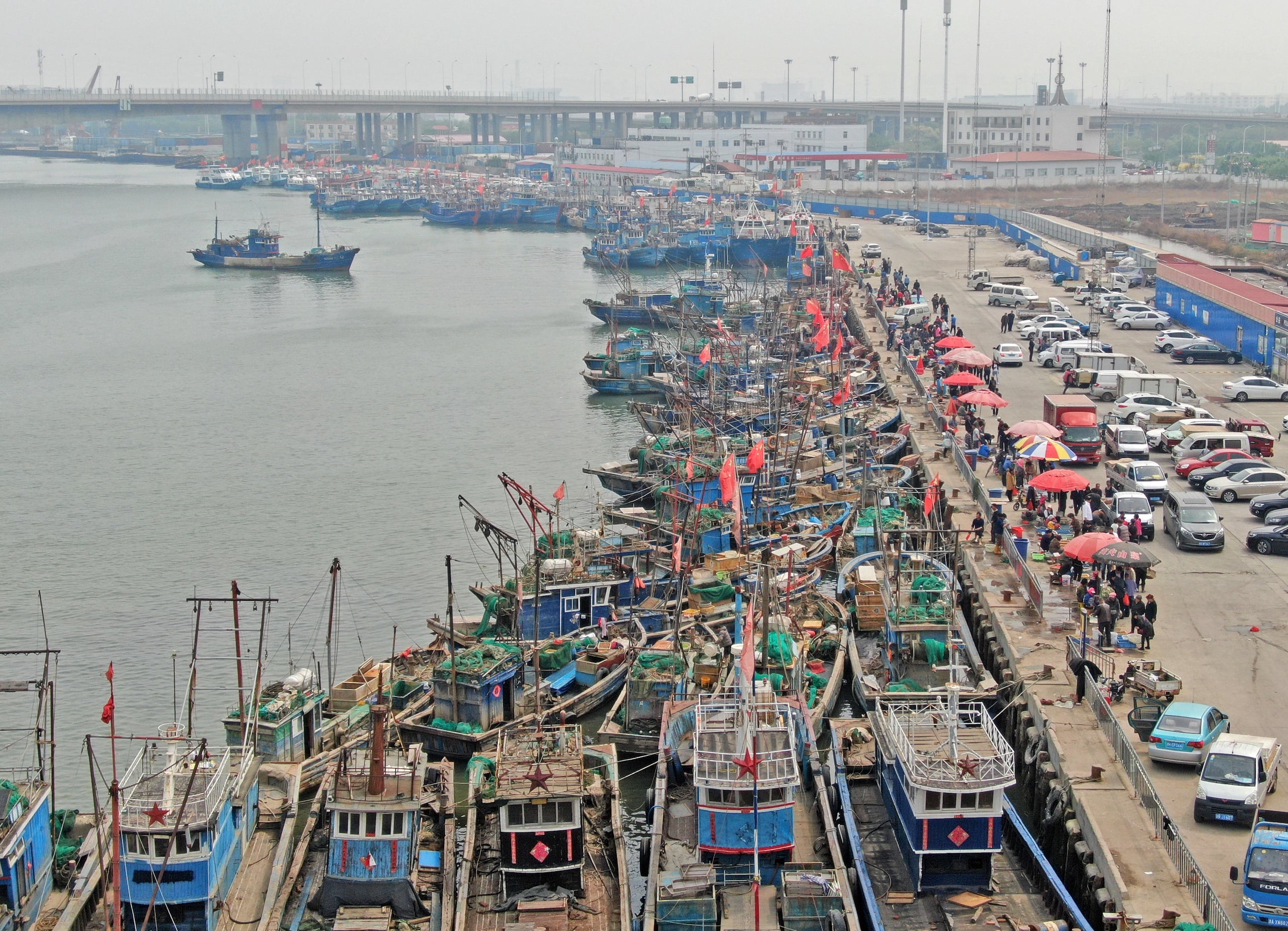
Liu Cuibo, 60, lives in eastern China’s Tianjin municipality and has been a fisher all his life. The four-month closed season causes his income to plummet. “With all the rules tightening up, I need the subsidies to survive,” he tells Dialogue Earth.
Wang Canfa says those compensation mechanisms have not appeared in the revised law because its purpose is to present overarching legal principles. Therefore, only compensation for changes or removal of aquaculture licences is included.
It is difficult for the law to cover local and seasonal compensations, so these are usually handled through government policy, he adds.
Recreational fishing no easy solution
Compensation can ease things in the short term, but it is no substitute for a stable and sustainable source of income.
Liu Cuibo explains that fishing vessels also get subsidies for accident insurance and equipment for navigation, firefighting and lifesaving. Even so, declining fishery resources mean life is hard and he is thinking about a change of job. “The reality we face is that fishing makes us poorer,” he says.
Taking tourists out to experience fishing is seen as one of the main alternative jobs. The revision of the Fisheries Law does not include much on this recreational fishing, besides saying provincial-level governments should set rules for managing it.
Liu Cuibo thinks recreational fishing is being left aside: “There’s very little content on who’s allowed to do it; it’s all left for the provinces to decide.”
Currently, implementation and management of closed seasons varies by location. Some exempt tourist boats, and some ban net fishing demonstrations, to reduce illegal fishing.
Liu explains that in Tianjin recreational fishing is not allowed during the closed season. The only suitable remaining month is September, but strong autumn winds mean sometimes they do not even earn enough to keep the boats running. To boost incomes, some recreational fishing vessels now offer services to scatter the ashes of departed family members.
An expert who preferred to remain anonymous explains that in Hainan, city and county governments can now decide which vessels can apply for recreational fishing licences, and what standards they need to meet. However, not many fishers have applied. The expert says this is because they have not yet found a profitable model: “In Hainan at least, there’s not a lot of recreational fishing. The sector hasn’t developed.”
Tong Yuhe, an associate professor at Hainan Tropical Ocean University, says there are too few options for fishers leaving the trade. Therefore, he says, policy restrictions on recreational fishing should be relaxed to allow more fishers to get involved.
Tong adds that support for changes of career should continue until fishers are fully settled in new jobs, rather than being restricted to short training courses.
But Wang Songlin, president and founder of the Qingdao Marine Conservation Society, says he worries the expansion of recreational fishing would put pressure on fisheries resources: “Recreational fishing can be as destructive as commercial fishing.” His organisation suggests requiring fishing permits and catch reporting for recreational activities that yield substantial harvests.
Illegal fishing hard to tackle
Some former fishers do not successfully transition to making a living on land, and wish to pick up their nets again. Current policy, though, does not provide a legal route to do so. Some decide to risk fishing illegally – or even use speedboats to steal gear from other fishers.
Those who are fishing without the proper licences and documentation do not receive fishing subsidies. This makes them more likely to ignore closed seasons or use banned fishing gear, worsening the overexploitation of fishery resources.
That all makes things even more difficult for the legitimate fishers. One reader left a comment on a Dialogue Earth article complaining that rampant illegal fishing was having a serious impact on their legitimate business.
Liu Cuibo says that strict management of the waters in his area means very few unregistered wooden vessels fish illegally, but there is a problem with widespread illegal use of speedboats.
He explains: “During the fishing season, they steal fishing gear and the catch inside and disrupt legitimate fishing. Their boats are quick, and they target fixed fishing gear, shifting to wherever the catches are good.”
Liu thinks the type of boats used should be forced to carry trackers so they can be identified and monitored, which is how unregistered fishing vessels are dealt with currently.
Those returning fishers have already benefited from compensation and policy support when they quit the industry, which makes them unpopular. Wang thinks more support is needed: “Current fishery resources can’t support a large number of fishers. Allowing those who have left to return and compete for those resources with fishers who have stuck with the job is unfair.”
Joint management
Experts say fishers and law-enforcement officials working together to manage illegal behaviour may be a good way of balancing conservation with the needs of the fishers.
Wang Songlin says the fisheries authorities could empower fishing communities to set up cooperatives to manage their own fishing and monitor illegal activity. “That would be more effective than just relying on the coastguard.”
A precondition for that public participation, though, is ownership of marine resources. Wang explains that almost all fishery resources are currently regarded as publicly owned. If the law could clarify which fishers have the rights to which fishing ground of migratory species, the fishers would be more motivated to fish sustainably. Some coastal fishing communities are experimenting with joint management, with good results.
Wang says the Qingdao Marine Conservation Society has yet to make any recommendations for joint management based on the current version of the law, but it hopes to start trials soon.
“If the fishers are going to take responsibility, they have to be given something to be responsible for,” says the anonymous expert. “When they feel a sense of ownership over their local waters, a shared interest, they will be motivated to protect them.”