![<p>Badruddin Sarkar stands atop a five-metre-high embankment and points to the tree stump, where his home used to be before it was drowned by the Bay of Bengal [Image by Joydeep Gupta]</p>](https://dialogue.earth/content/uploads/2016/05/Badruddin_Sarkar-1024x768.jpg)

The first batch of around 50 “climate refugees” has been recently shifted to a safer place in Louisiana in the US after the authorities built a higher wall to protect New Orleans from the rising sea.
Thousands of miles away, Badruddin Sarkar has been busy planting mangroves on the edge of the Sundarbans in West Bengal, India. “Tides are getting higher. This is the only way to save my farm, my home and my island,” the retired school teacher says.
The city fathers in Dordrecht, Netherlands, are wondering how to sentitise the residents about the impact of the rising sea. “Our studies show that our embankments may not be able to keep water out of many houses after 2050,” says an official of the municipal corporation. “We have given some information to the residents, but we don’t know how they will react when they will be briefed more,” he adds.
“We’re not depending only on our barrier to keep out the sea,” says an official in Europe’s busiest port Rotterdam, as he points to the showpiece barrier that can be raised to let ships in. “We’re studying the tides and currents and pouring sand along the coast to ensure the water is diverted from Rotterdam.” However, it may create havoc in cities like economically-weaker Dordrecht.
The rising sea affects people in two ways. One, it erodes the coast. Two, it leads to frequent and intense high tides and storm surges.
Sea walls and embankments, or mangroves and sand and corals – as sea levels rise due to climate change, planners across the world are debating the best way to protect their coasts. With over 40% of humanity crowded along coastlines – especially coastal cities – and with sea levels already having risen between 2.6-2.9 millimetres per year since 1993 as the earth warms up, protecting the coasts has become crucial.
It was debated at the May 10-13 Adaptation Futures conference in Rotterdam. Planners from temperate region rich nations have opted for sea walls and concrete embankments. New York is strengthening its walls after Superstorm Sandy, Louisiana has raised the wall after 2005 flooding, London has a floating wall which is also the pride of the city, Rotterdam has the boom. Planners from the developing nations are wondering if they should adopt the similar approach across the world. Should Mumbai, Karachi, Shanghai or Rio de Janeiro build similar high walls? Can they afford it?
A section of experts suggested a different approach to deal with the situation – controlling erosion and waves by planting mangroves or sea grass along the coast, protecting coral reefs or dumping sand to direct the currents away as the Dutch have been doing for ages.
There is no single solution for all the coasts. For example, neither mangroves nor corals grow outside tropical waters. If you build a high sea wall, beach tourism suffers and so does the real estate sector. The question is how high should be such a wall? There is a wide range of forecasts on how the seas will rise due to climate change and by when. It is difficult to take decisions in such scenarios, though most planners agree that something needs to be done urgently.
The consensus was that a combination of efforts – first use “softer” options like planting mangroves and protecting coral reefs, and then build walls and embankments, especially for cities and other valuable property – would be helpful.
Far away from Rotterdam, Sarkar stands atop the five-metre-high brick embankment that protects his home and farm from the rising sea in Bali Island, facing the Bay of Bengal on the edge of the Sundarbans.
“I used to teach geography,” recalls Sarkar. “Neither we knew the sea could rise like this, nor did we teach this to our students. This is a new world. Do you see that tree stump? That’s where my house used to be, before the sea engulfed it. Now, we have been forced to move back.” Sarkar is pointing at a stump that is barely visible among the breakers.
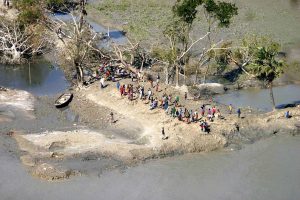
A series of waves crashed over the embankment during the next cyclone. Saline water ruined Sarkar’s paddy fields and freshwater pond. He, along with his family members, will move to Kolkata soon. They will be climate refugees, too, although unrecorded.