Pollution

China founds pesticide office to combat pollution overuse

New department will consolidate the regulation of agricultural chemicals under one roof, writes Fan Liya
English
<p>A farmer from the Miao ethnic minority group sprays pesticide on his Panax pseudoginseng field. Dehou Town, Wenshan County, Yunnan Province. (Image: Simon Lim / Greenpeace)</p>

A farmer from the Miao ethnic minority group sprays pesticide on his Panax pseudoginseng field. Dehou Town, Wenshan County, Yunnan Province. (Image: Simon Lim / Greenpeace)

China, the world’s largest producer and consumer of pesticides, is changing its approach to regulating the chemicals.

The Ministry of Agriculture announced Tuesday that it had established the Pesticide Management Office, which will regulate the production, sale, and use of such chemicals. Previously, oversight of pesticides was divided among several departments.

China leads the world in both pesticide production and consumption at 3.75 million tons and 1.7 million tons, respectively, in 2015. Through its exports, China is also a major international player, and in June, state-owned ChemChina announced it was acquiring Syngenta AG, then the world’s largest pesticide manufacturer.

According to research by the International Academy of Ecology and Environment Science (IAEES), a nonprofit organization, pesticide use in China helped avoid the loss of more than 167 million tons of grain and vegetables in 2007. But pesticides use in China is a double-edged sword. Zhang Wenjun, a professor of ecology and environmental sciences at Sun Yat-sen University in Guangzhou, capital of southern China’s Guangdong province, co-authored the IAEES research. He told Sixth Tone that the current use of pesticides poses health risks to people who ingest food that still has chemical residue.

One reason for this is overuse of pesticides. A government report in 2016 said that Chinese farmers use up to three times the global average. For example, annual pesticide use in the U.S., which has about one-and-a-half times as much arable land, is about a third of China’s.

In 2013, the environmental group Greenpeace reported that 70 percent of pesticide used in China was not absorbed by plants, but instead seeped into the soil and groundwater. The report concluded that pesticides had polluted at least 13 million hectares, or around 10 percent of the country’s arable land.
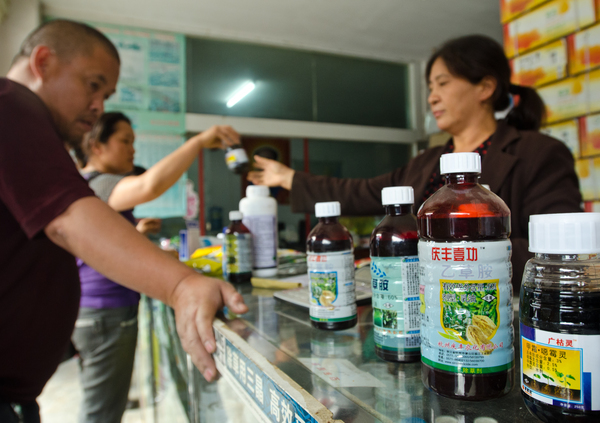

Farmers buy pesticides from a store in Wenshan, Yunnan Province. (Image: Simon Lim/Greenpeace)

Farmers and their families are at risk, too, as are animals. A study published in June found nearly 3,000 children were poisoned by pesticides in eastern China’s Zhejiang province between 2006 and 2015, with most cases occurring during the farming season. In August, a farmer in eastern China was detained after over 100 sheep died from eating scallions that he had sprayed with a banned pesticide.

Aware of the problems, the Chinese government in 2015 set a target of zero increased pesticide use by 2020, aiming for “an efficient, environmentally friendly, and sustainable system to manage pests.” Since June of this year, stricter regulations introducing a new licence for pesticide production and more specific rules for pesticide use have been put into effect.

Zhang, the ecology professor, welcomes the increased oversight. “The government previously implemented laws and regulations regarding pesticides,” he said, “but the results were far from ideal.”

This article was originally published on the Sixth Tone

Cookies Settings

Dialogue Earth uses cookies to provide you with the best user experience possible. Cookie information is stored in your browser. It allows us to recognise you when you return to Dialogue Earth and helps us to understand which sections of the website you find useful.

Required Cookies

Required Cookies should be enabled at all times so that we can save your preferences for cookie settings.

Dialogue Earth - Dialogue Earth is an independent organisation dedicated to promoting a common understanding of the world's urgent environmental challenges. Read our privacy policy.

Cloudflare - Cloudflare is a service used for the purposes of increasing the security and performance of web sites and services. Read Cloudflare's privacy policy and terms of service.

Functional Cookies

Dialogue Earth uses several functional cookies to collect anonymous information such as the number of site visitors and the most popular pages. Keeping these cookies enabled helps us to improve our website.

Google Analytics - The Google Analytics cookies are used to gather anonymous information about how you use our websites. We use this information to improve our sites and report on the reach of our content. Read Google's privacy policy and terms of service.

Advertising Cookies

This website uses the following additional cookies:

Google Inc. - Google operates Google Ads, Display & Video 360, and Google Ad Manager. These services allow advertisers to plan, execute and analyze marketing programs with greater ease and efficiency, while enabling publishers to maximize their returns from online advertising. Note that you may see cookies placed by Google for advertising, including the opt out cookie, under the Google.com or DoubleClick.net domains.

Twitter - Twitter is a real-time information network that connects you to the latest stories, ideas, opinions and news about what you find interesting. Simply find the accounts you find compelling and follow the conversations.

Facebook Inc. - Facebook is an online social networking service. China Dialogue aims to help guide our readers to content that they are interested in, so they can continue to read more of what they enjoy. If you are a social media user, then we are able to do this through a pixel provided by Facebook, which allows Facebook to place cookies on your web browser. For example, when a Facebook user returns to Facebook from our site, Facebook can identify them as part of a group of China Dialogue readers, and deliver them marketing messages from us, i.e. more of our content on biodiversity. Data that can be obtained through this is limited to the URL of the pages that have been visited and the limited information a browser might pass on, such as its IP address. In addition to the cookie controls that we mentioned above, if you are a Facebook user you can opt out by following this link.

Linkedin - LinkedIn is a business- and employment-oriented social networking service that operates via websites and mobile apps.