Interest in the "circular economy" has grown over the past decade in recognition that current rates of resource consumption are unsustainable. The shift to a more sustainable model of economic growth requires a circular economy in which products are recycled, repaired, or reused, and waste from one process is used as an input into others.
In 2015, the Paris Climate Agreement and the Sustainable Development Goals both highlighted the urgent need for “transformative” approaches to reduce greenhouse gas emissions and resource use. At the same time, a circular economy is being made possible by advances in information technology. Digital “Ebay-style” marketplaces for waste products and materials are, for example, being piloted in the United States and “trace and return” software is allowing firms to track products in the economy to optimise use and facilitate repairs and upgrading.
Until recently, the circular economy has largely been considered a rich-country agenda. Although pressures from resource extraction and waste are often more immediate in developing countries. Despite these countries often being considered more “circular” than wealthier ones, few studies have assessed the opportunities and risks for lower-income countries that are shifting towards a circular economy.
A new briefing paper by Chatham House addresses this gap. It argues that shifting towards an economy focused on reuse, remanufacturing and recycling may provide an urgent boost to growth and jobs in developing countries.
Careful approaches will be needed to manage potential trade-offs between the benefits and drawbacks of circular approaches, including those around the climate impacts of some “waste-to-energy” technologies that incinerate rubbish to generate electricity.
The paper also argues that the European Union (EU) and other leading countries can do more to work with developing countries and improve international cooperation in support of the circular economy. Here, China has a key role to play as the decisions it takes on its domestic economic agenda, on trade policy and on overseas investments will have a profound impact on the direction of travel.
China’s circular economy strategy
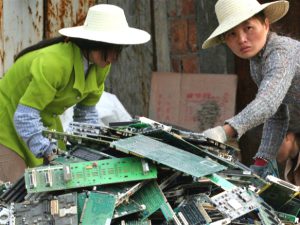
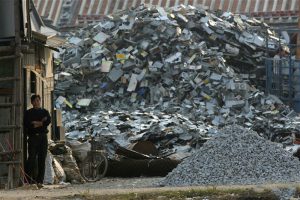
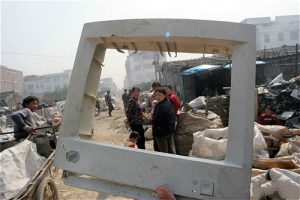
As a major manufacturer and processor of natural resources, China sees some of the worst effects of unchecked resource extraction and waste production. In 2014, China generated 3.2 billion tonnes of industrial solid waste, only two billion tonnes of which were recovered for recycling, incineration and reuse.
The growing waste crisis has had lethal consequences; 73 people were killed in a landslide at a waste dump in Shenzhen in 2015. Even when waste is managed, reliance on poor-quality processes can make matters worse. China has seen dozens of protests by local residents over waste-incineration projects.
However, the government has been taking action. It has set targets, introduced financial measures and passed laws to promote a circular economy. It is one of the few governments to have a circular economy strategy and law, and the concept has featured prominently in both the 12th and 13th Five-Year Plans.
As a result, there is a lot that developing countries can learn from China. One area is eco-industrial parks. China is a global leader on industrial symbiosis, the practice of ensuring that waste from one industrial process becomes a valuable input into others. Industrial parks across the country have been transformed to take advantage of such practices.
In Suzhou New District, for example, firms print circuit boards using copper recovered from elsewhere in the park rather than shipping in virgin copper. Local governments have a wealth of experience in running pilot projects and incentive-setting for firms. This could be shared with developing countries eager to establish their own circular economy industrial parks.
Global implications
China also has a large say over the direction of circular activities at a global level. It is the world’s biggest market for global waste: importing more than 70% of plastic waste and 37% of paper waste produced, globally.
However, the government is preparing to introduce major restrictions on imported waste materials at the beginning of 2018 that could have a profound impact on the ability of trade partners to meet recycling targets.
What’s more, they will likely have knock-on effects on other destinations for waste. In the UK, for example, reports suggest that without the option of shipping plastic waste to China for recycling more will be incinerated instead. Waste exports from the UK to other Asian countries have already increased, with exports to Malaysia twice what they were in 2016.
On trade, the short-term goal should be to align standards and build global markets for circular economy products. Here it will be crucial to work with other major markets and regional players that are accelerating action in this area. Yet, attempts to collaborate have been limited. One exception is the proposed China-Japan-Korea Circular Economy Model Bases, which aim to identify shared lessons.
Developing countries
Finally, there is the question of how circular economy fits within China’s existing international priorities, including its Belt and Road Initiative. There has been little discussion of circular economy in the context of Belt and Road projects, although some of the infrastructure investment planned is focused on waste management and processing.
The long term success of the initiative rests on China being able to get more partners to embrace its vision and finance projects. Making the circular economy more of a focus may be one way of enhancing collaboration, particularly with other economies for which circular activities are a major priority, such as the European Union.
The decisions China takes over the next few years – whether on lessons sharing and cooperation, trade, or Belt and Road – will shape the course of the circular economy for decades.
China should continue to upgrade its circular economy strategy at home and also seek opportunities to promote the agenda abroad. It can do this through cooperation on standards and trade, and infrastructure investment projects under Belt and Road. In doing so, China has a unique opportunity to help other developing countries make the leap to a circular economy.